

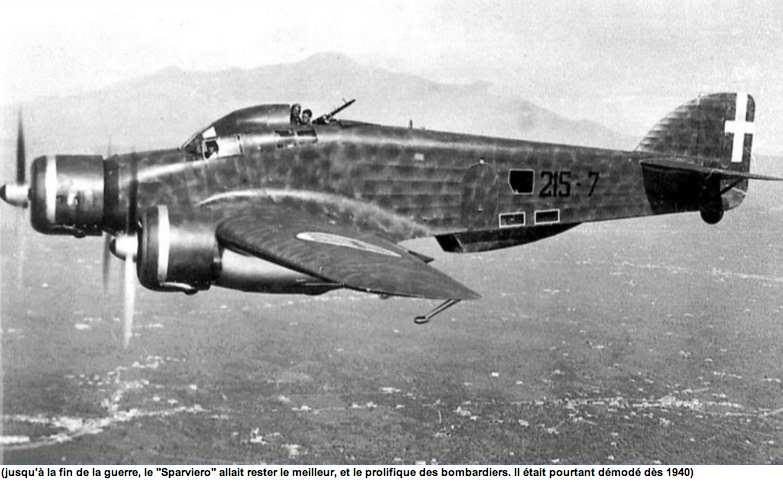
The SIAI-Marchetti S.M.79 Sparviero, a three-engine monoplane originally designed as a fast civilian transport aircraft, was first presented in the late 1930s and went on to become one of Italy’s most significant military aircraft of the Second World War era. Between 1937 and 1939, the aircraft established 26 world records and briefly held the distinction of being the world’s fastest medium bomber.
Design and Characteristics
Constructed from wood, canvas, and metal, the S.M.79 was identifiable by its distinctive profile: a pronounced hump behind the cockpit that housed a 12.7-millimetre machine gun and its operator. This structural feature became the subject of later mythmaking in Italian publications, which attributed to RAF pilots an unflattering nickname—the “gobbo maledetto” (cursed hunchback)—though historical documentation from either Italian or British wartime archives has never substantiated this claim.
Service History
The Sparviero first saw combat during the Spanish Civil War, where it flew with the Italian Legionary Air Force. During the Second World War, the Regia Aeronautica deployed the aircraft throughout the Mediterranean theatre in multiple capacities. Initially serving as a bomber, it was progressively replaced in that role by the CR.D.A. Cant.Z.1007 bis. As the Italian air force lacked a dedicated torpedo-bomber, the S.M.79 was pressed into that service as well, while also being used as a fast passenger transport.
The Romanian Air Force (FARR) also operated the aircraft, constructing approximately 1,300 examples under licence in a twin-engine configuration and employing them successfully on the Eastern Front. In Italy, the S.M.79 remained in service until 1950, making it one of the most widely produced Italian aircraft of its era.
On video
Frequently asked questions
What was the S.M.79 originally designed for?
The S.M.79 was originally conceived as a fast civilian transport aircraft before being adapted for military service.
How many world records did the aircraft establish?
The S.M.79 set 26 world records between 1937 and 1939.
In how many variants was the S.M.79 produced?
Romania constructed approximately 1,300 examples of the aircraft, including a twin-engine variant produced under licence for the Romanian Air Force.
Sources
- S1 — Ferrari, Paolo. L'aeronautica italiana: Una storia del Novecento. FrancoAngeli, 2004. ISBN 978-88-464-5109-5.
- S2 — Nicoloso, Paolo. Mussolini architetto: Propaganda e paesaggio urbano nell'Italia fascista. Einaudi, 2008. ISBN 978-88-06-19086-6.
Spotted an error? Write to the editors and we correct it the same day.
At auction this weekArt Deco glass, lighting and furniture are sold at auction every weekPieces from the 1920s and 1930s are open for bidding today on Catawiki, where an expert checks each lot before it goes live.See what is open on Catawiki →


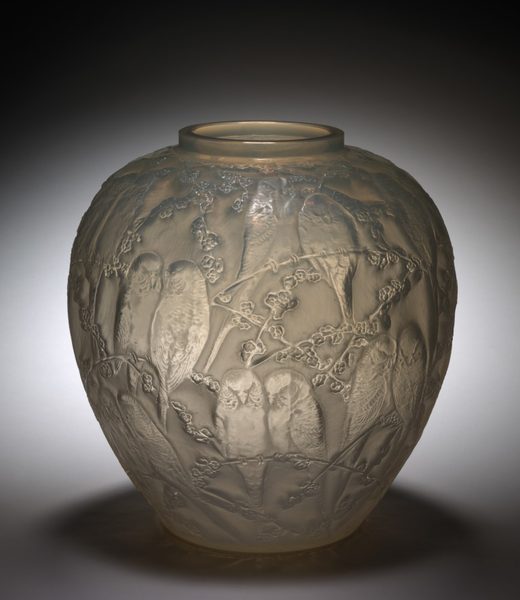
Advertisement. Pictured, from the Cleveland Museum of Art (CC0) and not for sale: three pieces of Lalique glass, 1920 to 1931. How we handle this