

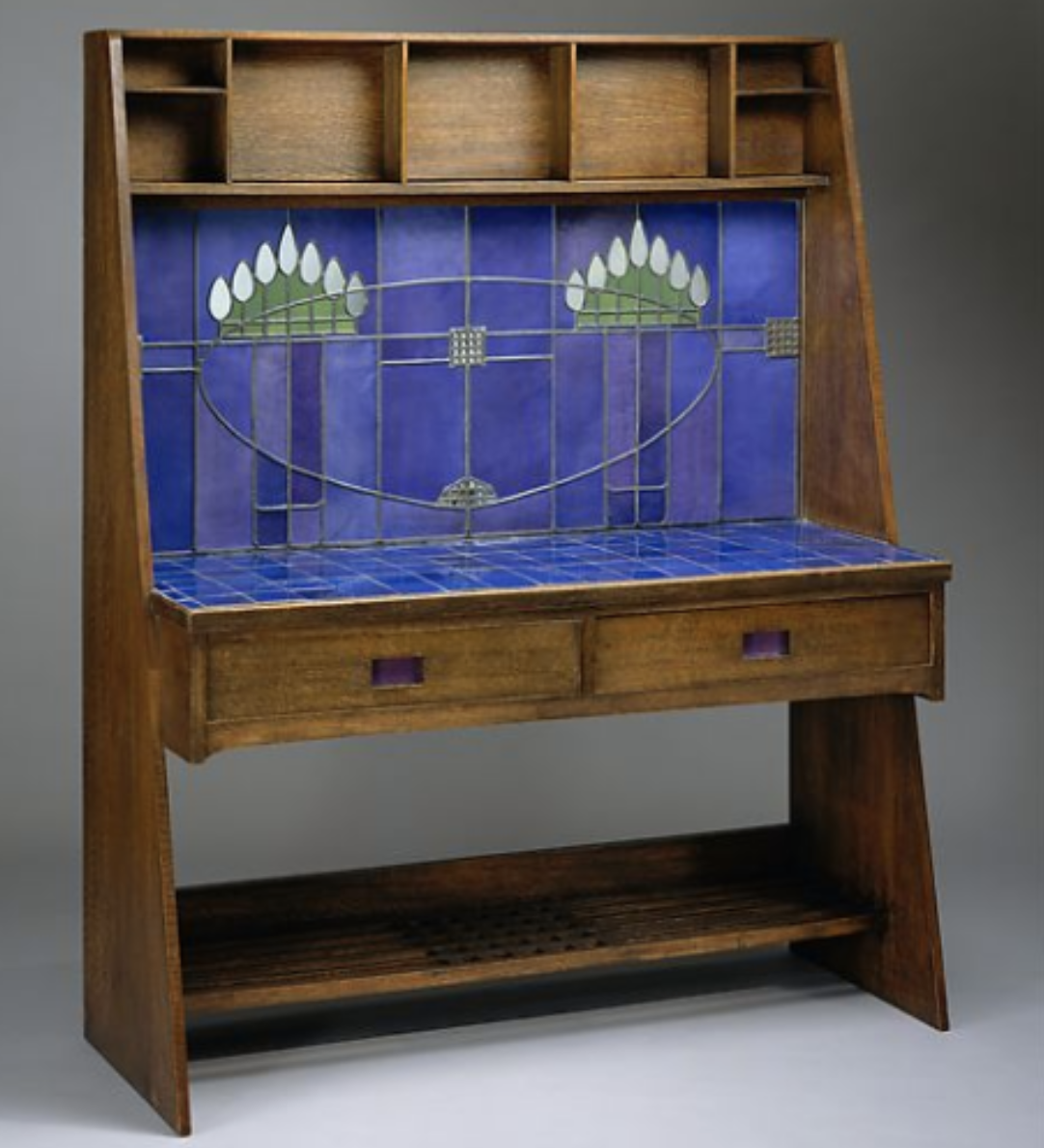
A washstand designed by Charles Rennie Mackintosh in 1904 for the Blue Bedroom at Hous’hill, Glasgow, combines oak, ceramic tiles, coloured glass and lead-light mirror elements. Mackintosh created the piece as part of interior furnishings for an eighteenth-century residential property in a Glasgow suburb that he had remodeled for Kate Cranston and her husband.
Kate Cranston was among Mackintosh’s most important patrons, owning a successful chain of tea rooms in Glasgow, many of which featured his distinctive design. The washstand reflects the designer’s characteristic integration of functional household objects with aesthetic refinement, employing materials and craftsmanship typical of his domestic interiors.
About Charles Rennie Mackintosh
Mackintosh (1868–1928) was a Scottish architect, designer and artist who worked in Glasgow. He developed a distinctive style that synthesized Art Nouveau principles with geometric restraint, profoundly influencing twentieth-century design practice.
Details
- Creator: Charles Rennie Mackintosh
- Year: 1904
- Materials: Oak, ceramic tiles, coloured glass, lead-light mirror
- Commission: Interior furnishings for Hous’hill, Glasgow
- Patron: Kate Cranston
Explore more: 13 heritage places in Glasgow
Frequently asked questions
Who designed this washstand?
Charles Rennie Mackintosh, a Scottish architect and designer based in Glasgow, created the piece in 1904 as part of his interior design work for Hous’hill.
Where was it made and for whom?
The washstand was designed for the Blue Bedroom at Hous’hill, a remodeled eighteenth-century residence in a Glasgow suburb belonging to Kate Cranston and her husband. Cranston was one of Mackintosh’s most significant clients and owned several tea rooms featuring his designs.
What materials were used?
The washstand combines oak, ceramic tiles, coloured glass and lead-light mirror elements, demonstrating Mackintosh’s attention to material craftsmanship and decorative detail in functional household furniture.
Sources
- S1 — De Fusco, Renato. Storia del design. Laterza, 2002. ISBN 978-88-420-6623-1.
- S2 — Sparke, Penny. Italian Design: 1870 to the Present. Thames & Hudson, 1988. ISBN 978-0-500-23531-7.
Spotted an error? Write to the editors and we correct it the same day.
Related places to visit
From the CHO directory — visit the places mentioned in this article.



Read more from the magazine
Editorial pieces from the CHO archive on the same topic.



Advertisement. Pictured, from the Cleveland Museum of Art (CC0) and not for sale: Latz commode, Meissen group, Paul Storr tureen. How we handle this