
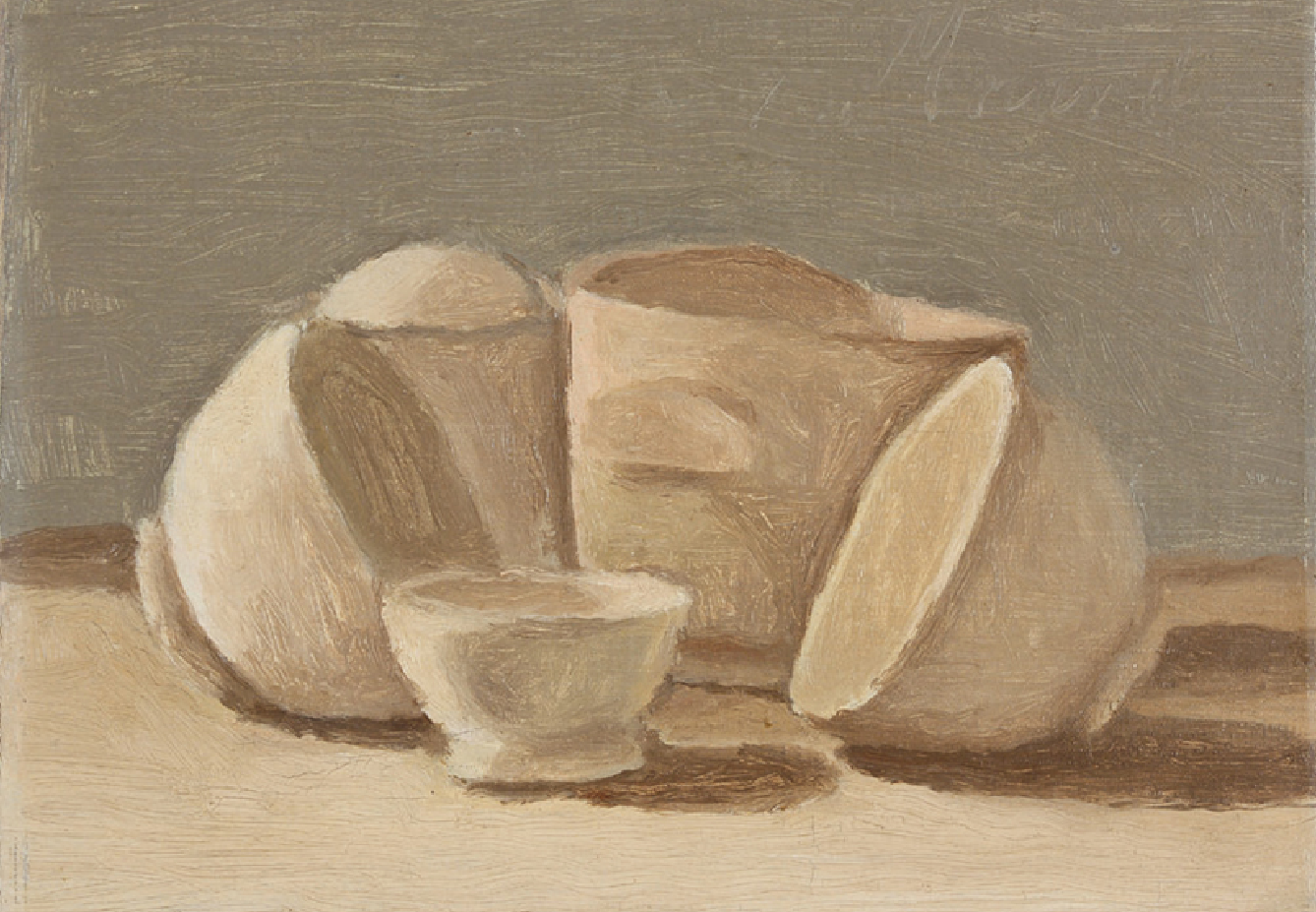
This still-life painting dates from 1942 and was created by Giorgio Morandi, the Italian painter and printmaker celebrated for his subtly muted compositions of ceramic vessels, flowers, and landscapes.
Morandi’s approach to still life emphasizes restraint and contemplative observation. Working with a limited palette of soft, earthy tones, he arranges ordinary ceramic objects to explore relationships of form, light, and spatial depth. The composition demonstrates his mature practice: carefully positioned vessels emerge from neutral backgrounds, their modest surfaces and simple geometry transformed through sensitive handling of tone and shadow. This restraint reflects his engagement with centuries of Italian painting tradition, from his studies at the Accademia di Belle Arti di Bologna through his lifelong examination of how humble domestic objects might carry profound visual and conceptual weight.
About Giorgio Morandi
Born in Bologna in 1890, Morandi studied at the Academy of Fine Arts there from 1907 to 1913. A formative visit to Florence in 1910 exposed him to Renaissance masters including Giotto, Masaccio, and Piero della Francesca, whose influence shaped his artistic sensibility. Morandi worked as both painter and printmaker, achieving international recognition for still-life works that prioritize subtle tonal variation over descriptive detail.
Details
- Creator: Giorgio Morandi
- Year: 1942
- Type: Oil painting, still life
- Subject: Ceramic vessels
On video
Explore more: 112 heritage places in Bologna
Frequently asked questions
Who was Giorgio Morandi?
Giorgio Morandi was an Italian painter and printmaker born in Bologna in 1890. He became widely known for still-life paintings of ceramic vessels, flowers, and landscapes rendered in subtly muted tones, and lived until 1964.
What subjects did Morandi typically paint?
Morandi focused on still-life compositions featuring ceramic vessels, flowers, and landscapes. He worked with ordinary domestic objects arranged with careful attention to form, light, and spatial relationships rather than decorative detail.
What artistic traditions influenced Morandi’s work?
Morandi studied at the Academy of Fine Arts in Bologna, which based its traditions on 14th-century painting. His 1910 visit to Florence exposed him to Renaissance masters including Giotto, Masaccio, Piero della Francesca, and Paolo Uccello, whose influence was profound and lasting.
Sources
- S1 — Pontiggia, Elena. Il Novecento Italiano. Abscondita, 2003. ISBN 978-88-8416-048-5.
- S2 — Bossaglia, Rossana. Il Novecento italiano. Electa, 1995. ISBN 978-88-435-6178-0.
Spotted an error? Write to editorial@culturalheritageonline.com and we correct it the same day.


