
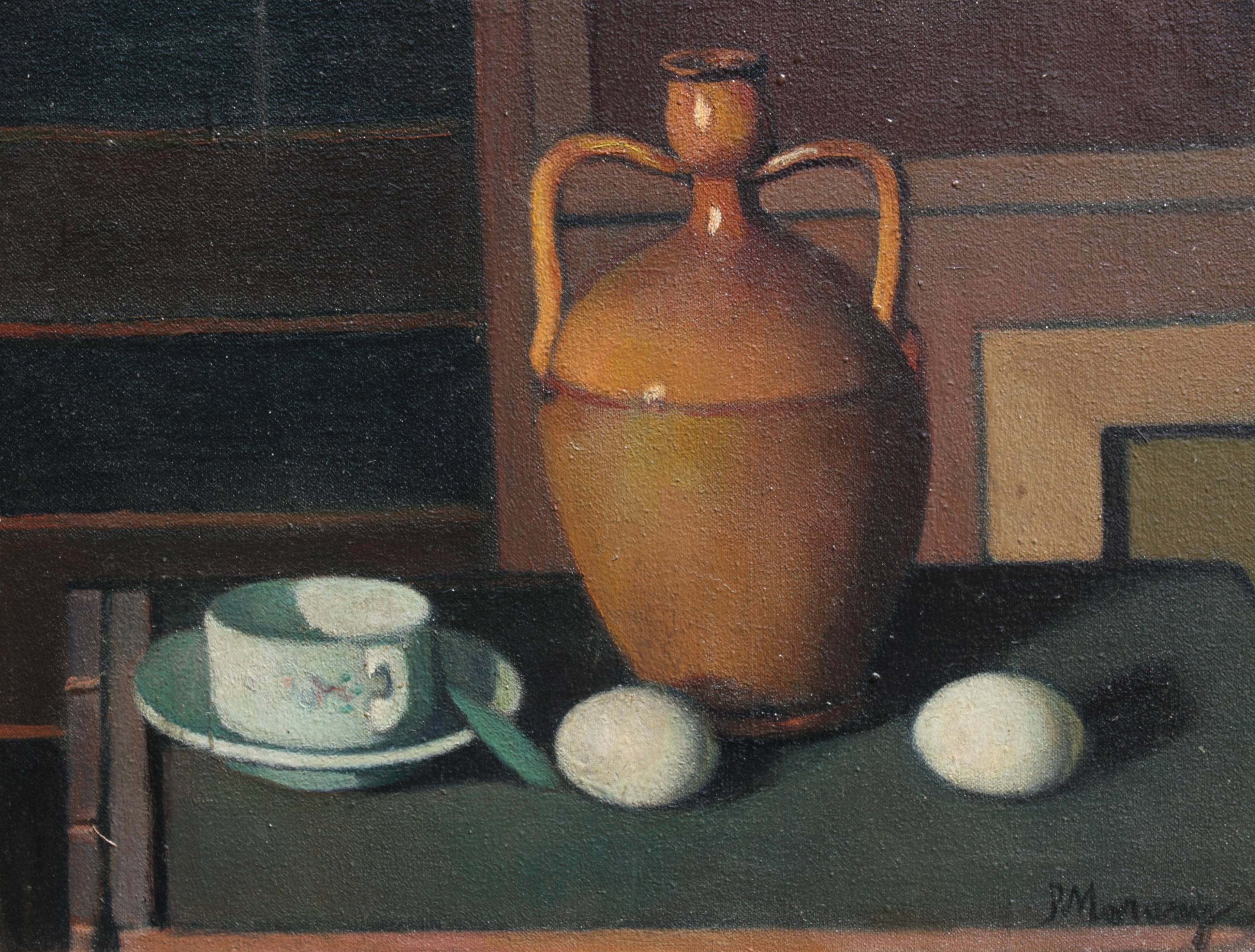
Still Life with Eggs is a painting by Italian artist Piero Marussig, created around 1924. The work belongs to the period of Marussig’s involvement with the Novecento Italiano movement, a pivotal moment in his artistic practice.
Marussig’s approach to still life reflects his broader stylistic concerns of the 1920s. His technique employed bold contours and a representative expressionist vocabulary, combining heavily impastoed brushwork with considered use of colour and light. The composition demonstrates the artist’s attention to formal structure and material presence characteristic of his work during this era.
About Piero Marussig
Piero Marussig (1879–1937) was a founding member of the Novecento Italiano group in 1922. Born in Trieste, he studied across Europe, including periods in Vienna with the Secession movement, in Paris, and in Rome, before establishing himself in Italy. His representational expressionist style combined influences from Post-Impressionism and Fauvism with Italian modernist concerns.
Details
- Artist: Piero Marussig
- Date: circa 1924
- Movement: Novecento Italiano
- Subject: Still life composition
Frequently asked questions
Who was Piero Marussig?
Piero Marussig (1879–1937) was an Italian painter and a founding member of the Novecento Italiano art movement in 1922. Born in Trieste, he studied across Europe and developed a representative expressionist style employing bold contours and strong colour.
What is Novecento Italiano?
Novecento Italiano was an Italian art movement founded in 1922, of which Marussig was a founding member. The movement sought to revitalise Italian modernism through engagement with representational forms and national artistic traditions.
What technique did Marussig use in his paintings?
Marussig employed bold contours to outline figures, applied heavily impastoed brushwork, and controlled colour and light to create works with distinct formal presence. His representative expressionist approach combined influences from Post-Impressionism, Fauvism, and Viennese Secession practice.
Sources
- S1 — Pontiggia, Elena. Il Novecento Italiano. Abscondita, 2003. ISBN 978-88-8416-048-5.
- S2 — Bossaglia, Rossana. Il Novecento italiano. Electa, 1995. ISBN 978-88-435-6178-0.
Spotted an error? Write to editorial@culturalheritageonline.com and we correct it the same day.


