
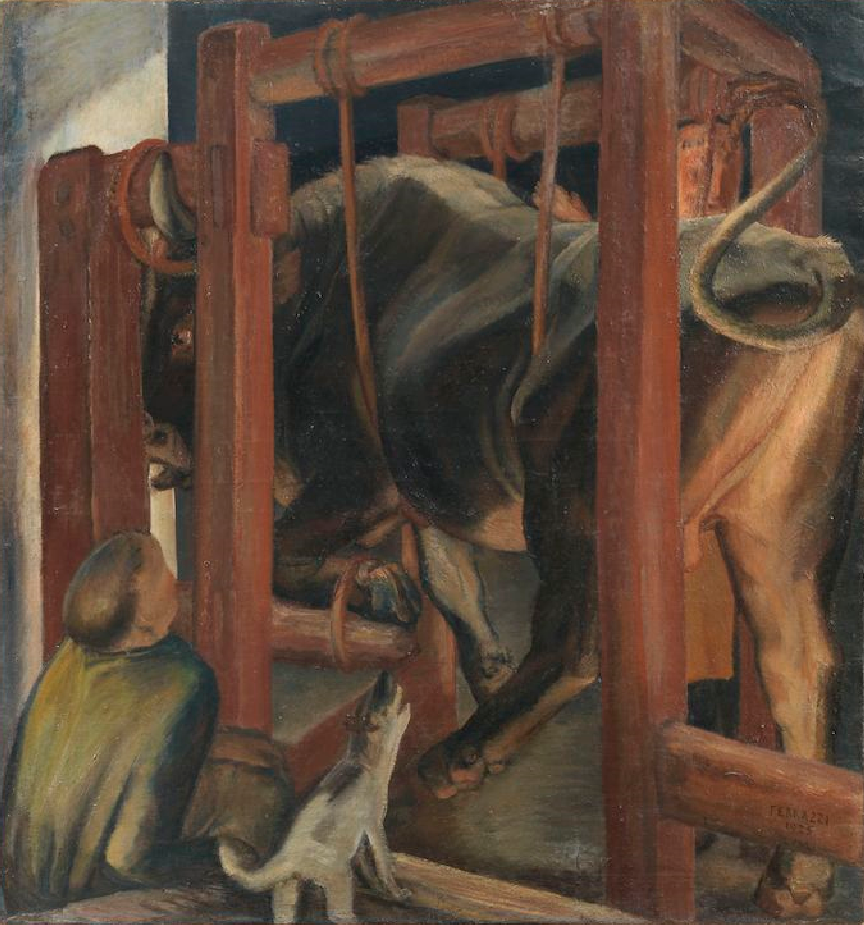
Bue alla ferratura is a work by Italian painter and sculptor Ferruccio Ferrazzi, created in 1925. The title translates as “Ox Being Shod,” capturing a moment of rural labour through the artist’s representational approach.
Ferrazzi’s practice during the 1920s encompassed both painting and sculpture, drawing on diverse artistic influences accumulated through his training and travel. His work from this period reflects engagement with figural subjects and naturalistic observation, characteristics central to Italian art of the interwar decades.
About Ferruccio Ferrazzi
Ferruccio Ferrazzi (1891–1978) was a Rome-born painter, sculptor and professor at the Accademia di Belle Arti of Rome. He was the son of sculptor Stanislao Ferrazzi and trained under Francesco Bergamini from 1904. Ferrazzi first exhibited publicly in 1907 and won a scholarship to the Instituto Catel in 1910. His artistic development was marked by exposure to contemporary movements and study at the Louvre in Paris, where he encountered the work of Georges Seurat.
Details
- Creator: Ferruccio Ferrazzi
- Year: 1925
- Medium: Painting
- Subject: Rural labour, oxen
On video
Explore more: 509 heritage places in Roma
Frequently asked questions
Who was Ferruccio Ferrazzi?
An Italian painter and sculptor born in Rome in 1891 and active until his death in 1978, Ferrazzi was also a professor at the Accademia di Belle Arti of Rome. He trained under Francesco Bergamini and was influenced by artists including Georges Seurat.
What does the title mean?
Bue alla ferratura translates to “Ox Being Shod,” referring to the process of fitting metal horseshoes or protective fittings to an ox’s hooves—a traditional rural practice.
When was this work created?
The work dates to 1925, a period in which Ferrazzi was engaged with figurative subjects and naturalistic representation.
Sources
- S1 — Pontiggia, Elena. Il Novecento Italiano. Abscondita, 2003. ISBN 978-88-8416-048-5.
- S2 — Ciucci, Giorgio. Gli architetti e il fascismo: architettura e città 1922-1944. Einaudi, 2002. ISBN 978-88-06-16310-5.
Spotted an error? Write to editorial@culturalheritageonline.com and we correct it the same day.


