
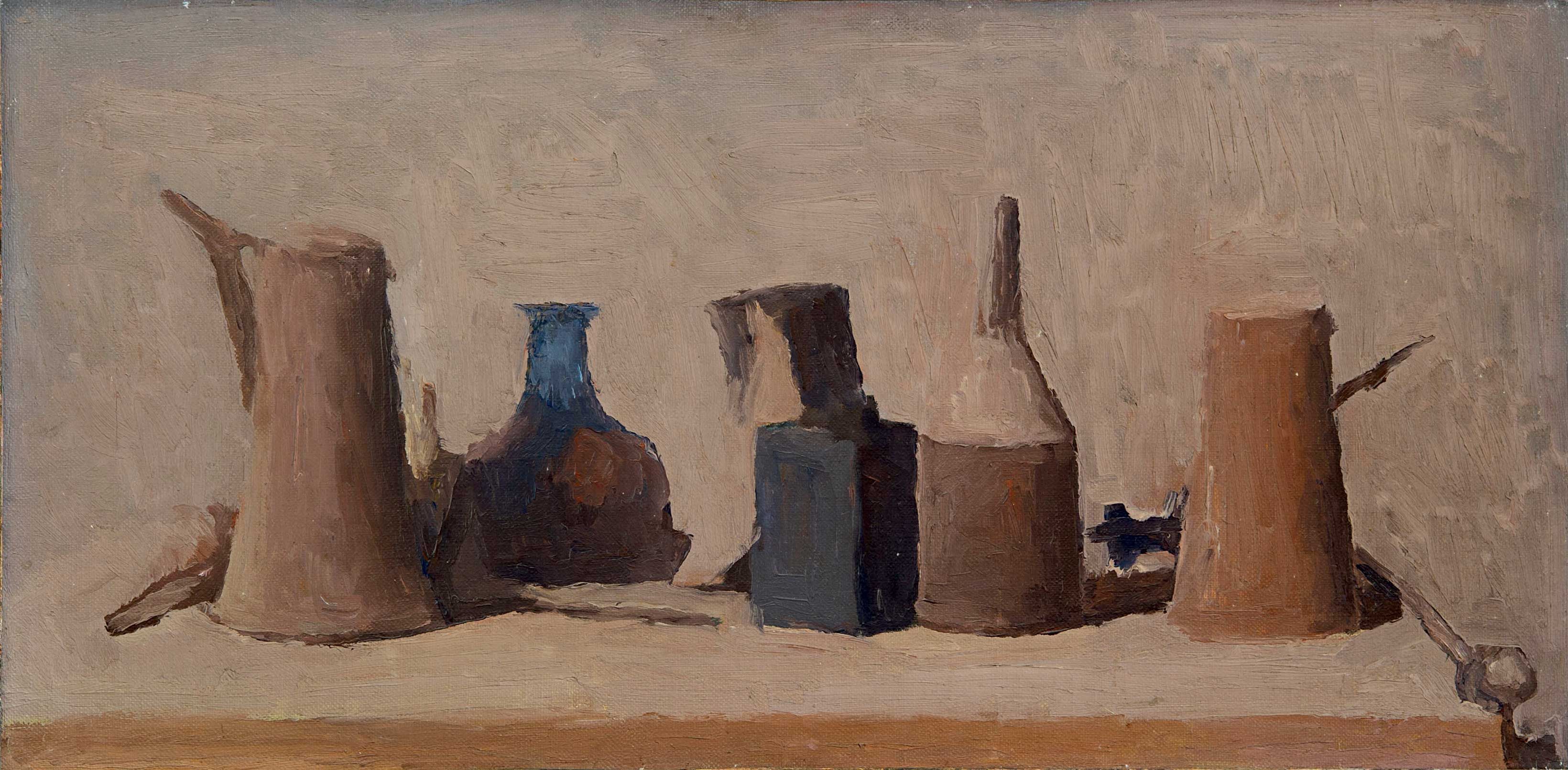
This still life was painted by Giorgio Morandi in 1929. The work demonstrates Morandi’s characteristic treatment of ceramic vessels and domestic objects in subtly muted hues, a method that defined his artistic practice across decades.
Morandi devoted much of his career to the genre of still life, exploring the formal and chromatic relationships between simple objects arranged in confined spaces. His approach eschewed dramatic gesture in favour of sustained observation and refined restraint. The 1929 painting reflects the artist’s mature engagement with problems of form, light, and colour within the constraints of modest subject matter.
About Giorgio Morandi
Born in Bologna in 1890, Morandi studied at the Accademia di Belle Arti di Bologna from 1907 to 1913, where he absorbed traditions rooted in fourteenth-century painting. A visit to Florence in 1910 exposed him to Renaissance masters including Giotto, Masaccio, Piero della Francesca, and Paolo Uccello, whose works left a lasting impression on his artistic formation. Morandi remained based in Bologna throughout his life, working as both painter and printmaker until his death in 1964.
Details
- Artist: Giorgio Morandi
- Year: 1929
- Medium: Oil painting
- Genre: Still life
- Associated location: Bologna, Italy
On video
Explore more: 112 heritage places in Bologna
Frequently asked questions
What subjects did Morandi paint?
Morandi was widely known for still-life paintings of ceramic vessels, flowers, and landscapes, rendered in subtly muted tones that emphasize formal arrangement over decorative display.
Where was Morandi based?
Morandi was born in Bologna, Italy, and remained there throughout his life, studying at the Accademia di Belle Arti di Bologna and maintaining his studio in the city until his death in 1964.
What artistic influences shaped Morandi’s work?
A 1910 visit to Florence exposed Morandi to Renaissance painters including Giotto, Masaccio, Piero della Francesca, and Paolo Uccello, whose compositions and treatment of form profoundly influenced his artistic development.


