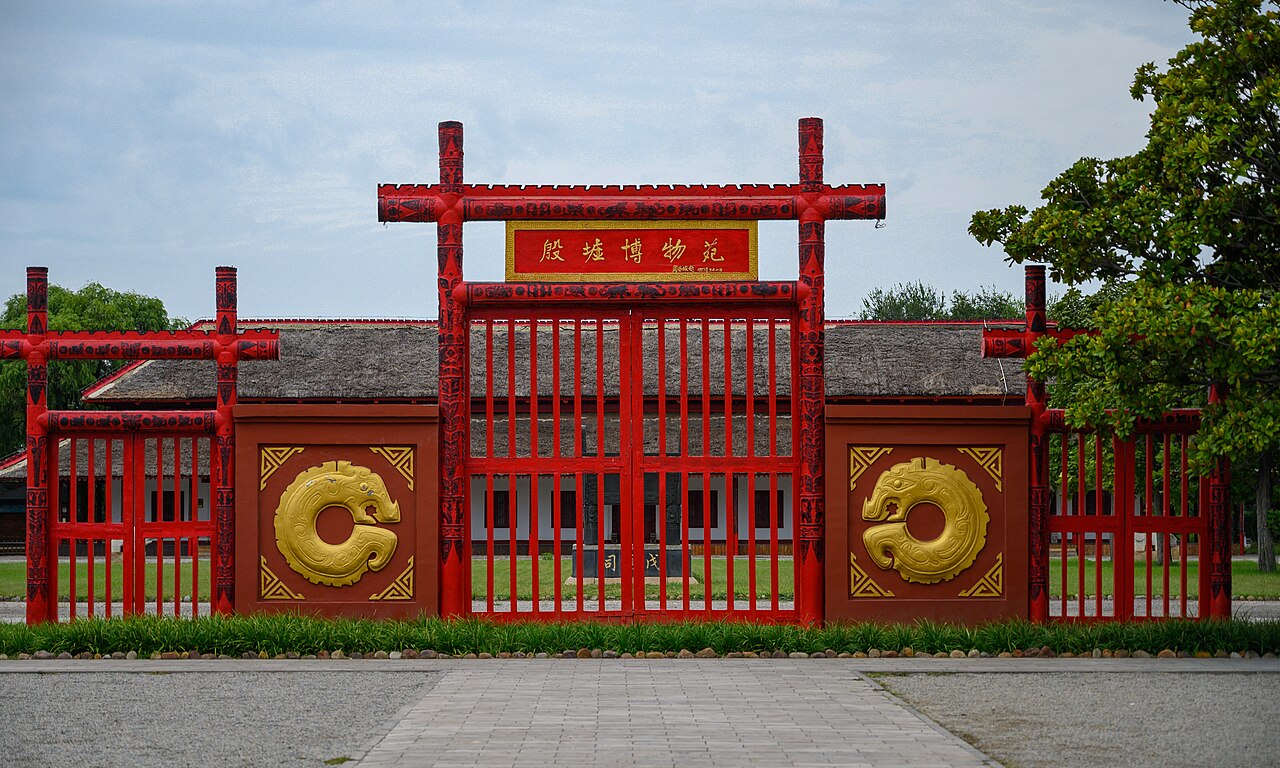
Yin Xu, inscribed by UNESCO in 2006, is the ancient capital of the late Shang dynasty (c. 1300–1046 BCE) — the archaeological site near modern Anyang, Henan Province, where systematic excavations since 1928 have recovered the earliest substantial evidence of Chinese writing (the oracle bone inscriptions, more than 150,000 inscribed animal bones and turtle plastrons constituting the earliest written archive in East Asia), the earliest bronze-casting workshops identified in China, and the royal mausoleum of the Shang kings, whose rammed-earth pit tombs at Xibeigang (the Royal Cemetery, approximately 3 kilometres west of the palace site) represent the most spectacular example of Shang-period royal funerary ritual known to archaeology. Yin Xu covers approximately 36 square kilometres — the ancient city and palace-temple precinct occupied an area of approximately 24 square kilometres at the confluence of the Huan River with the Yellow River plain — and is identified with the Shang capital referred to in the oracle bone texts as “the Great Settlement Shang” (da yi Shang), the city to which the Shang king Pan Geng moved the dynastic capital c. 1300 BCE, establishing the longest single-site royal residence in Shang history (approximately 254 years, ending with the Shang dynasty’s defeat by the Zhou at the Battle of Muye in 1046 BCE). The site’s Outstanding Universal Value rests on the oracle bone inscriptions’ status as the ancestor of modern Chinese script — every Chinese character in use today is directly traceable to the pictographic and ideographic conventions established in the Shang-period bone inscriptions — and on the bronze-casting evidence of the Fu Hao Tomb (the intact tomb of the Lady Fu Hao, royal consort of King Wu Ding, c. 1200 BCE, the only Shang royal tomb found unlooted, containing 468 bronze vessels, 755 jade objects, and 7,000 cowrie shells).
Central Henan: the Yellow River cradle of Chinese civilisation Longmen Grottoes Luoyang · Shaolin Temple Songshan · Yellow River Museum Zhengzhou — 90 to 280 km
Ninety Kilometres southwest of Anyang by road (approximately 1.5 hours on the G4 Beijing-Hong Kong-Macao Expressway south, then the G35 west, or approximately 1 hour by HSR from Anyang East Station to Zhengzhou East Station, then transfer to the Zhengzhou-Xi’an HSR to Luoyang Longmen Station, approximately 40 minutes), the Longmen Grottoes (inscribed 2000) represent the Buddhist sculptural achievement of the Northern Wei (c. 493–534 CE) and Tang (618–907 CE) dynasties at the same Yellow River valley civilization zone where the Shang dynasty built Yin Xu. Luoyang was the capital of both the Eastern Han dynasty (25–220 CE), which established Buddhism as a state-supported religion in China, and the Tang Empress Wu Zetian (reigned 690–705 CE), who built the Longmen Grottoes’ most spectacular monument — the Ancestor Worship Cave (Fengxian Si, 672–675 CE) with its 17.14-metre Vairocana Buddha. The civilizational continuity between Yin Xu and Longmen is direct: the Yellow River valley was the heartland of Chinese civilisation from the Shang period through the Tang period, and the Longmen Grottoes’ inscribed Buddhist sculptures are the artistic counterpart to Yin Xu’s bronze ritual vessels in documenting the same civilisation’s successive cultural and religious transformations. From Anyang, Luoyang Longmen is most efficiently reached by the Zhengzhou-Xi’an HSR (approximately 1 hour 40 minutes total, via Zhengzhou East transfer) or by direct coach (approximately 2.5 hours on the expressway).
One Hundred Kilometres south of Anyang by road and HSR (approximately 45 minutes from Anyang East Station to Zhengzhou East Station on the Beijing-Guangzhou HSR; Zhengzhou is the hub for connections to Luoyang, Xi’an, and Wuhan), Zhengzhou — the capital of Henan Province and the primary transportation hub for central China — is the departure point for visits to the broader Yellow River heritage zone. The Zhengzhou Shang City site (approximately 3.5 square kilometres of Zhengzhou’s urban core, the remains of an earlier Shang dynasty capital city, c. 1600–1300 BCE, predating Yin Xu’s occupation) demonstrates the civilizational continuity from the early Shang period through the Yin Xu period, but is largely unexcavated beneath the modern city and offers limited visitor experience compared to the Yin Xu Museum and the Royal Cemetery at Anyang. The Henan Museum (Zhengsheng Avenue, Zhengzhou) holds the largest collection of Central Plains archaeological material in China, including major Shang-period bronze vessels from pre-Yin Xu excavations, Longmen Buddhist sculpture fragments, Han dynasty ceramics, and the “Mother of Vinegar” bronze ding (square-tripod vessel, c. 1300 BCE, the largest bronze vessel from pre-Yin Xu Shang excavations, unearthed in Zhengzhou in 1974). The Henan Museum is accessible from Anyang in approximately 45 minutes by HSR and provides the best comparative context for the Yin Xu bronze-casting workshops’ technical achievements.
One Hundred and Twenty Kilometres southeast of Anyang by road (approximately 2 hours on the G45 Expressway to Xinxiang, then local road to Huixian and Jiaozuo County, where the Taihang Mountain northern section descends to the Yellow River plain), the Jiaozuo-area Taihang Mountain landscape — not UNESCO-inscribed but containing several national-level geological parks including the Yuntai Mountain Geopark — represents the natural environment of the northern Yellow River plain’s margin. The Taihang Mountains (also transliterated as Taiheng) form the western boundary of the North China Plain — the same geological edge that made the Anyang / Yin Xu site strategically significant in the Shang period: the Huan River valley at Anyang provided a defensible position at the junction of the mountain edge and the open plain, with mountain timber resources to the west and the agricultural plain’s grain supply to the east. The Taihang Mountain area is not a heritage travel destination of UNESCO significance but provides the landscape context for understanding why the Shang kings chose the Anyang site for their longest-occupied capital. From Anyang, the Taihang Mountain scenic area at Jiaozuo (Yuntai Mountain) is accessible by bus or taxi (approximately 2 hours south) and is commonly visited as a day extension for visitors spending multiple days in the Henan heritage zone.
One Hundred and Thirty Kilometres southwest of Anyang by road and HSR (approximately 45 minutes from Anyang East to Zhengzhou East, then approximately 30 minutes from Zhengzhou East to Dengfeng via local bus, or approximately 1 hour direct coach from Anyang), the Historic Monuments of Dengfeng in “The Centre of Heaven and Earth” (inscribed 2010) include the Shaolin Temple complex on Mount Song — Songshan (嵩山, Central Sacred Mountain, Zhongyue) — the most important single complex in the development of Chinese Buddhist monastic and martial culture. The Shaolin Temple (Shàolín Sì, “Young Forest Temple,” founded 495 CE in the Northern Wei period) was established at Songshan as part of the same Northern Wei Buddhist imperial patronage programme that produced the Longmen Grottoes at Luoyang — the same Northern Wei emperor (Xiaowen Emperor) who moved the Northern Wei capital from Datong (Yungang) to Luoyang (Longmen) also funded the Shaolin Temple’s construction. The temple’s claim to be the origin of Chinese martial arts (Chan Buddhist Chan/Zen Buddhism’s physical practice tradition, which developed at Shaolin between the 6th and 8th centuries CE) and the Shaolin monks’ martial combat expertise are historically documented in Tang dynasty military records. From Anyang, Dengfeng/Shaolin is reached by HSR to Zhengzhou East (45 minutes) and then bus or coach (60 minutes) to Dengfeng.
North China’s archaeological landscape and the Yellow River cultural corridor Temple of Heaven Beijing · Mount Wutai Shanxi · Yungang Grottoes Datong — 400 to 650 km
Four Hundred Kilometres north of Anyang by HSR (approximately 2 hours from Anyang East Station to Beijing West on the Beijing-Guangzhou HSR), the imperial heritage of Beijing — the Temple of Heaven (inscribed 1998), the Summer Palace (inscribed 1998), and the imperial sections of the Forbidden City within the Imperial Palace (inscribed 1987) — represents the terminus of the Yellow River civilizational corridor that begins at Yin Xu. The political and ritual geography that connects Yin Xu to Beijing is direct: the Shang kings at Yin Xu performed ritual sacrifice at the Huan River’s edge to communicate with their royal ancestors and the spirits of nature (the oracle bone inscriptions are the written records of these divinations); 3,000 years later, the Ming and Qing emperors at the Temple of Heaven performed the same cosmological function (the Circular Mound Altar’s winter solstice sacrifice connected the emperor to Heaven in the same structural relationship as the Shang king’s oracle bone communications to the ancestral spirits), using the same Blue Mountain Stone materials visible in Yin Xu’s royal tombs. The Temple of Heaven complex (Tiāntán, 273 hectares, 1406–1420 CE) is accessible from Beijing South Station (Beijing-Guangzhou HSR terminus at Beijing) via Metro Line 14 to Jinsong Station or Metro Line 5 to Tiantan East Gate.
Six Hundred Kilometres northwest of Anyang by road and coach (approximately 4 hours from Anyang to Datong on the G55 Eryuan Expressway north, or approximately 3 hours by HSR from Anyang East to Datong South via Shijiazhuang and the Datong-Xi’an HSR), the Yungang Grottoes (inscribed 2001) link directly to the Yin Xu civilizational sequence: both are UNESCO sites in the northern Chinese core civilizational zone whose excavation and interpretation reshaped modern understanding of Chinese history. Just as the Yin Xu excavations (systematic archaeological work 1928–1937, resumed 1949, ongoing) proved that the Shang dynasty documented in Chinese historical sources was historically real (before 1928, Western archaeologists doubted the Shang dynasty’s existence as a historical entity rather than a mythological one), the Yungang Grottoes’ excavation and art-historical documentation (early 20th century through ongoing UNESCO conservation work) established the chronology of Buddhist sculptural transmission from Northwest India through Central Asia to China. From Anyang, Datong is reached by HSR via Shijiazhuang (approximately 3 hours total, with transfer at Shijiazhuang for the Datong-Xi’an line).
Practical information
Yin Xu is located approximately 2 kilometres northwest of the centre of Anyang City, Henan Province, in the Yindu District. Anyang East Station (on the Beijing-Guangzhou HSR) provides fast rail connections: Beijing West (approximately 2 hours), Zhengzhou East (approximately 45 minutes), Wuhan (approximately 2.5 hours), and Guangzhou South (approximately 6 hours). The Yin Xu Museum (Yīn Xū Bówùguǎn, opened 2005, redesigned and reopened 2022) is the primary visitor facility, built directly over the archaeological remains of the palace-temple precinct and designed to display the oracle bone inscription archive in situ context. The Royal Cemetery at Xibeigang (approximately 3 km northwest of the museum, accessible by taxi or tourist bus) contains the eleven unlooted royal tomb pits and 2,500 secondary burial pits (each containing a retainer sacrifice, approximately 10,000 individuals in total). Admission to Yin Xu covers both the palace-temple area and the museum; the Royal Cemetery requires a separate admission at Xibeigang. The Fu Hao Tomb — the only intact Shang royal tomb ever recovered unlooted (1976 excavation by Zheng Zhenxiang) — is preserved in situ within a purpose-built display hall at the palace-temple museum complex; the bronzes from this tomb are among the finest examples of Shang bronze-casting in existence. The best visiting season is April–June and September–October; Anyang summers are hot (35°C+) and the site has limited shade. Budget 4–5 hours for the museum complex and the Royal Cemetery. The Anyang City Museum (separate from Yin Xu, in the city centre) provides complementary coverage of Anyang’s post-Shang history including its role as a major Tang-period ceramic production centre.
Frequently Asked Questions
What are oracle bone inscriptions and why are they significant for the history of Chinese writing?
Oracle bone inscriptions (jiǎgǔwén, 甲骨文, “shell and bone script”) are divination records inscribed on the scapula bones of cattle and the plastrons (ventral shells) of turtles by Shang dynasty court diviners between approximately 1250 BCE and 1046 BCE — a corpus of more than 150,000 inscribed fragments recovered from Yin Xu and now held in museums and collections in China, Japan, Europe, and North America. The inscriptions record the questions put to the royal ancestors through the divination ritual (pyroscapulimancy — burning the bone or plastron with a hot metal rod to produce a network of cracks whose pattern the diviner interpreted), the diviner’s interpretation of the crack pattern as a “positive” or “negative” answer, and often a verification record noting what actually happened. The oracle bone archive therefore functions simultaneously as a religious document (recording the ritual dialogue between the Shang king and his royal ancestors), an administrative record (the questions address military campaigns, harvests, hunting expeditions, weather, illness, and the king’s activities), and a linguistic document (representing approximately 4,500 distinct characters, of which approximately 2,000 have been deciphered and matched to later Chinese script forms). The significance of the oracle bone script for the history of Chinese writing is threefold: it is the earliest substantial written record in any East Asian language; it is demonstrably ancestral to the modern Chinese script system (by a process of continuous evolution, not reinvention, traceable through the bronze inscription script, the small seal script, the clerical script, and the standard script to modern simplified and traditional characters); and it is evidence that the writing system was already mature and standardised in the Shang period — meaning Chinese writing was invented considerably earlier than the Yin Xu records, probably in the early Shang or late Xia period (c. 1600–1300 BCE), in as yet unidentified earlier sites.
Who was Lady Fu Hao and why is her tomb the most important Shang-period discovery in archaeology?
Lady Fu Hao (婦好, Fu Hao, also referred to as Consort Hao in some translations) was the wife, military commander, and ritual officiant of the Shang King Wu Ding (reigned approximately 1250–1192 BCE), and is the first female military commander in Chinese history documented by contemporary written records — her military campaigns are recorded in more than 200 oracle bone inscriptions in which Wu Ding consulted the ancestral spirits about her military operations and her health. The oracle bone texts describe Fu Hao commanding armies of up to 13,000 soldiers in campaigns against the Qiang, Tu Fang, and other peoples of the Shang periphery — the largest armies recorded in oracle bone military texts and larger than the forces commanded by male Shang generals in the same period. Fu Hao’s tomb (M5, excavated 1976 by the archaeologist Zheng Zhenxiang of the Institute of Archaeology, Chinese Academy of Social Sciences) was discovered intact because it was sited outside the Royal Cemetery at Xibeigang and buried under the later Shang-period building foundations that protected it from the systematic looting that destroyed the Xibeigang royal tombs. The tomb’s contents — 468 bronze vessels (including 24 bells and 130 weapons), 755 jade objects (the finest corpus of Shang-period jade carving known), 564 bone objects, 11 pottery vessels, 6,900 cowrie shells, and 16 human sacrificial victims — constitute the largest intact Shang-period archaeological assemblage in existence. The bronze vessels include two inscribed “Fu Hao” ding tripods (one 117.5 kg, one 82.7 kg) that are among the three largest known bronze vessels from the Shang period. The intact character of the tomb — which means that the full assemblage can be studied in its original depositional context rather than as decontextualised fragments from looted sites — makes Fu Hao’s tomb the single most important Shang-period discovery for understanding Shang elite material culture, ritual practice, and gender roles.
How did the discovery and excavation of Yin Xu change the Western understanding of Chinese history?
Before the systematic excavation of Yin Xu began in 1928, the Shang dynasty (c. 1600–1046 BCE) — though documented in Chinese historical texts including the Shiji (Historical Records) of Sima Qian (c. 145–86 BCE) and the Bamboo Annals — was regarded by most Western sinologists and historians as either mythological or at best uncertain history: a cultural tradition of origin myths with limited archaeological confirmation. The oracle bones had been discovered earlier (the first scholarly identification of Yin Xu oracle bones as Shang-period documents was made by Wang Yirong and Liu E in 1899–1903, when oracle bones began appearing in the Peking antiquities market as “dragon bones” purchased by traditional pharmacists), but systematic excavation of the oracle bone deposits at Yin Xu began only in 1928, when the Academia Sinica’s newly established Institute of History and Philology (under Fu Sinian) launched the first modern archaeological excavation in China at the Xiaotun village site near Anyang. The 1934–1935 excavations at the Royal Cemetery at Xibeigang revealed the full scale of the Shang royal funerary ritual — eleven large pit tombs with ramps (each tomb requiring an estimated 7,000 workdays to construct, with hundreds of human sacrificial victims), confirming the oracle bone inscriptions’ accounts of royal ancestor worship — and established that the Chinese historical sources were documenting a real Bronze Age civilisation, not mythology. The Yin Xu discoveries also established the chronological anchor for Chinese prehistoric and early historic archaeology: by cross-referencing the oracle bone inscription’s king-list with the traditional Chinese historical chronology, it became possible to establish an absolute chronology for the late Shang period (1250–1046 BCE) that provided the basis for dating earlier Chinese Bronze Age sites by typological comparison with the Yin Xu material culture.
Sources
- S1 — UNESCO World Heritage Centre — Yin Xu (Ref. 1114) — https://web.archive.org/web/20230601000000/https://whc.unesco.org/en/list/1114/
- S2 — UNESCO World Heritage Centre — Statement of Outstanding Universal Value (Ref. 1114) — https://whc.unesco.org/en/list/1114/
Spotted an error? Write to editorial@culturalheritageonline.com and we correct it the same day.