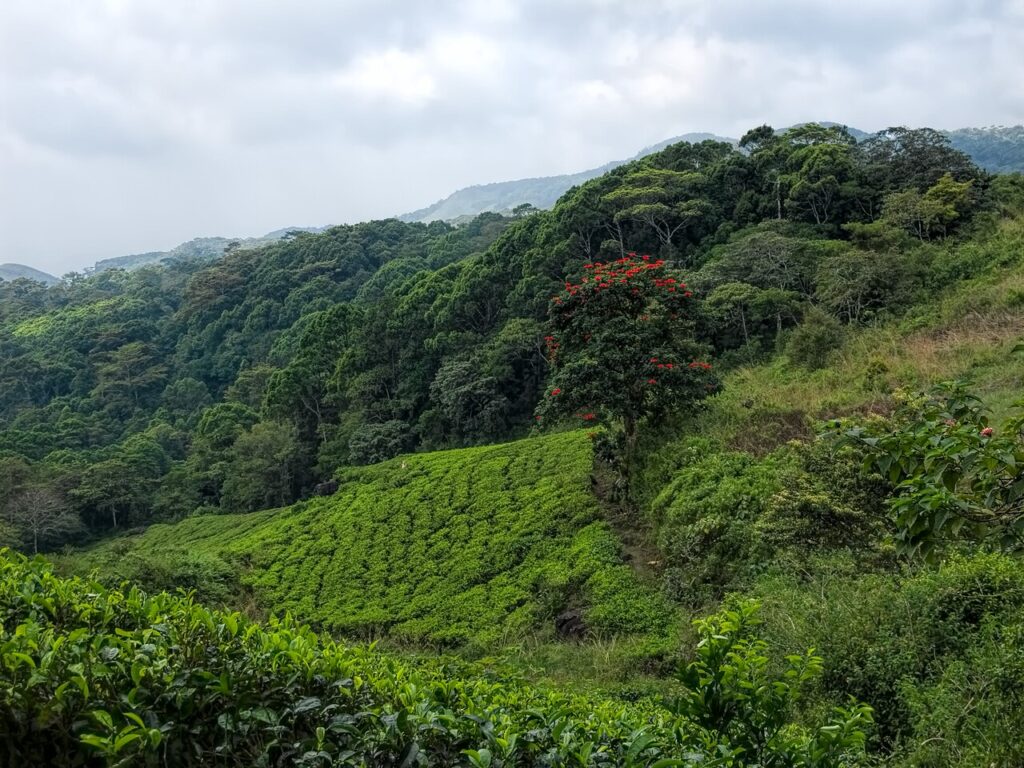
The Sinharaja Forest Reserve (Sinhala: “සිංහරාජ” — “Lion’s Kingdom” or “Lion King’s Realm”, from “sinha” = lion + “raja” = king), inscribed by UNESCO in 1988, is the largest remaining primary lowland tropical rainforest in Sri Lanka — a legally protected rain forest covering approximately 11,187 hectares (approximately 36 km long × 7 km wide, running east–west along the ridges of the Rakwana Hills in the Sabaragamuwa and Southern Provinces, with the highest peak at Hinipitigala Kanda, approximately 1,171 m above sea level) in the southwestern wet zone of Sri Lanka, which receives approximately 5,000 mm of annual rainfall from both the southwest monsoon (May–September) and the northeast monsoon (October–January). Sinharaja is the last substantial remnant of a tropical rainforest biome that once covered the entire southwestern lowlands of Sri Lanka — a biome that has been reduced to approximately 3% of its original extent by the combination of colonial-era plantation agriculture (the British cleared most of the lowland forest for tea, rubber, and coconut plantations in the 19th century CE) and post-independence smallholder agriculture. The reserve is exceptional for its level of biodiversity and endemism: approximately 64% of the endemic trees and plants of Sri Lanka occur in Sinharaja, and the forest is the primary habitat for the majority of Sri Lanka’s endemic bird species — the forest is home to approximately 21 of the 26 endemic bird species of Sri Lanka, including the Sri Lanka blue magpie (Urocissa ornata), the Sri Lanka spurfowl (Galloperdix bicalcarata), the Sri Lanka red-faced malkoha (Phaenicophaeus pyrrhocephalus), and the Sri Lanka white-faced starling (Sturnia albofrontata) — making it the single most important site for endemic bird watching in Sri Lanka. The mammal fauna includes the purple-faced langur (Trachypithecus vetulus), the Sri Lanka leopard (Panthera pardus kotiya), the Asian elephant (Elephas maximus maximus), and the rare Sri Lanka jungle fowl (Gallus lafayettii, the national bird of Sri Lanka).
Sinharaja’s biodiversity and access routes Kudawa entrance · Pitadeniya entrance · Rakwana–Kalawana road · Galle · Colombo — 40 to 160 km
The Sinharaja Forest Reserve has two main visitor access points: the Kudawa entrance (on the northern boundary, near Weddagala village, approximately 40 km north of Galle and accessible by road from Kalawana town, which is the most frequently used entrance for day visitors from Colombo’s western lowlands) and the Pitadeniya entrance (on the southern boundary, accessible from the Deniyaya–Rakwana road, which is the starting point for the trails into the eastern part of the reserve and the preferred entry for multi-day trekking). Visitor movement within the reserve is controlled: all visitors must be accompanied by a government-licensed nature guide (mandatory; guides are assigned at the entrance and cannot be refused — the guide system serves both to prevent poaching and to limit trail erosion), and the maximum group size is 12 persons per guide per day. The permitted trails are the Sinharaja boardwalk trails (maintained for approximately 5 km into the forest from the Kudawa entrance, looping through different forest strata and crossing the Kiriberiya stream at several points) and the research/trekking routes (approximately 15–20 km of marked trails for multi-day research-permit trekking to the eastern boundary, used primarily by ornithologists and herpetologists). The endemic bird mixed-species foraging flocks (a characteristic behavioural feature of Sinharaja’s understory — multiple species of endemic birds forage together in mobile flocks of 20–50 individuals, moving through the forest understory together, which concentrates the bird diversity in a moving zone that guides learn to locate) are the primary wildlife experience for most visitors. The Old Town of Galle and its Fortifications (UNESCO 1988, approximately 40 km south of the Kudawa entrance) is the natural complement site for a Sri Lanka southwest circuit — the Dutch colonial fortification of Galle Fort on the Indian Ocean, together with the endemic-forest biodiversity of Sinharaja, represents the two distinct heritage values (natural and cultural) inscribed in the same year.
Practical information
Sinharaja is approximately 160 km south of Colombo (approximately 3.5 hours by road to Kalawana via the Ratnapura highway, then approximately 40 km unpaved road to Kudawa). The forest is open daily 07:30–17:00; entrance fees and mandatory guide fees apply (daily permit required from the Forest Department of Sri Lanka). The optimal visiting season is January–April (the dry season between the two monsoons — trails are accessible and wildlife is more visible due to lower vegetation density) and August–September (a secondary dry window). The wet season (October–December, May–July) brings extremely heavy rain (Sinharaja receives some of the highest annual rainfall in Sri Lanka), making the trails very muddy and leeches extremely active — waterproof boots and full-leg gaiters are essential at all times, and long-sleeved clothing with leech repellent (salt or salt solution is the traditional and most effective repellent) is strongly recommended even in the dry season. Accommodation in the Sinharaja area is limited — the Forest Department’s research bungalows (bookable in advance from Colombo) are the only options within the reserve; Kalawana town and Deniyaya have basic guesthouses. Birding groups should arrive at the Kudawa entrance by 06:00 for the best dawn chorus sightings.
Frequently Asked Questions
Why is Sinharaja considered one of the most important biodiversity hotspots in Asia?
Sinharaja’s extraordinary biodiversity significance rests on two interlocking factors: the extreme antiquity and isolation of Sri Lanka as a biological unit, and the exceptional completeness of the surviving forest ecosystem that Sinharaja represents. Sri Lanka separated from the Indian subcontinent approximately 10,000 years ago (with earlier separations during glacial periods of lower sea level — the Palk Strait between India and Sri Lanka, now approximately 40–80 m deep, was repeatedly exposed as a land bridge during Pleistocene glacial periods, allowing faunal exchange, and then isolated when sea levels rose, promoting divergent evolution of island populations). This long history of partial isolation combined with Sri Lanka’s equatorial position (no glaciation during the Pleistocene — the island maintained humid tropical conditions throughout the ice ages while comparable latitudes in continental Asia experienced significant climate disruption) created conditions for the evolution of a highly endemic biota. Sri Lanka is considered one of 36 global “biodiversity hotspots” (areas that are both exceptionally species-rich AND severely threatened — defined as having ≥1,500 endemic vascular plant species and having lost ≥70% of their original natural vegetation): specifically, Sri Lanka and the Western Ghats mountain range of southwestern India form the joint “Western Ghats and Sri Lanka” hotspot, which contains approximately 5,000 plant species of which approximately 3,049 are endemic (found nowhere else in the world), and approximately 1,073 vertebrate species of which approximately 649 are endemic. Within Sri Lanka, the southwest wet zone (where Sinharaja is located) has dramatically higher levels of endemism than the dry-zone north and east of the island — approximately 88% of Sri Lanka’s endemic vertebrate species are confined to the wet zone, reflecting the much longer geological stability and lower climate variability of the southwest. Sinharaja’s specific importance within this hotspot is that it is the largest remaining primary (old-growth, unlogged) tropical forest block in the island — the adjacent forest remnants (Kanneliya-Dediyagala-Nakiyadeniya, Peak Wilderness, Knuckles) have been selectively logged to varying degrees, while the Sinharaja core zone has been legally protected from logging since 1978 CE and from all commercial exploitation since the UNESCO inscription in 1988. The consequences of this old-growth status are ecologically profound: old-growth forests have more complex vertical stratification (5+ canopy layers versus 2–3 in secondary/selectively-logged forests), more tree cavity microhabitats for cavity-nesting birds and bats, more dead wood for invertebrate and fungal biodiversity, and more intact mycorrhizal networks in the soil that support the germination of large-seeded endemic tree species whose recruitment fails in disturbed forest. All of these old-growth characteristics make Sinharaja irreplaceable — a secondary forest growing on the same site would take 200–500 years to develop comparable structural complexity, even if it could reassemble the same species.
How was Sinharaja threatened and how has it been protected?
The threat history of the Sinharaja Forest Reserve is a microcosm of the broader conflict between development priorities and biodiversity conservation in post-independence Sri Lanka. The most serious direct threat came in 1971–1977 CE when the government of Sri Lanka, facing a foreign exchange crisis and seeking to exploit the softwood resources of the Sinharaja forest to supply a proposed chipboard factory at Ginigathhena, authorised a commercial logging programme that cleared approximately 1,500 hectares of the western sector of the Sinharaja forest. The logging programme triggered the first major organised environmental protest campaign in Sri Lanka’s history — led by the Wildlife and Nature Protection Society of Ceylon, with significant involvement from the academic community (biologists from the University of Colombo and the University of Peradeniya who had conducted research in the forest) and from the international conservation community (the World Wildlife Fund and the International Union for Conservation of Nature provided international pressure). The combination of domestic and international protest led the government to halt the commercial logging programme in 1977 CE, declare the Sinharaja Man and Biosphere Reserve in 1978 CE (a UNESCO MAB designation that provided scientific legitimacy without full legal protection), and finally gazette the forest as a legally protected nature reserve under the Forest Ordinance and the Fauna and Flora Protection Ordinance in 1988 CE (the same year as the UNESCO World Heritage inscription). The current protective regime covers: a core zone (the inner 7,648 hectares, into which no human activity other than scientific research with permit is allowed), a buffer zone (the outer ring where traditional villages with pre-existing land use rights continue traditional non-commercial activities — gathering of non-timber forest products such as kithul palm sap, medicinal plants, and cane under government-issued permits), and the encircling plantation belt (tea and rubber estates that form the agricultural boundary). The most persistent ongoing threats are: encroachment by smallholder agriculture into the buffer zone (particularly on the northern boundary where population pressure from the Ratnapura district is high); the impact of gem mining outside the reserve boundary (gemstone deposits in the alluvial soils around the forest margin attract illegal mine-workers whose spoil mounds alter drainage patterns); and the local impact of the legal non-timber forest product collection in the buffer zone, where kithul palm tapping (the collection of toddy from the Caryota urens palm to produce jaggery palm sugar) is the main traditional livelihood of the surrounding villages and creates selective pressure on specific non-tree species.
EXCERPT: Sinharaja Forest Reserve, Sri Lanka, UNESCO-inscribed 1988, is the last surviving primary lowland tropical rainforest in Sri Lanka — 11,187 hectares with 64% of Sri Lanka’s endemic plant species, 21 of 26 endemic bird species (Sri Lanka blue magpie, purple-faced langur), old-growth forest saved from commercial logging in 1977 after Sri Lanka’s first environmental protest campaign.
META: UNESCO World Heritage Sites near Sinharaja Forest Reserve Sri Lanka: Old Town of Galle and its Fortifications 40 km south (UNESCO 1988), Central Highlands of Sri Lanka 80 km north (UNESCO 2010), Sacred City of Kandy 120 km north (UNESCO 1988) — Sinharaja Forest Reserve Sri Lanka UNESCO 1988, endemic birds blue magpie purple-faced langur leopard, lowland tropical rainforest biodiversity hotspot, Western Ghats Sri Lanka hotspot, Sabaragamuwa Province.
Sources
- S1 — UNESCO World Heritage Centre — Sinharaja Forest Reserve (Ref. 405) — https://web.archive.org/web/20230601000000/https://whc.unesco.org/en/list/405/
- S2 — UNESCO World Heritage Centre — Statement of Outstanding Universal Value (Ref. 405) — https://whc.unesco.org/en/list/405/
Spotted an error? Write to the editors and we correct it the same day.