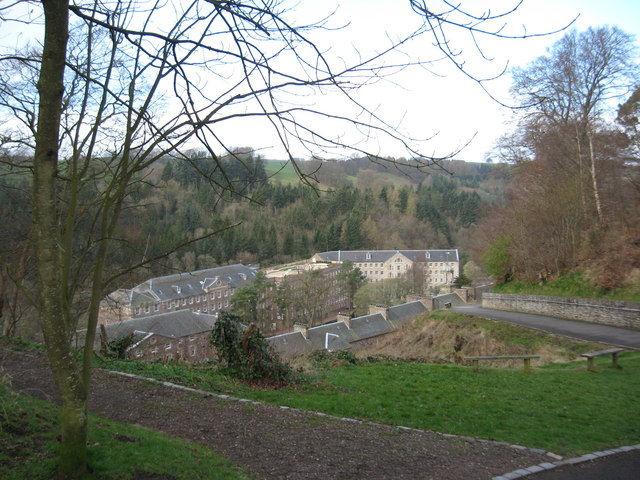
New Lanark — inscribed by UNESCO in 2001 — is the best-preserved example of an 18th–19th century industrial village in Scotland and one of the most significant sites of early socialist experiment in the world: the cotton mill village established by David Dale (1739–1806 CE) on the falls of the River Clyde at Lanark in 1785 CE, and developed from 1800 CE by his son-in-law Robert Owen (1771–1858 CE) into a model of enlightened industrial management — combining profitable cotton manufacture with genuine improvements in workers’ housing, education, child welfare, and working conditions that attracted visitors from across Europe and influenced the development of socialist and co-operative thought for the following century.
Robert Owen’s social experiment, the cotton mills, and the planned industrial village Mill No 1 (1789 CE, the original Dale mill) · Mill No 3 (1826 CE, the largest surviving building) · Robert Owen’s Institute for the Formation of Character (1816 CE) · New Lanark Visitor Centre · Falls of Clyde Wildlife Reserve
David Dale (1739–1806 CE, Glasgow merchant and banker, licensed lay preacher, one of the founders of the Royal Bank of Scotland, philanthropist known in Glasgow as “the honest man”) chose the site at the Falls of the Clyde near Lanark in 1783 CE for a cotton spinning mill on the practical grounds of its exceptional water power (the River Clyde drops approximately 30 metres over the falls at Corra Linn and Dundaff Linn within a short distance, providing an extraordinarily reliable and powerful water supply for cotton spinning machinery), and entered a partnership with Richard Arkwright (the inventor of the water frame and the factory system) who visited the site with Dale in 1783 CE and agreed to provide the spinning machinery and technical expertise. The partnership with Arkwright dissolved before the first mill was complete (the two men disagreed on terms), but Dale proceeded independently, completing Mill No 1 in 1789 CE and subsequently building a total of four large cotton mills on the Clyde gorge site. By the early 1790s CE, New Lanark was one of the largest cotton spinning mills in Britain, employing approximately 2,000 workers — the majority of whom were pauper apprentices (children aged 5–14 CE, contracted to Dale by parish authorities from the Edinburgh and Glasgow poorhouses as a form of industrialised apprenticeship that provided the children with food, housing, clothing, and the equivalent of a primary education in exchange for their factory labour). Dale was considered a relatively humane employer by the standards of his time: he prohibited corporal punishment of child workers, provided a school and religious instruction, and built workers’ housing that was substantially better than the conditions of most industrial workers’ housing in Scotland. However, it was his son-in-law Robert Owen who transformed New Lanark from a relatively enlightened version of the standard early industrial factory into a genuinely revolutionary experiment in social management. Robert Owen (1771–1858 CE, born in Newtown, Montgomeryshire, Wales, son of a saddler and ironmonger, largely self-educated but extraordinarily able in business and social theory) married Dale’s daughter Caroline in 1799 CE, purchased New Lanark from his father-in-law in the same year (in partnership with other investors including the Quaker manufacturers Jeremy Bentham and William Allen), and from 1800 CE implemented a series of radical changes to the management of the factory and village. Owen’s key changes: he eliminated the pauper apprentice system entirely (replacing child labour with adult workers and establishing a minimum working age of 10 CE — later raised to 12 CE); he reduced the working day from 13 hours to 10 hours and 30 minutes; he refused to reduce wages during the cotton embargo of 1806 CE (when raw cotton imports were disrupted by the Napoleonic Wars, forcing most mills to lay off workers or reduce wages — Owen maintained full employment and full wages for four months, at a personal cost of approximately £7,000); he established the New Institution for the Formation of Character (1816 CE — a combined school, church, lecture hall, and dancing hall that provided education for all children in the village from the age of 1 CE, with the infant school being the first of its kind in Britain); he introduced a system of character monitoring (the “Silent Monitor” — a wooden cube with four coloured faces indicating the character assessment of each worker for the previous day, hung at each workstation for all to see, intended to operate through peer pressure and shame rather than physical punishment); and he improved the workers’ housing, sanitation, and food supply through the company store (selling goods at cost rather than at profit, a departure from the “truck shop” system that most industrial employers used to extract additional profits from their workers). New Lanark attracted an extraordinary range of visitors from across Europe: the Grand Duke Nicholas of Russia (later Tsar Nicholas I) visited in 1816 CE; the Prussian reformers visited; Owen’s publication of “A New View of Society” (1813–1814 CE) made him the most discussed social reformer in Britain. The village today (managed by the New Lanark Trust since 1974 CE, when the mills finally closed as a working textile operation) is remarkably complete: all four mill buildings survive, three have been converted to residential and commercial uses, Mill No 3 (the largest, 1826 CE, seven storeys of red sandstone) houses the main visitor attraction including working textile machinery demonstrations, and the workers’ tenement housing of Braxfield Row and New Buildings continues to be lived in by approximately 200 residents — making New Lanark one of the very few World Heritage Sites that remains an inhabited community rather than a museum.
Practical information
New Lanark is located approximately 1.5 km south of Lanark town centre in South Lanarkshire, Scotland, at the bottom of a steep gorge on the River Clyde. The nearest railway station is Lanark (train from Glasgow Central, approximately 55 minutes, then a 20-minute walk down to the mills, partly via a steep path through the Clyde gorge — allow extra time if mobility is a concern; there is a shuttle bus from Lanark station to New Lanark in peak season). By car: approximately 40 km from Glasgow via the M74; follow signs from Lanark town centre. The New Lanark Visitor Centre (New Lanark Trust, entry fee for the main mill museum; village streets and exterior free at all times) is open year-round and includes working textile machinery, an Annie McLeod Experience (a fairground-ride-style trip through New Lanark’s history), and exhibitions on Robert Owen’s social ideas. The Falls of Clyde Wildlife Reserve (Scottish Wildlife Trust, free entry) is immediately adjacent, with waymarked paths to the Corra Linn waterfall (approximately 1.5 km from the village — particularly spectacular in spate conditions). The Lanark Loch and the Clyde Walkway provide additional walking options. Allow 2–3 hours for the village and visitor centre; a half-day if including the Falls of Clyde walk. Best season: May–September (the Clyde gorge woodland is particularly beautiful in late spring and autumn); December is quieter but the village is fully open.
Frequently Asked Questions
Who was Robert Owen and what did he actually change at New Lanark?
Robert Owen (1771–1858 CE) is one of the most significant figures in the history of social reform, education, and the labour movement — a self-made textile manufacturer who became the most influential advocate of co-operative living, non-exploitative employment, and state-funded universal education in early 19th-century Britain and who directly inspired the British co-operative movement, the early trade union movement (he co-founded the Grand National Consolidated Trades Union in 1833 CE, then briefly the largest trades union in Britain with approximately 500,000 members), and a series of intentional communities in Britain and America (including New Harmony, Indiana, 1825–1828 CE, where he invested the majority of his personal fortune in an unsuccessful attempt to establish a self-sustaining co-operative community). Owen’s specific reforms at New Lanark (which he managed profitably from 1800 to 1824 CE, demonstrating that humane management of workers was not incompatible with commercial success) included: the elimination of the pauper apprentice system; the reduction of the working day; the refusal to dismiss or reduce wages during commercial crises; the establishment of the first infant school in Britain (the “New Institution for the Formation of Character,” 1816 CE, where children from age 1 upward received education through play, singing, dancing, and direct experience rather than through corporal punishment and rote repetition — a pedagogical approach that anticipated the kindergarten movement by decades); the establishment of a company store selling goods at cost rather than for profit (reducing the cost of living for workers substantially); and the maintenance of clean, regularly painted workers’ housing with adequate ventilation and fresh water. The most remarkable aspect of Owen’s achievement at New Lanark is that the mills were consistently profitable throughout his management: his investors received substantial dividends, the mills produced high-quality cotton yarn that competed successfully in international markets, and the workforce was demonstrably healthier, less criminal, and more productive than the workforces of comparable unenlightened mills. Owen used this combination (profitable mill + happy workers) as evidence for his central theoretical argument: that human character was entirely formed by the circumstances in which people were raised (the doctrine of “environmental determinism” that Owen derived partly from the Enlightenment philosopher John Locke and partly from his own observation of the children in the New Lanark mills), and that therefore improving the environment in which workers lived and worked would automatically produce better, more productive, less criminal workers — benefiting employers and workers equally. This argument made Owen the most famous and admired employer in Britain in the period 1800–1825 CE, attracting visits from statesmen, monarchs, and reformers across Europe, before his later religious heterodoxy (he publicly rejected Christianity in 1817 CE) and his increasingly radical communitarian experiments alienated his early supporters.
What is the condition of the surviving mill buildings today and how is the village used?
The four mill buildings at New Lanark (Mill No 1, 1789 CE; Mill No 2, 1788 CE; Mill No 3, 1826 CE; and the Twisting Mill, 1815 CE — the numbering reflects the sequence in which they were constructed by Dale and Owen, not their current spatial arrangement) survive in varying conditions and have been converted to different uses by the New Lanark Trust (established 1974 CE to save the village from demolition; the mills closed as a working textile operation in 1968 CE with the closure of Gourock Ropework Company’s operations, which had acquired the mills after Owen’s partnership). Mill No 3 (the largest surviving building, seven storeys of red sandstone, approximately 55 metres long) houses the main visitor centre, including exhibitions on New Lanark’s history and Robert Owen’s social experiments, a working textile machinery demonstration (using period-appropriate spinning machinery to produce cotton yarn), and the “Annie McLeod Experience” (a fairground-style dark ride telling the story of New Lanark through the life of a fictional mill girl of 1820 CE — a slightly unusual interpretation method for a serious heritage site, but effective for families with children). Mill No 1 and Mill No 2 have been converted to self-catering holiday apartments (run by the New Lanark Trust as a revenue source to fund the conservation programme), providing visitors with the unusual experience of sleeping inside a Georgian cotton mill building in the gorge of the River Clyde. The Twisting Mill has been converted to a hotel (the New Lanark Mill Hotel). The workers’ tenement housing (Braxfield Row, New Buildings, Caithness Row, and Long Row — rows of stone tenement apartments built between 1785 and 1800 CE to house Dale’s workers) continues to be occupied by approximately 200 permanent residents, making New Lanark one of the very few UNESCO World Heritage Sites that remains a genuinely inhabited community rather than a preserved monument or a museum. Owen’s original Institute for the Formation of Character (1816 CE, the building that housed the infant school and the village meeting hall and dancing room) survives and has been restored; the village school building also survives. The village church (New Lanark Nursery School, originally Robert Owen’s school building of 1817 CE) is similarly in good condition. The entire site is in a dramatically beautiful setting — the River Clyde gorge at this point is a steep-sided wooded ravine with the mills at the bottom, the workers’ housing on a terrace above, and the Falls of Clyde (one of the most celebrated scenic attractions in Scotland in the 18th and 19th centuries CE — painted by J. M. W. Turner in 1801 CE) immediately upstream.
What was the influence of New Lanark on subsequent social reform and the co-operative movement?
The influence of New Lanark on subsequent social reform, the co-operative movement, and the labour movement in Britain and internationally is difficult to overstate: the village served as the primary practical demonstration that Owen’s theoretical argument — humane working conditions produce more profitable factories — was viable, and the visitors who came to New Lanark between 1800 and 1825 CE (approximately 20,000 per year at the peak, including politicians, manufacturers, social reformers, and foreign dignitaries) carried the New Lanark model back to their own countries and organisations. The most significant direct influences: the co-operative movement (the Rochdale Pioneers, who established the Rochdale Society of Equitable Pioneers in 1844 CE — widely regarded as the first successful consumer co-operative — were directly inspired by Owen’s New Lanark company store selling goods at cost and his writings on co-operative organisation); the infant school movement in Britain (Owen’s New Institution of 1816 CE was the model for Samuel Wilderspin’s later infant school movement of the 1820s CE, which spread to hundreds of schools across Britain); Robert Owen’s “A New View of Society” (1813–1814 CE, published in four essays and widely translated into French, German, and other languages) directly influenced the early French socialists (particularly Saint-Simon and Charles Fourier) and the German reformers who developed the kindergarten (Friedrich Froebel specifically acknowledged Owen’s educational ideas); and the Grand National Consolidated Trades Union (1833–1834 CE, co-founded by Owen and briefly the largest union in Britain) was the first attempt to organise all workers of all trades into a single union, a model for the “one big union” concept that persisted in the labour movement. Owen’s later experiments (New Harmony in Indiana, 1825–1828 CE, where Owen purchased the existing Harmonist community town from the Rappites and attempted to establish a self-governing co-operative community — the experiment failed within three years, costing Owen approximately four-fifths of his fortune) were less successful, but they directly influenced the American communitarian and utopian socialist movements of the 1830s–1850s CE (Brook Farm, Fruitlands, and dozens of other experiments). The United Kingdom Co-operative movement (today one of the largest consumer co-operative networks in the world, with approximately 4 million members and £10 billion in annual turnover) continues to hold Owen as its founding inspiration and regards the Rochdale Pioneers of 1844 CE as the institutional link between Owen’s ideas and the modern co-operative.
EXCERPT: New Lanark (UNESCO 2001) — Robert Owen’s revolutionary model industrial village on the Falls of the Clyde: four cotton mills (1789–1826 CE), the world’s first infant school (1816 CE), workers’ tenement housing still occupied today, and the site where the idea of building a better society through better working conditions was first proved commercially viable.
META: UNESCO World Heritage Sites near New Lanark Scotland UK: Antonine Wall 50 km northwest, Heart of Neolithic Orkney 350 km north — Scotland heritage circuit from the Enlightenment social experiment to the Roman frontier wall and the Neolithic sacred landscape.
Sources
- S1 — UNESCO World Heritage Centre — New Lanark (Ref. 429) — https://web.archive.org/web/20230601000000/https://whc.unesco.org/en/list/429/
- S2 — New Lanark Trust Official Portal — https://www.newlanark.org/
Spotted an error? Write to the editors and we correct it the same day.