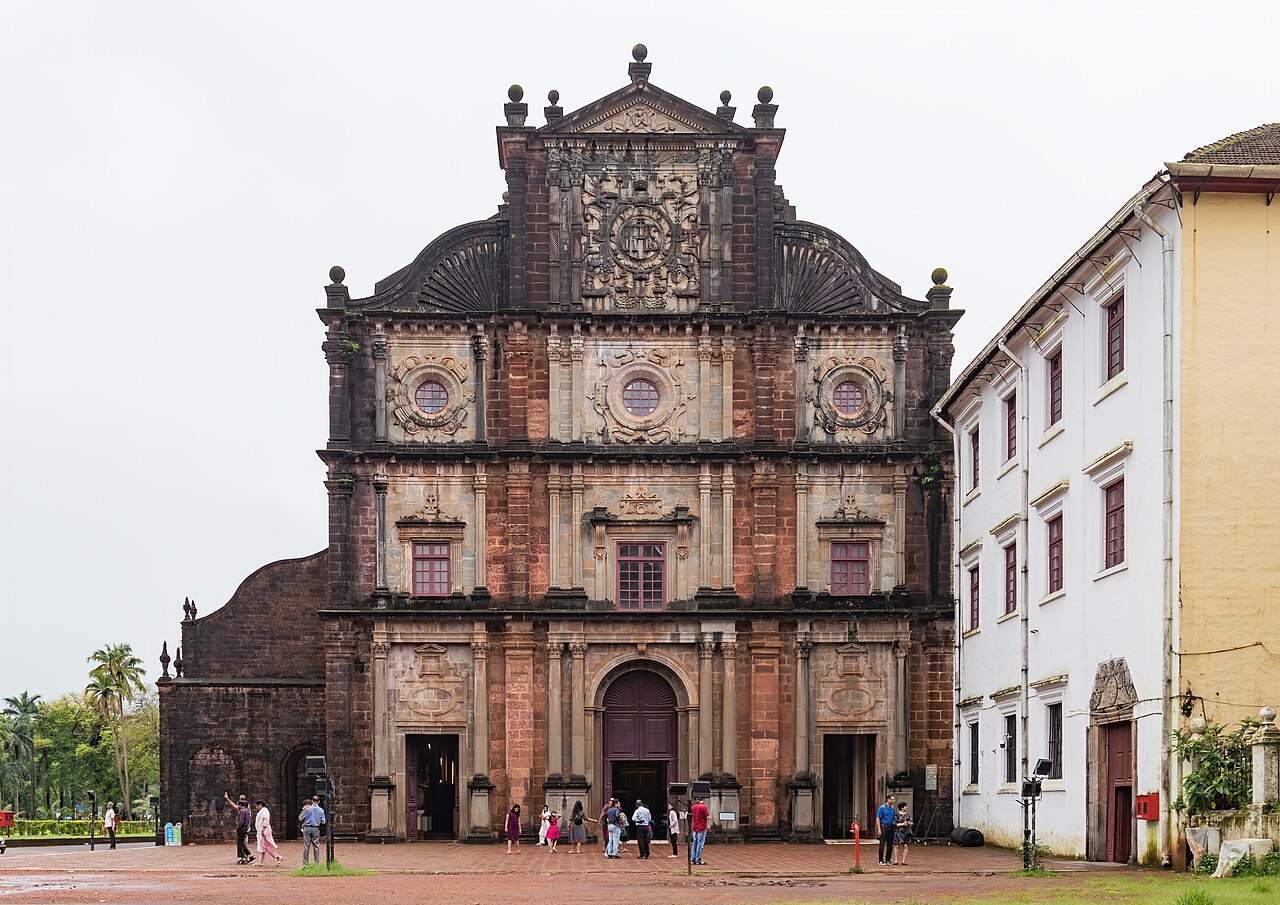
The Churches and Convents of Goa (Velha Goa, Old Goa), inscribed by UNESCO in 1986, is the most important group of Portuguese colonial ecclesiastical architecture in Asia — nine monuments in Old Goa (the Portuguese colonial capital of “Golden Goa”, at its peak in the 16th–17th centuries one of the largest cities in Asia with a population rivalling contemporary Lisbon) that demonstrate the full range of European religious architectural styles (Mannerist, Baroque, Gothic, and the distinctly Portuguese Manueline style) transplanted and sometimes hybridised with local Konkani architectural craftsmanship in the laterite and stucco construction traditions of coastal Konkan India. The defining monument of the group is the Basilica of Bom Jesus (built 1594–1605 CE, the only monument in Old Goa not covered in plaster — its laterite brick exterior left exposed in a 19th-century aesthetic decision — Baroque facade with Corinthian, Doric, Ionic, and Composite orders superimposed in the standard three-storey Jesuit church formula) which contains the silver casket holding the body of St. Francis Xavier (Francis de Jasso Azpilicueta, 1506–1552 CE, the Navarrese Jesuit co-founder with Ignatius of Loyola, who died on the island of Shanghchuan near Guangzhou awaiting entry to China and whose body was transported to Goa in 1553 CE, where it remains — the “incorrupt” body of Francis Xavier displayed in the Baroque silver casket (1698 CE, by the Florentine sculptor Giovanni Battista Foggini) every decade for a Novena exposition, last held 2024–25 CE, attracting millions of Catholic pilgrims from India, Portugal, and across Asia).
Old Goa’s ecclesiastical complex and the Goa heritage corridor Basilica of Bom Jesus · Sé Cathedral · Church of St. Cajetan · Panaji · Goa beaches — 0 to 30 km
The nine UNESCO-inscribed monuments of Old Goa are distributed along a 1 km stretch of the road connecting the Mandovi River ferry crossing (now replaced by the Panjim–Old Goa road bridge) with the remains of the old city centre — the entire area walkable, though the principal monuments are visited in clusters. The Basilica of Bom Jesus (the most significant monument and the primary pilgrimage destination, open daily, silver casket of St. Francis Xavier visible in the chapel on the right side of the altar in the Sacristia da Natividade attached to the main church; the ornate Baroque altar features an Italian marble floor inlaid with coloured stone, the mausoleum of the patron Duke Cosimo III de’ Medici in the north chapel) and the Sé Cathedral (dedicated to St. Catherine of Alexandria, built 1562–1619 CE by the Portuguese colonial administration — the largest church in Asia by interior volume, 76.2 m in length with five aisles, the famous “Golden Bell” in the south tower — the single surviving tower, the north tower having collapsed in 1776 CE — said to be the largest bell in Goa with the most melodious tone; the altar panels depicting scenes from the life of St. Catherine are 16th-century paintings of significant quality) stand 500 m apart. The Church of St. Francis of Assisi (1661 CE, built on the site of a chapel of 1521 CE, with an interior that combines late Gothic (Manueline) exterior portal with a florid Baroque altar and an original painted floor of tombstones — the Museum of Old Goa, immediately adjacent, houses the finest collection of Portuguese colonial sculpture and paintings in India). The Convent and Church of St. Cajetan (1651 CE, built by Italian Theatine friars on the model of St. Peter’s Basilica in Rome — the dome specifically modeled on the Roman prototype, making St. Cajetan’s the only church in Asia based on Michelangelo-Maderno’s St. Peter’s design, and a rare instance of the 17th-century Italian Baroque architectural tradition in colonial Asia). The ruined Convent of St. Augustine (1602 CE, the most atmospheric of the Old Goa monuments — the massive 46-metre main tower still standing in the archaeological reserve as a Gothic-Baroque ruin surrounded by jungle, one bell preserved in the Archaeological Museum).
Panaji (Panjim, the current Goa state capital, 10 km west of Old Goa on the Mandovi River) contains the Latin Quarter of Fontainhas — 19th-century Portuguese colonial domestic architecture with pastel-painted houses, Portuguese tile work (azulejo), and narrow streets that survived the urbanisation pressure of post-1960 Goa, and is now the most atmospheric urban heritage area in Goa for walking. The Goa Velha heritage area (south of Panaji, the site of the pre-Portuguese Goa capital of the Kadamba dynasty, Gopakkapattana — excavations have revealed Kadamba-period Hindu temple platforms beneath the Portuguese-built churches) provides the pre-colonial layer. The Basilica of Bom Jesus Feast Day (December 3, the feast of St. Francis Xavier) and the Novena exposition of the body every decade (the next is projected for 2034–35 CE) are the peak religious pilgrimage events.
Practical information
Old Goa is 10 km east of Panaji (Panjim) by road (approximately 20 minutes by taxi or bus from Panaji bus stand). Nearest airport: Goa International Airport (Dabolim, now partially replaced by the new Mopa airport in North Goa, approximately 25 km south of Panaji, 35 km from Old Goa). Direct international flights from London, Frankfurt, Moscow, and regional Indian connections. The UNESCO-inscribed monuments in Old Goa are managed by the Archaeological Survey of India (ASI) and by the Diocese of Goa and Daman (for the active churches). The Basilica of Bom Jesus is open daily 09:00–18:30 (closed during mass). Admission to the ASI monuments (Sé Cathedral, Church of St. Francis of Assisi/Museum, St. Cajetan’s) is subject to standard ASI fees. The Archaeological Museum of Goa (adjacent to Church of St. Francis of Assisi) is open Tuesday–Sunday 10:00–17:00. Visiting time: 2–3 hours for the principal monuments; allow 4 hours for a comprehensive visit including the ruined convent of St. Augustine. Old Goa’s central monument cluster generates significant visitor numbers in the November–March peak tourist season. Best visiting time: early morning (09:00–11:00) to avoid tour groups from the beach resorts. Goa’s beach resort belt (Calangute, Baga, Anjuna in North Goa; Palolem in South Goa) provides the primary accommodation base for most international visitors, with Old Goa as a half-day cultural excursion from the coast.
Frequently Asked Questions
Who was St. Francis Xavier and why is his body preserved in Old Goa?
St. Francis Xavier (Francisco de Jasso y Azpilicueta, April 7, 1506 – December 3, 1552 CE) was a Navarrese Catholic priest and Jesuit missionary, co-founder of the Society of Jesus with Ignatius of Loyola (the Jesuits were formally established in 1540 CE by Pope Paul III), and one of the principal figures of the Catholic Counter-Reformation’s missionary expansion into Asia. Xavier arrived in Goa on May 6, 1542 CE — the first Jesuit to reach India — and spent the following decade in an extraordinarily mobile and ambitious missionary campaign across South and Southeast Asia: from Goa he travelled to the Pearl Fishery Coast of Tamil Nadu (1542–1545), Malacca (Malaysia, 1545), the Banda Islands (Indonesia, 1546), Ternate (Indonesia, 1546–1547), Japan (1549–1551, where he founded the first Christian communities in Japan at Kagoshima, Hirado, and Yamaguchi), and finally attempted to enter China (1552) — a country that remained closed to European missionaries. Xavier died on December 3, 1552 CE on the island of Shangchuan (São João, approximately 200 km southwest of Guangzhou, present-day China), waiting for a passage into China that never came, of fever and exhaustion after approximately 10 years of continuous travel across Asia. His body was transported to Goa arriving in March 1554 CE (initially via Malacca, where the body was briefly interred). The preservation of the body (classified as “incorrupt” — meaning that it did not decompose normally in the manner expected — by the Catholic Church, the condition first officially noted in 1556 CE by the Jesuit Visitor Gonçalvo Silveira on his inspection of the body 18 months after death, and subsequently attested by multiple ecclesiastical inspections since) has been a matter of both religious significance and medical curiosity; the official Catholic position is that the incorruption is miraculous, while several physical examinations in the 20th century (including a 1951 autopsy conducted by the Church that documented the body’s current state of preservation) describe a body in an advanced state of mummification consistent with natural desiccation rather than miraculous preservation. Xavier’s body underwent a series of reliquary operations: the right arm was sent to Rome in 1614 (where it remains in the Gesù church, the Jesuit mother church, in a silver reliquary); the right hand was sent to Japan in 1619 (at the Jesuits’ Japanese mission request); fragments have been distributed to Jesuit communities globally. What remains in the Bom Jesus casket is the torso and limbs of the body (without the right arm) in the silver-and-crystal casket created by the Florentine sculptor Giovanni Battista Foggini in 1698 CE. The Exposition of the Body (the periodic public display in the Basilica of Bom Jesus for pilgrimage) has been held approximately every decade since 1782 CE (the first formal Exposition after the Jesuit suppression of 1759 CE) — the last Exposition took place from November 21, 2024 to January 5, 2025, attracting approximately 4 million pilgrims over 45 days.
What happened to “Golden Goa” — the Portuguese colonial capital that once rivalled Lisbon?
Old Goa (Velha Goa, also called “Roma do Oriente” — “Rome of the East” — in Portuguese colonial literature, and “Goa Dourada” — “Golden Goa”) was at its demographic peak in the 1580s–1610s CE, with a population estimated at 200,000–300,000 — comparable to Lisbon at the time and substantially larger than most contemporary European cities outside London and Paris. The city was the administrative capital of the Estado da India (the Portuguese colonial empire in Asia, extending from East Africa through the Indian Ocean to Macau and Japan), the seat of the Archbishop of Goa (primate of the East, with ecclesiastical authority over all Portuguese Asian territories), and the most important entrepôt in the eastern Indian Ocean trade network. The Portuguese captured Goa from the Bijapur Sultanate in 1510 CE under Afonso de Albuquerque — the first permanent European territorial possession in Asia — and began building the administrative, religious, and commercial infrastructure of a major colonial capital over the following decades. The decline of Old Goa was rapid and almost complete: epidemic diseases (plague in 1543, 1570, 1635; cholera epidemics regularly from the 1650s onward) killed tens of thousands; the collapse of the Portuguese spice trade monopoly following Dutch and British entry into the Asian trade in the early 17th century reduced Goa’s commercial centrality; the shift of the capital to Panaji in 1843 CE removed the administrative rationale for the city; and by the early 19th century, Old Goa had been almost entirely abandoned, its churches and convents standing in a landscape that had reverted to jungle. The Anglican traveller and naturalist Henry Forbes observed in 1815 CE that Old Goa was “a city of ruins and churches”. The conservation of the surviving monuments occurred incrementally through the 19th and 20th centuries: the Portuguese colonial government gazetted the major churches as national monuments in the 1840s; the Archaeological Survey of India (post-1947) continued conservation work; the UNESCO inscription in 1986 provided the international framework for systematic conservation and the prevention of further urban encroachment on the ruins.
EXCERPT: Churches and Convents of Goa, UNESCO-inscribed in 1986, includes the Basilica of Bom Jesus with the silver casket of St. Francis Xavier (died 1552, incorrupt body displayed every decade, last 2024–25), the Sé Cathedral (largest church in Asia), and the Convent of St. Cajetan modeled on St. Peter’s Basilica — the most complete Portuguese colonial heritage complex in Asia, 10 km from Panaji.
META: UNESCO World Heritage Sites near Churches and Convents of Goa India: Hampi Group of Monuments 350 km northeast (UNESCO 1986), Elephanta Caves 550 km north (UNESCO 1987) — Goa Portuguese colonial heritage, St. Francis Xavier pilgrimage, Old Goa Velha Goa ecclesiastical architecture, Estado da India capital 16th century.
Sources
- S1 — UNESCO World Heritage Centre — Churches and Convents of Goa (Ref. 234) — https://web.archive.org/web/20230601000000/https://whc.unesco.org/en/list/234/
- S2 — UNESCO World Heritage Centre — Statement of Outstanding Universal Value (Ref. 234) — https://whc.unesco.org/en/list/234/
Spotted an error? Write to editorial@culturalheritageonline.com and we correct it the same day.