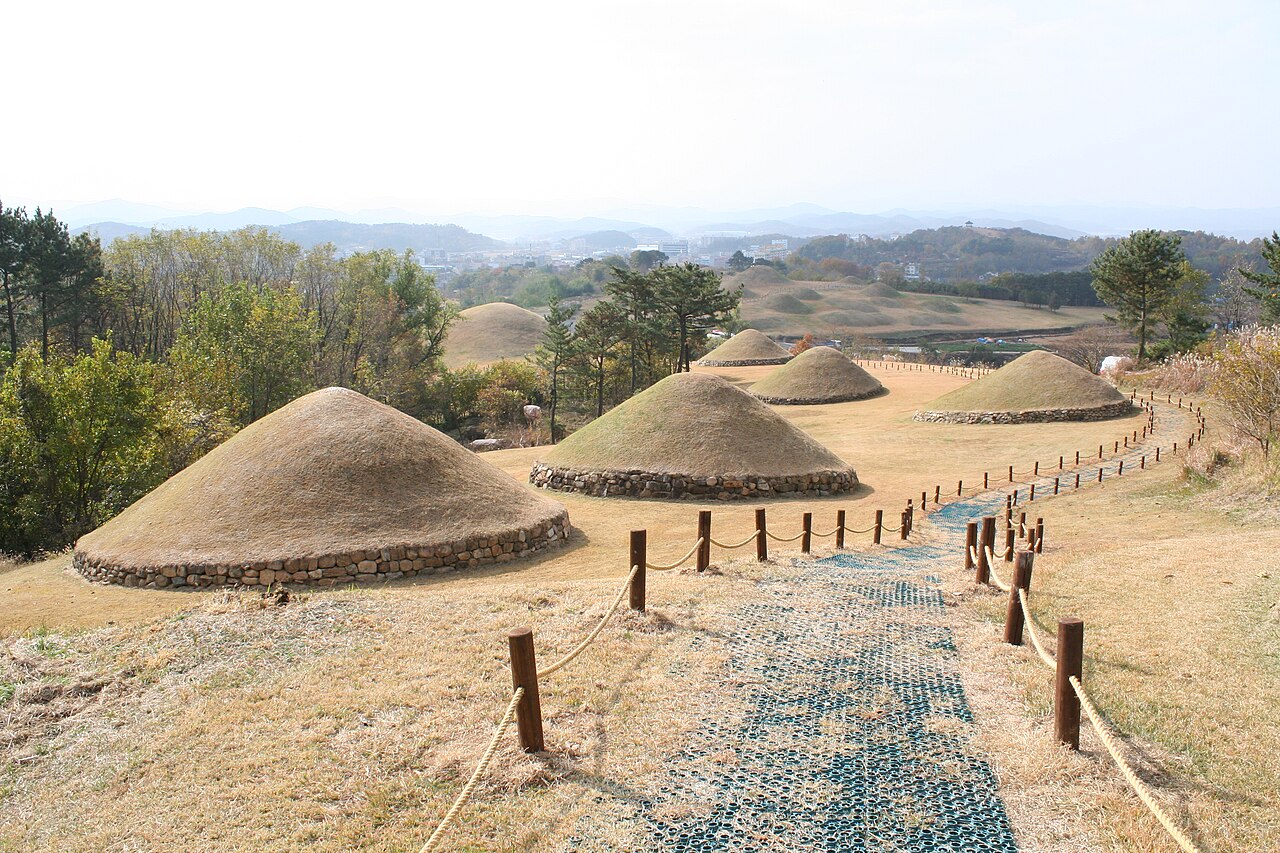
The Gaya Tumuli (가야 고분군), inscribed by UNESCO in 2023, protect seven clusters of tumuli (burial mounds) of the Gaya confederacy (가야, 1st–6th centuries CE) — Gimhae Daeseong-dong Tumuli (김해 대성동 고분군), Hamान Malisan Tumuli (함안 말이산 고분군), Goryeong Jisan-dong Tumuli (고령 지산동 고분군), Changnyeong Gyodongni Tumuli (창녕 교동 고분군), Hapcheon Okjeon Tumuli (합천 옥전 고분군), Goseong Songhakdong Tumuli (고성 송학동 고분군), and Namwon Yugnang Tumuli (남원 유락동 고분군) — across South Gyeongsang, South Jeolla, and North Gyeongsang Provinces, constituting the primary surviving physical evidence of the Gaya confederacy, a political entity that existed as a loosely federated network of independent city-states in the southern Korean peninsula simultaneously with the Three Kingdoms of Goguryeo, Baekje, and Silla, and that was not incorporated into either of the competing Korean kingdoms until the final Gaya polity (Daegaya) was absorbed by Silla in 562 CE. The Gaya Tumuli’s Outstanding Universal Value rests on their demonstration of a unique political and cultural formation — a multi-centred confederacy without a unified kingship, maintaining cultural coherence (shared burial practices, ceramic styles, ironworking techniques) across geographically dispersed polities — that provides essential evidence for the plurality of political models in the ancient Korean peninsula and completes the archaeological record of the Three Kingdoms period by documenting what was happening in the south while Goguryeo, Baekje, and Silla competed in the north and centre.
The Gaya tumuli corridor across South Gyeongsang Province Gimhae Daeseong-dong · Goryeong Jisan-dong · Hapcheon Okjeon — 30 to 130 km
Gimhae Daeseong-dong Tumuli (김해 대성동 고분군, in Gimhae city, approximately 30 km west of Busan by KTX — 15 minutes from Busan Sasang Station or 30 minutes by bus from Busan city centre) represent the burial ground of the ruling lineage of Geumgwan Gaya (금관가야, the most powerful of the early Gaya polities, centred on the mouth of the Nakdong River and controlling the iron trade between the Korean peninsula and the Japanese archipelago in the 1st–5th centuries CE). The Gimhae tumuli are the most archaeologically informative of the seven components for understanding Gaya’s role in the international iron trade: the excavated burial goods from the Daeseong-dong mounds (displayed in the adjacent Daeseong-dong Tumulus Museum and the Gimhae National Museum) include Japanese Yayoi-period pottery and bronze ritual objects imported from the Japanese archipelago, Chinese Han-dynasty bronze mirrors imported from the continent, and the characteristic Gaya iron armour and iron weapons that define the Gaya material culture. Iron was the primary export of the Gaya confederacy to both Goguryeo in the north, Baekje and Silla on the peninsula, and the Wa polities of Japan — the Chinese dynastic history Samguk Ji (“Records of the Three Countries”, 289 CE) describes the Gaya region (then called Pyeonhan) as producing iron of such quality that it was used as a currency substitute in regional trade, with Chinese and Japanese merchants coming to buy it “like coins”. The Daeseong-dong mounds (46 mounds excavated, with ongoing excavation of additional mounds) range from approximately 5 m to 2.5 m in height and follow the characteristic Gaya burial form: a stone-lined burial chamber (木槨, wooden coffin chamber inside a stone-cist enclosure) buried in the natural ground surface and covered by an earthen mound, occasionally with evidence of ritual human sacrifice (순장, sunjang — the burial of attendants, both alive and dead, alongside the primary deceased in the same mound, documented in 13 Daeseong-dong mounds by the presence of multiple human skeletal remains in the same burial layer). Goryeong Jisan-dong Tumuli (고령 지산동 고분군, approximately 80 km north of Busan by road, in Goryeong County, North Gyeongsang Province), the burial ground of the Daegaya (대가야) polity — the last and most powerful of the Gaya kingdoms before the 562 CE Silla conquest — contains the largest individual Gaya tumuli (the No. 44 and No. 45 mounds, 25 m and 20 m in height respectively, the two largest surviving Gaya burial mounds), each of which has been identified by excavation as a royal mound with multiple subsidiary burial chambers (순장묘) for attendants: the No. 44 mound contained the main burial plus 32 subsidiary chambers with the remains of 40 attendants, the largest documented single-mound ritual human sacrifice assemblage in the Korean archaeological record.
The Hapcheon Okjeon Tumuli (합천 옥전 고분군, approximately 50 km northwest of Busan by road, in Hapcheon County), the burial ground of the Dara Gaya polity (다라국), has produced the most technically sophisticated metalwork found in any Gaya burial context: the Okjeon tumuli excavations (1985–2004 CE) recovered multiple gold earrings with granulation decoration of a quality comparable to contemporaneous Silla royal jewellery, iron helmets with cheek-guards and neck-guards of a type found elsewhere only in the Late Roman and Byzantine military tradition (a connection that has generated significant scholarly debate about whether the similar helmet form reflects independent invention or long-distance technology transmission through Central Asian nomadic intermediaries), and a dragon-head pommelled sword (용봉문 환두대도, a type of long sword with a ring-pommelled handle decorated with a dragon-and-phoenix motif, found in multiple Korean Three Kingdoms period royal burials and in contemporaneous Japanese Kofun-period burials — the shared sword type being one of the clearest material-culture links between the Korean and Japanese elites of the 4th–6th centuries). The Namwon Yugnang Tumuli (남원 유락동 고분군, approximately 130 km west of Busan, in Namwon city, South Jeolla Province) is the westernmost of the seven components and represents a late Gaya polity (possibly Eullyangna 기문국 or a western Gaya affiliate) occupying the Seomjin River basin — an area that was at the intersection of the Gaya cultural sphere, the Baekje political sphere, and the natural boundary between the two. The Namwon Yugnang mounds (some burial goods displaying both Gaya and Baekje stylistic characteristics) provide the physical evidence for understanding how the Gaya confederacy’s western frontier operated as a contact zone with Baekje.
Practical information
The seven Gaya Tumuli components are distributed across a 130-km stretch of the Gyeongsang and Jeolla provinces and require separate visits for a comprehensive circuit. The Gimhae components (Daeseong-dong, 30 km from Busan) are the most accessible and best interpreted for international visitors: the Daeseong-dong Tumulus Museum (대성동 고분 박물관, adjacent to the mound cluster, Tuesday–Sunday 09:00–18:00, free admission) provides Korean/English exhibits on the 1992–2019 excavations; the Gimhae National Museum (국립김해박물관, 20 minutes by bus from Gimhae Intercity Bus Terminal, Tuesday–Sunday 09:00–18:00, free) provides the most comprehensive collection of Gaya archaeological material in a single institution. From Gimhae, Goryeong Jisan-dong (80 km north) is accessible by bus from Gimhae via Daegu (2 hours total), with the Jisan-dong Tumulus Museum (지산동 고분군 박물관, open Tuesday–Sunday, free) on-site. Hapcheon Okjeon (50 km from Busan) is accessible by bus from Busan to Hapcheon (1.5 hours), with the Hapcheon Museum (합천박물관, Tuesday–Sunday, free) housing the Okjeon excavation finds. Changnyeong Gyodongni Tumuli (창녕 교동 고분군, approximately 60 km north of Busan by road) is the closest Gaya tumuli site to the Tongdosa Sansa UNESCO monastery (approximately 30 km east of Changnyeong), making a Gaya tumuli + Sansa monastery combined itinerary practical from a Busan base. The Gaya Tumuli UNESCO inscription is very recent (2023) and visitor infrastructure at the smaller components (Hamān, Goseong, Namwon) is less developed; English-language information is available at the Gimhae and Goryeong components but limited at others. Best visiting season: autumn (October–November, the grass mounds turn golden in autumn light, and the site photography is at its best) and spring (April–May, wildflowers on the mound surfaces).
Frequently Asked Questions
What was the Gaya confederacy and why is it not as well known as Goguryeo, Baekje, and Silla?
The Gaya confederacy (가야연맹, approximately 1st–6th centuries CE) was a network of city-state polities occupying the southern Korean peninsula (primarily the Nakdong River basin and the adjacent coastal areas of modern South Gyeongsang and South Jeolla Provinces) that coexisted with the three larger Korean kingdoms of Goguryeo (northeastern and northern peninsula), Baekje (southwestern peninsula), and Silla (southeastern peninsula) for approximately 600 years before being incrementally absorbed into Silla (Geumgwan Gaya absorbed by Silla 532 CE, the remaining Gaya polities including Daegaya absorbed 562 CE). The Gaya confederacy’s relative obscurity in Korean popular historical consciousness — compared to the Three Kingdoms, which are extensively covered in Korean school curricula, television drama, popular history, and cultural heritage discourse — stems from a specific historiographical problem: the primary sources for ancient Korean history are the Samguk Sagi (삼국사기, “History of the Three Kingdoms”, compiled 1145 CE by Kim Busik) and the Samguk Yusa (삼국유사, compiled circa 1281 CE by the monk Iryeon), both of which were written by Silla-descended Goryeo-period scholars who naturally foregrounded the Silla perspective, treated Gaya as a peripheral confederation that Silla was destined to absorb, and gave Gaya’s independent political and cultural history relatively limited coverage. The Chinese dynastic histories (particularly the Wei Zhi section of the Sanguozhi, 289 CE) provide the most geographically and politically detailed description of the Gaya predecessor states (called Byeonhan/Pyeonhan in the Chinese sources), but they do not cover the full 600-year span of the confederacy. The result is that Gaya history has been reconstructed primarily from archaeology rather than from textual sources — the seven tumuli clusters of the 2023 inscription are the primary evidence for Gaya’s political geography, trade connections, and elite material culture, and the inscription itself is partly an act of official historical recognition of a political formation that Korean academic archaeology has spent 40 years documenting but Korean popular history has largely ignored.
What is the practice of human sacrifice burial (sunjang) documented in the Gaya tumuli?
Human sacrifice burial (순장, sunjang, literally “following burial” — the interment of living or recently killed attendants alongside a deceased high-status individual in the same burial mound or burial chamber) is documented in multiple Gaya tumuli excavations and represents the most ethically complex dimension of the Gaya material culture for modern visitors and scholars. The practice is attested in Korea from the Bronze Age dolmen period but reached its most systematic and archaeologically well-documented form in the Gaya confederacy’s elite burial tradition of the 4th–6th centuries CE: excavations at Goryeong Jisan-dong No. 44 mound (the largest surviving Gaya tumulus), Gimhae Daeseong-dong, Hapcheon Okjeon, and other Gaya sites have identified skeletal remains of multiple individuals (ranging from 4 to over 40 individuals per mound) positioned in small subsidiary stone chambers surrounding the primary burial chamber of the main deceased — the subsidiary chamber size (too small for a living adult to sit upright) and the body positions (contracted, sometimes with evidence of binding) indicate that the individuals in the subsidiary chambers were interred at the same time as the primary burial rather than as later additions. The individuals in the subsidiary chambers were not random victims but selected retainers: the buried individuals in the Goryeong Jisan-dong subsidiary chambers include adolescents (possibly pages or attendants), adult women (possibly consorts or ritual specialists), and adult males (possibly personal guards or craftsmen), with their burial goods reflecting their occupational identity in life. The Gaya sunjang practice has parallels in contemporaneous elite burial practice in other ancient cultures (Chinese Western Zhou period, early Japanese Kofun period, Scythian kurgans) and was explicitly prohibited in Silla by King Jijeung in 502 CE (according to the Samguk Sagi), who replaced human sacrifice with burial of clay figures (土偶, ceramic substitutes for human attendants, equivalent to the Chinese mingqi mortuary ceramic tradition). The Silla prohibition of sunjang is one of the specific distinctions the Samguk Sagi makes between Gaya and Silla practice, suggesting that the human sacrifice burial tradition was associated specifically with the Gaya political-religious system rather than being universal across the southern Korean peninsula polities.
How did the Gaya confederacy’s iron trade shape the early Korean and Japanese political systems?
The Gaya confederacy’s control of the iron trade in the 1st–4th centuries CE (the period of maximum Gaya power before the expansion of Silla reduced Gaya’s political territory and trade reach) is the primary economic foundation for understanding both the confederacy’s internal organisation and its external relationships with China, the Korean kingdoms, and the Japanese Wa polities. Iron in the 1st–4th century CE Korean peninsula was the strategic material for both agricultural production (iron ploughshares and sickles allowing more intensive cultivation of the Nakdong River basin’s alluvial soil) and military capacity (iron swords, spearheads, and armour — the technological frontier of military power in East Asia between the collapse of bronze-weapon technology in the early Han period and the 7th-century Tang military expansion). The Gaya region’s geological resource advantage — iron ore deposits in the mountains of the Nakdong River headwaters, with the river itself providing transport to coastal exchange points — combined with the craft specialisation in iron smelting and forging developed by the Byeonhan predecessors of the Gaya polities (attested in the 3rd-century CE Chinese sources as already a regional specialisation) to produce a multi-century iron-export economy whose proceeds funded the elite burial culture visible in the tumuli. The Japanese Wa polities’ dependence on Gaya iron for agricultural tools and weapons (attested by the presence of iron ingots, Korean-type iron tools, and Korean pottery in 3rd–4th century Kofun-period burial mounds in the Kinai and Kyushu regions of Japan, and by the continuous documentary references to Korean iron in early Japanese texts including the Nihon Shoki) created a structural Japanese interest in maintaining political relationships with the Gaya confederacy — a relationship that produced the controversial diplomatic episodes described in the Nihon Shoki as the “Mimana Nihon-fu” (任那日本府), a term interpreted by Japanese nationalist historians as a Japanese administrative office in southern Korea and by Korean and Western scholars as a Yamato-period diplomatic or commercial liaison arrangement, or as a Nihon Shoki literary invention designed to retroject Japanese political authority onto the Korean peninsula. The Gaya tumuli’s archaeological evidence — Japanese Yayoi pottery in Gimhae mounds, Korean iron objects in Japanese Kofun mounds, shared ornamental and ceramic styles across the Korea-Japan sea — documents the material-cultural dimension of a trade relationship whose political form remains debated.
Sources
- S1 — UNESCO World Heritage Centre — Gaya Tumuli (Ref. 1666) — https://web.archive.org/web/20230601000000/https://whc.unesco.org/en/list/1666/
- S2 — UNESCO World Heritage Centre — Statement of Outstanding Universal Value (Ref. 1666) — https://whc.unesco.org/en/list/1666/
Spotted an error? Write to editorial@culturalheritageonline.com and we correct it the same day.