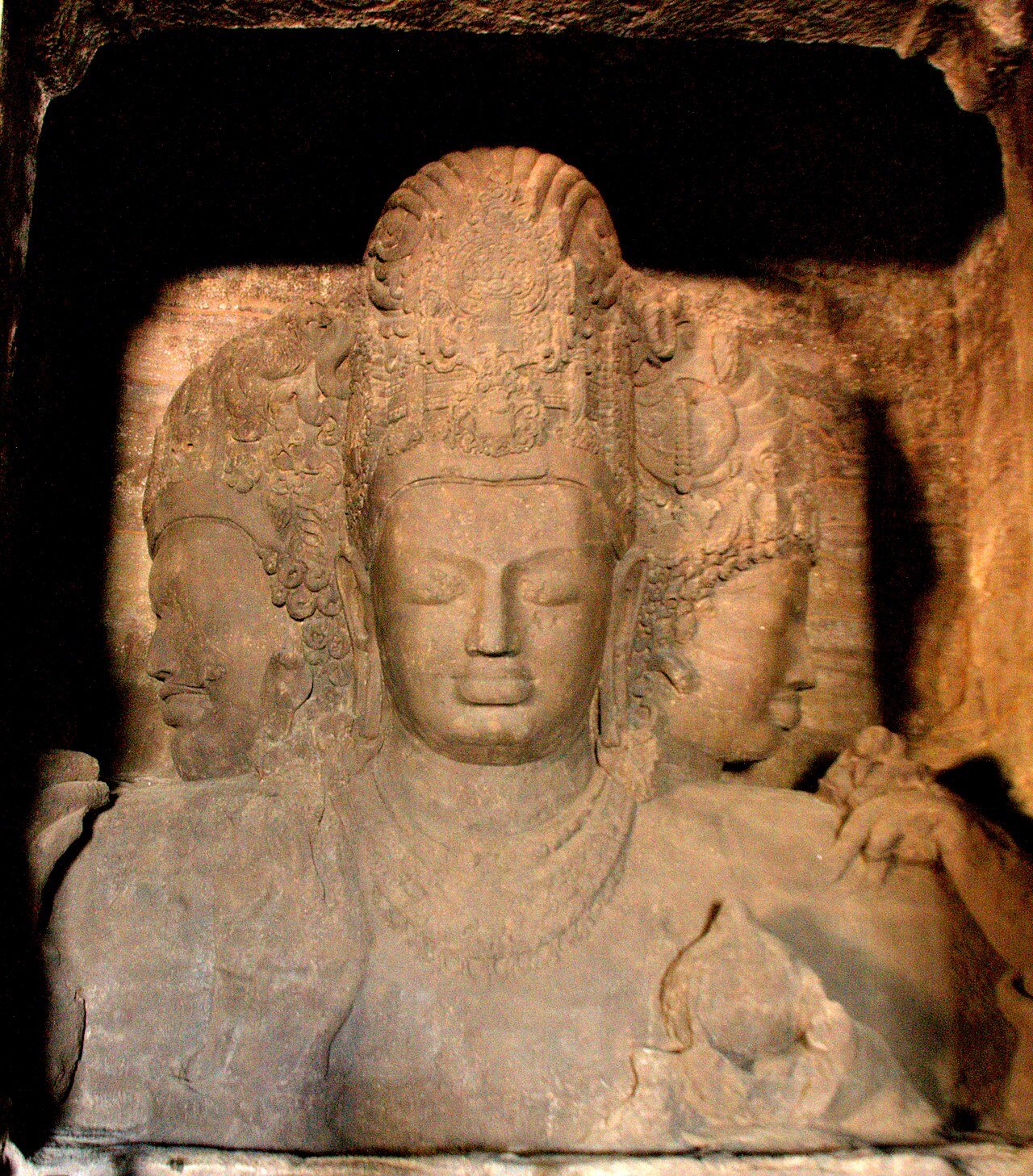
The Elephanta Caves (घारापुरीच्या लेण्या, Gharapuri), inscribed by UNESCO in 1987, is a group of rock-cut cave temples on Elephanta Island (Gharapuri) in Mumbai Harbour — approximately 11 km by ferry from the Gateway of India, the most accessible major UNESCO World Heritage site from Mumbai. The inscription comprises a group of Hindu and Buddhist rock-cut caves on the 11.7 km² island, dominated by Cave 1 (the “Great Cave”, the largest and most important of the five main Hindu caves, approximately 39 m × 39 m, carved on three sides into the basalt hillside with a columned hall approaching 7 m in height and containing the Trimurti, one of the greatest sculptures in world art history). The caves were excavated approximately 550–600 CE (the Kalachuri period or early Chalukya period — the specific dynasty responsible for the commission remains debated, as the historical records of Maharashtra in this period are fragmentary), cut directly into the volcanic basalt of the island’s central hill and reached through a rock-cut stepped corridor from the main landing on the island’s northern shore. The Elephanta Caves are exceptional among India’s rock-cut heritage for the quality and scale of their sculptural programme: the Cave 1 interior contains the Trimurti (Maheshmurti, the “Great Lord”, a 5.5-metre-high three-faced bust of Shiva representing his three cosmic functions as creator in the right face, preserver in the central face, and destroyer in the left face), the Ardhanarishvara (a half-male, half-female representation of Shiva and his consort Parvati in a single figure, approximately 5 m high, the right half of the body in male Shaivite form and the left half in female Shakta form — the most celebrated Ardhanarishvara sculpture in Indian art), and the Sadashiva (Shiva in his five-faced form, carved as a 9-panel programme of Shaivite mythology on the cave’s principal wall panels).
Elephanta Island and the Mumbai harbour heritage landscape Cave 1 Trimurti · Ferry from Gateway of India · Victorian Gothic and Art Deco Ensembles · Chhatrapati Shivaji Terminus — 11 to 30 km
Cave 1 (the Great Cave, Shiva Cave) is the architectural and sculptural centrepiece of the Elephanta UNESCO inscription — a roughly cruciform plan approximately 39 m × 39 m, supported by a regular grid of approximately 26 square pillars carved directly from the rock (many partially damaged by Portuguese soldiers who used the cave for target practice in the 16th–17th centuries CE, causing damage to approximately 40% of the figural sculpture in the cave), with three deep sanctuary niches on the south, east, and west walls. The Trimurti in the south niche (5.5 m in height, the three faces carved to show different aspects of the deity: the central face serene and cosmic in the attitude of preservation, the right face female-associated and gentle in the aspect of creation, the left face fierce and mustachioed in the aspect of destruction) is the defining image of Elephanta — when the morning ferry traffic has not yet arrived (approximately 09:30–10:30), the Trimurti can be viewed in a state of near-solitude that allows the full impact of the sculpture’s scale and serenity to be experienced. The Ardhanarishvara panel (east wall of the cave, approximately 5 m high) and the Sadashiva shrine (the main sanctuary on the cave’s west side, a large linga shrine entered through a doorway guarded by massive stone dvārapālas, approximately 4 m high) are the other principal sculptural elements that require extended time. The Cave 2 (Sitabacha), Cave 3 (Kandoba’s cave), and the smaller caves on the island’s eastern hill are less visited and less sculptural than Cave 1 but provide important context for the overall scope of the island’s sacred landscape. The Buddhist caves on the western side of the island (a few modest cells with no pictorial decoration, earlier than the Hindu caves) mark the island’s pre-Shaivite occupation.
The Gateway of India (built 1924 CE by the British colonial administration to commemorate the landing of King George V and Queen Mary in 1911 CE, in a hybrid Mughal-Hindu architectural style designed by George Wittet — the triumphal arch from which the last British troops sailed from India in 1948) is the direct departure point for the Elephanta ferry — the monument serves simultaneously as a departure point, a tourist landmark, and the ceremonial entry to Mumbai from the sea. The Victorian Gothic and Art Deco Ensembles of Mumbai (UNESCO 2018, the Victorian-era buildings along the Oval Maidan in Colaba and the Art Deco apartments along Marine Drive in Nariman Point — approximately 2–8 km from the Gateway of India by road or on foot) are the most important heritage complement to an Elephanta visit in Mumbai. The Victorian Gothic cluster (Chhatrapati Shivaji Maharaj Terminus (formerly Victoria Terminus), UNESCO-inscribed separately in 2004; the Bombay High Court; the University of Bombay with Rajabai Clock Tower; the Bombay Municipal Corporation headquarters) represents the most concentrated collection of Victorian Gothic civic architecture outside Great Britain, commissioned by the British colonial administration between 1860 and 1900 CE as physical expressions of imperial power and civic modernity.
Practical information
Elephanta Island is accessible exclusively by boat from the Gateway of India ferry terminal (the Gateway of India itself is at the southern tip of Mumbai island in Colaba, approximately 10–15 minutes by taxi from Chhatrapati Shivaji Terminus). Maharashtra Tourism Development Corporation (MTDC) and private operator ferries depart approximately every 30 minutes from approximately 09:00 to 14:30 (check current schedules; last return ferry is approximately 17:00 or later in season). The ferry crossing takes approximately 1 hour each way; boats range from economy launches (inexpensive) to air-conditioned catamarans (faster and more comfortable, higher price). On Elephanta Island, from the landing jetty a 10-minute walk (or toy train ride in season) leads to the cave entrance. The site is open Tuesday–Sunday 09:00–17:30 (closed Mondays). Admission fee (foreign visitors): standard ASI monument fee. Photography is permitted but flash photography in the cave is discouraged to protect the sculptural surfaces. The island also has a small bazaar with Maharashtra handicrafts and refreshments. Visiting time: 1.5–2.5 hours for Cave 1 plus the smaller caves; the total ferry-plus-site day trip from Mumbai takes approximately 4–5 hours. Best visiting season: October–April (dry season; the monsoon ferry service is reduced July–September and the island can be slippery after rain). Mumbai’s humidity is significant year-round; carry water. Early departure (first ferry approximately 09:00) allows more time on the island and better light for photography before the mid-morning crowds arrive. Combine with a Gateway of India area walk and the Victorian Gothic buildings of South Mumbai (Chhatrapati Shivaji Terminus is 15 minutes by taxi from Gateway of India — UNESCO-inscribed in 2004 and worth 45 minutes; the Bombay High Court and Rajabai Tower are 5 minutes walk from the terminus).
Frequently Asked Questions
What is the Trimurti at Elephanta and why is it considered one of the great sculptures of world art?
The Trimurti (literally “three-form”, also called Maheshmurti “Great Lord”) at Elephanta Caves is a three-faced representation of Shiva approximately 5.5 metres in height from the chest to the top of the crown, carved approximately 550–600 CE from the basalt of the cave’s south niche — a bust rather than a full-body representation, the face and upper torso emerging from a plain flat ground as if the deity is emerging from the rock itself. The three faces represent Shiva’s three primary cosmic aspects (in Shaivite theology, Shiva is not a limited deity but the infinite divine consciousness that expresses itself in three modes): the central face (Tatpurusha, the “Transcendent Person”, facing outward from the niche) represents Shiva as the Absolute, in the aspect of eternal preservation and cosmic serenity — the expression of the central face (heavy-lidded eyes almost closed in meditation, full lips in a slight half-smile, the crown of matted hair piled high with a crescent moon visible) is the characteristic that most consistently strikes visitors as transcending conventional sculptural representation into something approaching presence; the right face (Vamadeva, “the Beautiful One”, in the aspect of creation, associated with the feminine principle and shown with softer features and a gentler expression) and the left face (Aghora, “the Terrible”, in the aspect of destruction, shown with fierce features, mustache, and in some interpretations with a skull visible in the crown) flank the central face. The art-historical significance of the Trimurti is debated: some scholars (notably Stella Kramrisch, Wendy Doniger) treat it as the greatest expression of the Shaivite theological concept of the One appearing in Many, while others contextualise it within the broader corpus of 6th-century Deccan sculpture (noting that equally accomplished sculptures exist at Badami in Karnataka and at several Chalukyan rock-cut temples). The specific quality that distinguishes the Elephanta Trimurti in art-historical comparison is the scale (5.5 m makes it substantially larger than most contemporaneous Deccan sculpture) combined with the spatial relationship between the bust and the cave interior (the niche is approximately 4.3 m in depth, placing the sculpture approximately 20 m from the cave entrance across the columned hall — the visitor approaches through a forest of pillars and first sees the central face appearing in the deep shadow of the niche, a dramatic spatial composition that is part of the sculptural programme rather than incidental to it). The Portuguese damage (approximately 1540–1600 CE, when Portuguese soldiers used the cave sculptures for target practice, damaging or destroying the lower sections of approximately 8 major relief panels and the nose of the central Trimurti face) is an irreversible loss; what survives is approximately 60–70% of the original sculptural programme.
How does the Ardhanarishvara at Elephanta compare to other representations of this form?
The Ardhanarishvara (“the Lord who is half female”, the composite form of Shiva and Parvati unified in a single body divided vertically — the right half in Shiva’s male form, the left half in Parvati’s female form) at Elephanta (Cave 1, east wall, approximately 5 m high, approximately 550–600 CE) is considered the canonical representation of the Ardhanarishvara in Indian sculptural tradition — the standard against which all other Ardhanarishvara representations are compared. The theological significance of the Ardhanarishvara form (it appears in Puranic literature from approximately the 3rd century CE onward) is that it resolves the apparent duality of Shiva (the cosmic destroyer, the ascetic, the male principle of consciousness) and Shakti/Parvati (the cosmic creative energy, the fertile mother, the female principle of material existence) into a non-dual unity — the composite form shows that the distinction between male and female, between destruction and creation, between consciousness and energy, is not a real distinction in the cosmic order but a complementary expression of a single divine reality. The Elephanta Ardhanarishvara makes this theological unity physically visible through a careful division of physical attributes: the right half of the figure has Shiva’s lean muscular body, his matted hair (jata) in a high crown with a serpent coiled around it, his third eye, and his bull (Nandi, visible in the lower right corner of the panel); the left half has Parvati’s rounded feminine body, her elaborately decorated hair (veni, in the female braided style), her feminine ornaments (bangles, earrings), and her parrot (vahana vehicle of Parvati, visible in the lower left). The Elephanta version is superior in art-historical terms to the earlier Badami Cave 3 version (approximately 578 CE, similar date) and to later examples at Rajasthani temples because of the quality of the surface carving (the modelling of the facial features, with a single face combining both male and female aspects in a single countenance rather than two half-faces simply placed together, and the delicate treatment of the transition zone at the centre of the figure where the two halves blend rather than meeting in a hard line) and the integration of the sculptural programme with the compositional space of the cave panel.
EXCERPT: Elephanta Caves, UNESCO-inscribed in 1987, is a complex of rock-cut Shaivite cave temples on Gharapuri Island in Mumbai Harbour — Cave 1’s Trimurti (5.5-metre three-faced Shiva bust, circa 550 CE, among the great sculptures of world art) and the Ardhanarishvara panel (half-male, half-female Shiva-Parvati unity in a single body) — 11 km by ferry from the Gateway of India, 340 km from Ellora Caves (UNESCO 1983).
META: UNESCO World Heritage Sites near Elephanta Caves Mumbai India: Victorian Gothic and Art Deco Ensembles Mumbai 11 km west (UNESCO 2018), Chhatrapati Shivaji Terminus Mumbai 12 km west (UNESCO 2004), Ellora Caves 340 km east (UNESCO 1983) — Mumbai harbour UNESCO heritage day-trip from Elephanta Island to Victorian Gothic Mumbai to Chhatrapati Shivaji Terminus.
Sources
- S1 — UNESCO World Heritage Centre — Elephanta Caves (Ref. 244) — https://web.archive.org/web/20230601000000/https://whc.unesco.org/en/list/244/
- S2 — UNESCO World Heritage Centre — Statement of Outstanding Universal Value (Ref. 244) — https://whc.unesco.org/en/list/244/
Spotted an error? Write to editorial@culturalheritageonline.com and we correct it the same day.