
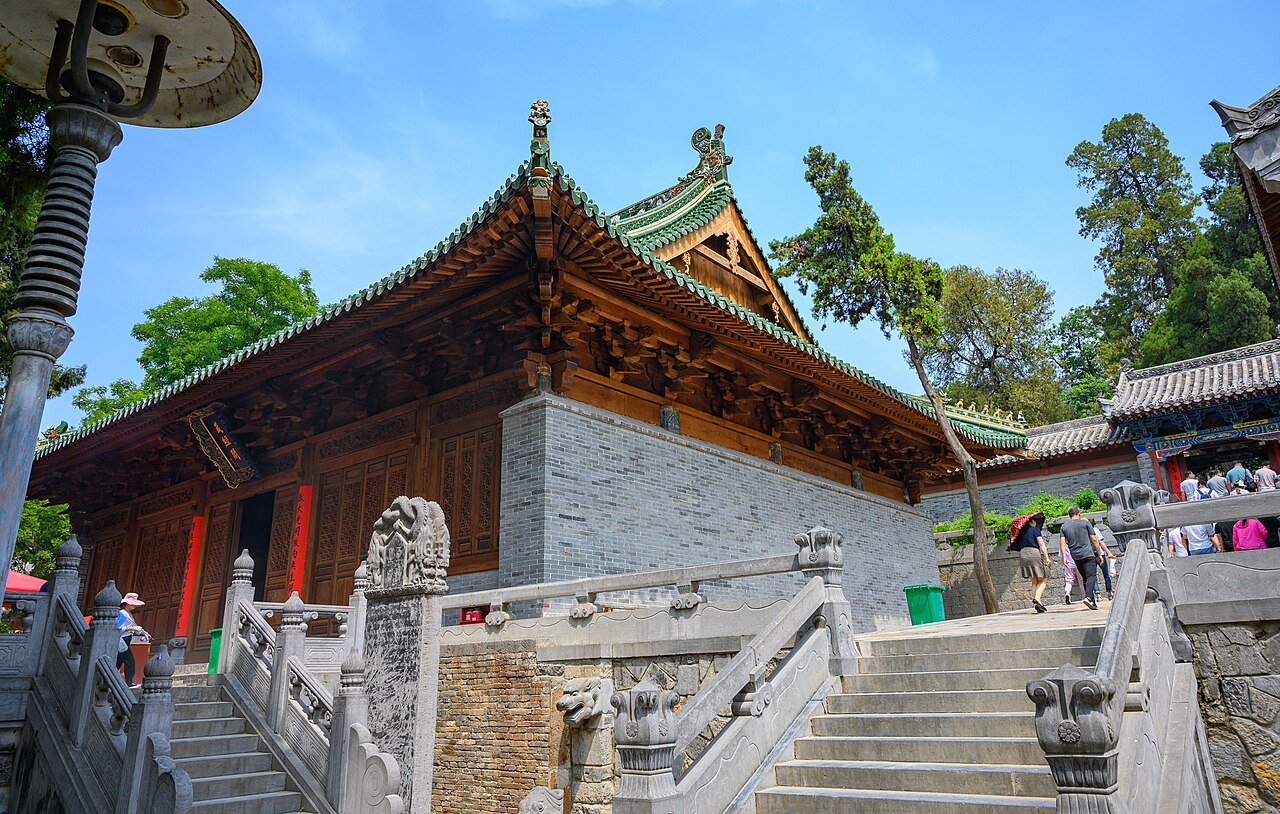
The Historic Monuments of Dengfeng “in the Centre of Heaven and Earth” were inscribed as UNESCO World Heritage in 2010, covering eight clusters of structures on and around Mount Song (Songshan) in Henan Province: the Zhongyue Temple, Shaolin Temple, the Shaolin Pagoda Forest, Huishan Temple, Songyang Academy, Songyue Pagoda, Taishi and Shaoshi Stone Watch Towers, and the Zhou Observatory (Dengfeng Observatory). The Shaolin Temple archives record 1,500 warrior monks (seng bing) serving Tang-dynasty military functions; a Tang-dynasty inscription at the temple confirms the role of 13 warrior monks in the defeat of Wang Shichong in 621 CE. The Dengfeng Observatory, constructed by Guo Shoujing in 1276 CE under the Yuan dynasty, uses a 3.97-metre gnomon (shadow-casting post) to measure the solstice shadow length, and the measurements produced there contributed to the Shoushi calendar of 1281 CE, which was accurate to within 26 seconds of the modern calculated value for the tropical year.
Western and northern connections: Longmen Grottoes and Ruins of Yin at Anyang Longmen Grottoes/Luoyang 100 km west, 40 min HSR or 1.5h by road; Ruins of Yin/Anyang 200 km north, 2h by car via Zhengzhou
The Longmen Grottoes in Luoyang, Henan Province, inscribed as UNESCO World Heritage in 2000, are approximately 100 kilometres west of Dengfeng and reachable in approximately 40 minutes by high-speed rail from Zhengzhou East to Luoyang Longmen Station (with Dengfeng approximately 1 hour from Zhengzhou by road, making a combined Dengfeng–Luoyang day trip practical via Zhengzhou as a rail hub), or in approximately 1.5 hours by direct road from Dengfeng to Luoyang. The Longmen Grottoes comprise approximately 2,300 caves and niches carved into the limestone cliffs of the Yi River gorge over a period from the Northern Wei dynasty (494 CE) through the Tang dynasty (8th century CE), containing approximately 110,000 Buddhist stone sculptures ranging from 2 centimetres to 17.14 metres in height. The largest figure, the Vairocana Buddha in the Fengxian Temple cave (completed 675 CE), is 17.14 metres high with ears measuring 1.9 metres; the cave was commissioned by Emperor Gaozong of Tang and his consort Wu Zetian, whose face is traditionally said to have provided the model for the Vairocana’s serene expression, though this attribution is not corroborated by contemporary documentation. The Northern Wei caves (particularly the Guyang Cave, begun 493 CE, and the Binyang Central Cave, commissioned 500 CE) are significant for preserving the transition from the earlier Yungang Grottoes style (characterised by sharp facial features and schematic drapery derived from Central Asian Buddhist iconography) to a distinctly Chinese stylistic idiom with softer, rounder modelling and flowing robes reflecting the Northern Wei court’s adoption of Chinese court dress in 495 CE. The connection between Longmen and the Dengfeng monuments is both geographic and cultural: Luoyang served as the Eastern Han (25–220 CE), Western Jin, Northern Wei and Tang dynasty secondary capital, while Dengfeng’s location at the cosmological centre of China was defined by its proximity to the Luoyang-Zhengzhou-Kaifeng axis of imperial capitals. Tang-dynasty Emperors Xuanzong and Gaozong both visited the Shaolin Temple at Dengfeng; the warrior monks whose 621 CE military intervention is commemorated in the temple’s Tang-dynasty inscription served a Tang court whose capital was at Chang’an (modern Xi’an) and whose secondary capital was Luoyang. The Longmen Grottoes are located 13 kilometres south of Luoyang city on the Yi River; the site is accessed by taxi or bus from Luoyang Longmen High-Speed Rail Station (8 kilometres from the grottoes) or from Luoyang central bus station.
The Ruins of Yin (Yin Xu) in Anyang, Henan Province, inscribed as UNESCO World Heritage in 2006, are approximately 200 kilometres north of Dengfeng and reachable in approximately 2 hours by car from Dengfeng via the Zhengzhou–Xinxiang–Anyang expressway, or in approximately 1 hour from Zhengzhou by high-speed rail to Anyang East Station followed by a 20-minute taxi to the site. The Ruins of Yin are the archaeological remains of the last capital of the Shang dynasty (approximately 1300–1046 BCE), identified through 19th-century discoveries of oracle bones — turtle plastrons and ox scapulae inscribed with divination questions and answers — by antiquity dealers and subsequently excavated beginning in 1928 by the Institute of History and Philology of Academia Sinica. The site has yielded more than 150,000 inscribed oracle bone fragments, making it the largest single archive of ancient Chinese writing in existence; the oracle bone script documented at Yin Xu is the ancestor of modern Chinese characters, making the Anyang finds the most significant source for the history of Chinese writing. The royal tombs of the Shang dynasty at Yin Xu (the eleven large pit tombs in the royal cemetery at Xibeigang, north of the Huan River, each measuring approximately 10 metres deep with four access ramps) contained bronze vessels, jade objects and the skeletal remains of sacrificial victims (human and animal) in quantities exceeding any other known Bronze Age site in East Asia. The connection between the Ruins of Yin and the Dengfeng monuments is a shared location in the Central Plains (Zhongyuan) of Henan Province, identified in Chinese historical geography as the cultural heartland of Chinese civilisation from the Shang dynasty through the Tang. Dengfeng’s cosmological centrality — the Tang-dynasty cosmographers’ identification of Mount Song as the Centre of Heaven and Earth — builds on the same Central Plains geography that made the Shang dynasty’s last capital at Anyang the political centre of the Bronze Age world in this region.
Northwest and east: Ancient City of Pingyao and Temple of Confucius at Qufu Ancient City of Pingyao 400 km northwest, 3.5h HSR via Zhengzhou to Taiyuan; Temple of Confucius Qufu 300 km east, 2.5h HSR via Zhengzhou to Qufu-Nishan
The Ancient City of Pingyao in Shanxi Province, inscribed as UNESCO World Heritage in 1997, is approximately 400 kilometres northwest of Dengfeng and reachable in approximately 3.5 hours by high-speed rail from Zhengzhou East to Taiyuan South (approximately 2.5 hours), then by conventional rail or bus from Taiyuan to Pingyao (approximately 1 hour). Dengfeng is connected to Zhengzhou by road in approximately 1 hour. Pingyao is a Ming-dynasty (1368–1644 CE) walled city whose original street plan, city wall, temples, residential courtyard houses and commercial buildings have survived substantially intact within the 2.25-kilometre perimeter wall completed in 1370 CE. The wall is constructed from fired brick on a rammed earth core, 12 metres high, 3 to 6 metres wide at the top, with 3,000 battlements and 72 towers corresponding to the number of disciples of Confucius as recorded in the Analects, a coincidence (or intentional alignment) recorded in Ming-dynasty local chronicles. Pingyao’s significance in the UNESCO inscription rests primarily on its role as the centre of Chinese private banking in the 19th century: the Rishengchang Exchange House, established in 1823 on Xi Dajie (West Main Street) as the first institution offering banknote exchange and interregional draft transfer across China, inaugurated the system of Chinese private banks (piaohao, “draft banks”) that by the 1890s handled a significant portion of Chinese imperial government tax revenues transferred between provinces. At its peak in the 1880s and 1890s, Pingyao’s piaohao offices operated branches in Beijing, Shanghai, Tianjin, Xi’an, Hankou, Chengdu and overseas in Japan and Russia; the 1911 revolution and the subsequent disruption to government fiscal flows collapsed the piaohao system by the 1920s. The connection between Pingyao’s merchant banking heritage and Dengfeng’s philosophical and astronomical monuments lies in the shared patronage of Chinese intellectual institutions by merchant wealth: the Songyang Academy at Dengfeng, one of the four great academies of the Song dynasty, received endowments from local merchant families as well as state support.
The Temple and Cemetery of Confucius and the Kong Family Mansion in Qufu, Shandong Province, inscribed as UNESCO World Heritage in 1994, are approximately 300 kilometres east of Dengfeng and reachable in approximately 2.5 hours by high-speed rail from Zhengzhou East to Qufu-Nishan Station on the Beijing-Shanghai line (approximately 1.5 hours), followed by a 25-minute bus or taxi to the Qufu historic monuments. The inscribed property covers three components: the Temple of Confucius (Kong Miao), comprising 466 rooms in 9 courtyards on a north-south axis 1,120 metres long, including the Dacheng Hall (Hall of Great Achievement, rebuilt 1724 CE) with 28 dragon-carved stone columns; the Cemetery of Confucius (Kong Lin), the burial ground for the descendants of Confucius covering 200 hectares north of the city wall and containing more than 100,000 graves from the Han dynasty to the 20th century; and the Kong Family Mansion (Kong Fu), the residential compound of the Yansheng Duke (the hereditary title granted to the eldest male descendant of Confucius in the direct patrilineal line), comprising 463 rooms built between the 15th and 18th centuries. The connection between Qufu and the Dengfeng monuments is explicit in the UNESCO inscription itself: the Songyang Academy at Dengfeng was one of the primary centres of Neo-Confucian scholarship in the Song dynasty (960–1279 CE), and its founding masters Cheng Yi and Cheng Hao (the “Two Chengs”) developed the philosophical synthesis of Confucian classical texts with Buddhist and Taoist metaphysical frameworks that became state orthodoxy under the Ming and Qing dynasties. The Tang-dynasty cosmological framework that placed Dengfeng at the Centre of Heaven and Earth drew on the same Confucian ritual geography that identified the cardinal mountains (Wuyue, the Five Sacred Mountains, of which Songshan is the central one) as the structural axes of the Chinese world. Qufu, as the birthplace and burial place of Confucius (551–479 BCE), is the primary node of Confucian pilgrimage; Dengfeng’s Songyang Academy is a secondary node of the same intellectual tradition as mediated through Song-dynasty Neo-Confucianism.
Practical information
Dengfeng is 80 kilometres southwest of Zhengzhou, the capital of Henan Province and the main rail hub for central China. From Zhengzhou East High-Speed Railway Station, buses to Dengfeng depart approximately every 30 minutes from the adjacent long-distance bus station and take approximately 1 hour. Zhengzhou has direct high-speed rail connections to Beijing (2 hours), Shanghai (3.5 hours), Xi’an (2 hours) and Luoyang (40 minutes). The eight monument clusters of the Dengfeng UNESCO inscription are spread across a 5-kilometre radius around the base of Mount Song; a hired car or taxi for the day is the most efficient way to cover the Shaolin Temple complex, the Dengfeng Observatory, the Zhongyue Temple and the Songyue Pagoda (the oldest surviving brick pagoda in China, 523 CE, 12 storeys, 40.9 metres) in a single visit. Entrance to the Shaolin Temple scenic area, which includes access to the temple buildings, the Pagoda Forest (248 brick stupas from the Tang to Qing dynasties) and the wushu performance venue, costs approximately 100 CNY (combined ticket). The Dengfeng Observatory (Guanxing Tai) charges a separate entrance fee of approximately 60 CNY. Spring (April to May) and autumn (September to October) are the most comfortable seasons; summer temperatures in Henan regularly exceed 35°C. Zhengzhou is the practical base for day excursions to both Dengfeng and Luoyang, and for the HSR connection to Anyang in the north or Qufu in the east.
Frequently Asked Questions
Why did Tang-dynasty cosmologists identify Mount Song and Dengfeng as the Centre of Heaven and Earth?
The identification of Mount Song (Songshan) and the surrounding area of Dengfeng as the Centre of Heaven and Earth derives from the Chinese system of the Five Sacred Mountains (Wuyue), a cosmological geography in which five specific mountains mark the cardinal and central points of the Chinese world: Taishan in the east (Shandong), Huashan in the west (Shaanxi), Hengshan (northern) in the north (Shanxi), Hengshan (southern) in the south (Hunan), and Songshan in the centre (Henan). The Five Sacred Mountain system is documented in texts from at least the Zhou dynasty (1046–256 BCE) and was formalised in the Han dynasty’s state ritual system; emperors made progresses to the Five Sacred Mountains to perform rituals confirming their cosmic mandate, with Taishan receiving the most prestigious rite (the Feng and Shan sacrifices, performed only by emperors who had achieved great merit). Mount Song’s status as the central mountain was understood within the cosmological framework of Chinese geomancy (fengshui) and the correlative cosmology that mapped the human body, the cardinal directions, the five elements and the imperial state onto a single integrated schema: the centre corresponded to earth (among the five elements), to yellow (the imperial colour), and to the emperor’s direct territorial domain. Dengfeng’s name itself reflects this cosmology: the city was renamed Dengfeng (“ascending to make offerings”) by Empress Wu Zetian in 696 CE after she performed the Feng and Shan sacrifices on Mount Song, the only empress in Chinese history to perform this rite. The co-presence at Dengfeng of the Zhongyue Temple (dedicated to the Lord of the Central Sacred Mountain), the Shaolin Buddhist monastery, the Confucian Songyang Academy and the Daoist ritual observatory reflects the Tang dynasty’s policy of officially patronising all three major Chinese philosophical and religious traditions simultaneously at the cosmologically central site.
What is the historical basis for the Shaolin Temple’s association with martial arts?
The Shaolin Temple’s association with martial arts has documentary foundations in specific Tang-dynasty records and has been significantly elaborated by later literary, theatrical and cinematic tradition. The primary historical document is a Tang-dynasty stele inscription at the Shaolin Temple recording that 13 warrior monks (seng bing, literally “monk soldiers”) assisted the Tang prince Li Shimin (later Emperor Taizong) in defeating the rebel Wang Shichong at the Battle of Hulao in 621 CE; the inscription, dated to the early Tang period, names the 13 monks and records the granting of imperial privileges (permission to eat meat and drink wine, and a meat ration from the imperial court) to the temple in recognition of their military service. A second Tang-dynasty source, the Xu Gaoseng Zhuan (“Continued Biographies of Eminent Monks”) compiled by the monk Daoxuan in 645 CE, records 1,500 warrior monks at Shaolin in the context of the late Sui dynasty’s disorder, suggesting that the militarisation of the monastery preceded the 621 CE incident. The specific martial arts system associated with Shaolin today — Shaolin Quan (Shaolin fist), characterised by its emphasis on external strength, jumping techniques and animal-mimicry forms, and later subdivided into numerous named lineages — is documented in martial arts manuals from the Ming dynasty (14th–17th centuries) onward; the Jixiao Xinshu (“New Treatise on Military Efficiency”) compiled by the general Qi Jiguang in 1561 CE includes a discussion of Shaolin boxing techniques as one of several regional martial arts styles. The attribution to Bodhidharma (Damo), the Indian or Central Asian monk traditionally credited with bringing Chan (Zen) Buddhism to China in the early 6th century, of the founding of Shaolin martial arts is a legend documented in texts from the 17th century onward; it is not supported by any source contemporary to Bodhidharma’s lifetime. The wushu performance programme currently offered to visitors at the Shaolin scenic area represents a modern systematisation and theatrical presentation of the Shaolin fighting tradition developed primarily in the 20th century.
How does the Dengfeng Observatory relate to the history of astronomy and calendar-making in China?
The Dengfeng Observatory (Guanxing Tai, “Platform for Watching the Stars”) is a Yuan-dynasty instrument built in 1276–1279 CE by the astronomer and engineer Guo Shoujing (1231–1316 CE) under the commission of Kublai Khan, who wished to reform the Chinese calendar after the Mongol conquest of the Song dynasty. The structure is an elevated platform 9.46 metres high in local brick, with a horizontal stone “shadow scale” (gui biao) 31.19 metres long running northward from the base of the platform on the ground level. The gnomon is not a projecting post but rather the entire north face of the tower, whose top edge casts a shadow onto the stone scale below; the 3.97-metre measurement specified in historical sources refers to the effective height of the shadow-casting element above the scale, not a separate physical pole. On the summer and winter solstices, the shadow cast by the tower’s top edge onto the stone scale reaches its shortest and longest extents respectively; by measuring the exact shadow length on the solstice days, Guo Shoujing could calculate the length of the tropical year (the time between successive summer solstices) with the precision necessary to reform the calendar. The measurements produced at Dengfeng and at 26 other observation stations that Guo Shoujing established across the Yuan empire (from Korea to Yunnan) between 1279 and 1281 CE formed the basis of the Shoushi calendar, promulgated in 1281 CE; the Shoushi calendar’s calculated value for the tropical year is 365.2425 days, accurate to within 26 seconds of the modern measured value and identical to the Gregorian calendar’s value (adopted in Europe in 1582 CE, 301 years later). The Dengfeng structure is the oldest surviving astronomical observation platform in China. The earlier Zhou-dynasty observation tower whose location at Dengfeng prompted the site’s cosmological significance is documented in texts but has not survived archaeologically; the Yuan observatory replaced it at the same site, inheriting the cosmological associations of the older structure.
Sources
- S1 — UNESCO World Heritage Centre — Historic Monuments of Dengfeng in “The Centre of Heaven and Earth” (Ref. 1305) — https://web.archive.org/web/20230601000000/https://whc.unesco.org/en/list/1305/
- S2 — Dengfeng Cultural Heritage Bureau — https://whc.unesco.org/en/list/1305/
- S3 — Kuhn, Dieter. <em>The Age of Confucian Rule: The Song Transformation of China</em>. Harvard University Press, 2009. ISBN: 978-0-674-03661-1.
Spotted an error? Write to editorial@culturalheritageonline.com and we correct it the same day.


.jpg)