
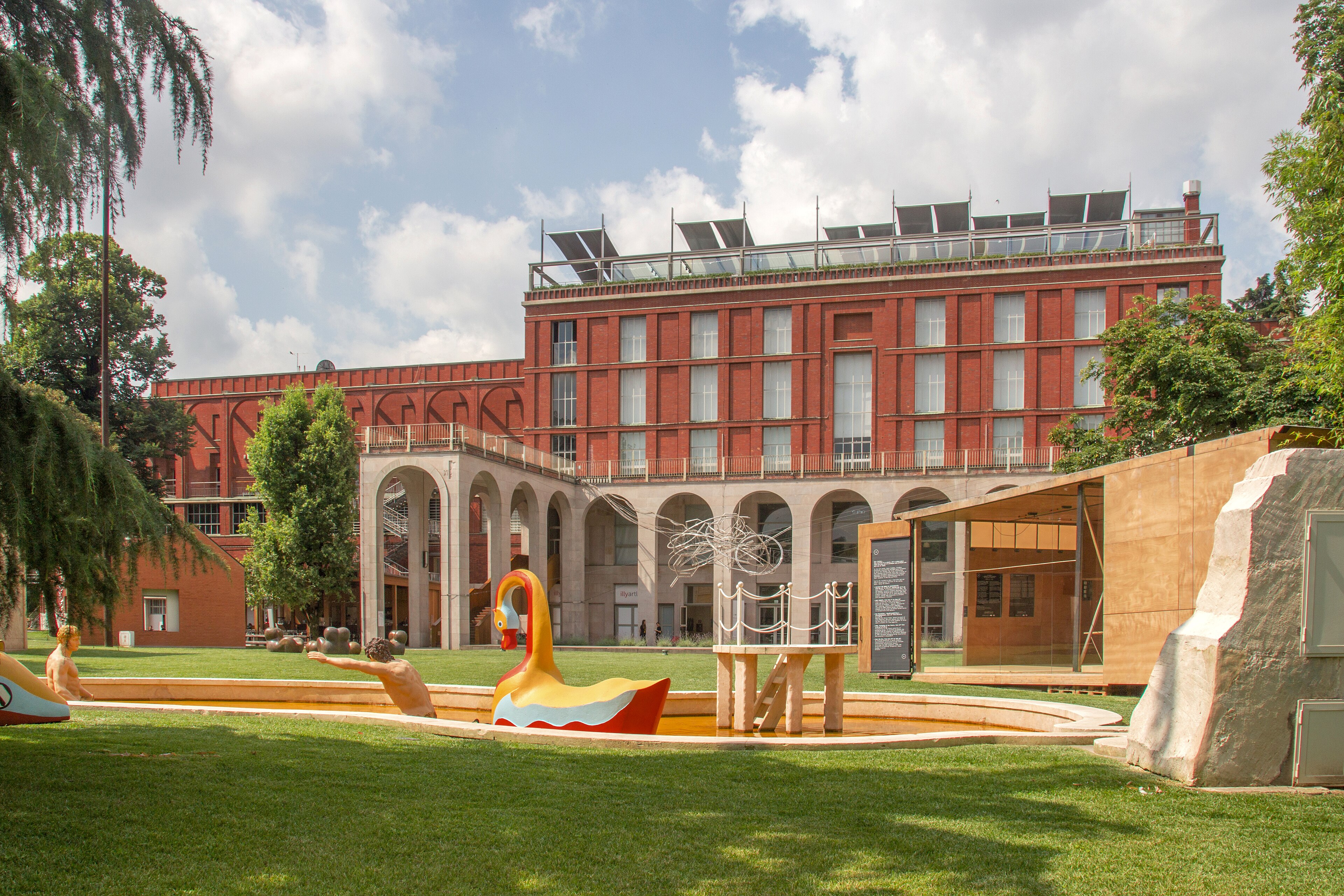
The Palazzo dell’Arte in Milan’s Parco Sempione, designed by Giovanni Muzio between 1931 and 1933, houses the Triennale di Milano, a museum dedicated to art and design. The building and its integrated Teatro dell’Arte were both conceived by Muzio and financed by industrialist Antonio Bernocchi and his brothers Andrea and Michele.
Muzio’s design exemplifies the stripped-down modernism of the Novecento Italiano movement, of which he was a central figure. The architect, born and died in Milan, established his practice in 1920 and became known for works that simplified classical forms into essential geometric language. The Palazzo dell’Arte represents a mature expression of this aesthetic applied to institutional architecture, combining functional exhibition and performance spaces within a rationalist framework.
About Giovanni Muzio
Giovanni Muzio (1893–1982) was closely associated with the Novecento Italiano artistic group and is credited with some of the movement’s most significant built works. After World War I service, he opened his Milan studio in 1920 and collaborated with prominent designers including Gio Ponti and Mario Sironi on major exhibitions and pavilions throughout the 1920s and 1930s.
Details
- Architect: Giovanni Muzio
- Construction: 1931–1933
- Location: Parco Sempione, Milan, Lombardy
- Financed by: Antonio Bernocchi and brothers Andrea and Michele
- Current use: Triennale di Milano museum; includes Teatro dell’Arte theatre
- Movement: Novecento Italiano
Frequently asked questions
Who designed the Palazzo dell’Arte?
Giovanni Muzio, a prominent Milan architect closely associated with the Novecento Italiano movement, designed both the palazzo and its integrated theatre between 1931 and 1933.
Where is the Palazzo dell’Arte located?
The building stands in Parco Sempione in Milan, Lombardy, in northern Italy, and houses the Triennale di Milano museum of art and design.
What is the architectural significance of the building?
The Palazzo dell’Arte exemplifies Novecento Italiano’s stripped-down neo-classical modernism, translating the movement’s aesthetic principles of simplified forms and essential geometry into a major institutional commission.
On the heritage map: Palazzo dell’Arte — Triennale di Milano by Giovanni Muzio


