In 1923, amid the technological flowering of Berlin, brothers Siegmund and David Ludwig Loewe founded their pioneering electronics laboratory. Dedicated to radio communication and vacuum-tube physics, Loewe catalyzed one of humanity’s decisive media revolutions: collaborating with brilliant physicist Manfred von Ardenne to present the world’s first fully electronic television broadcast at the 1931 Berlin Radio Exhibition.
From Vacuum Tubes to the First Electronic Television
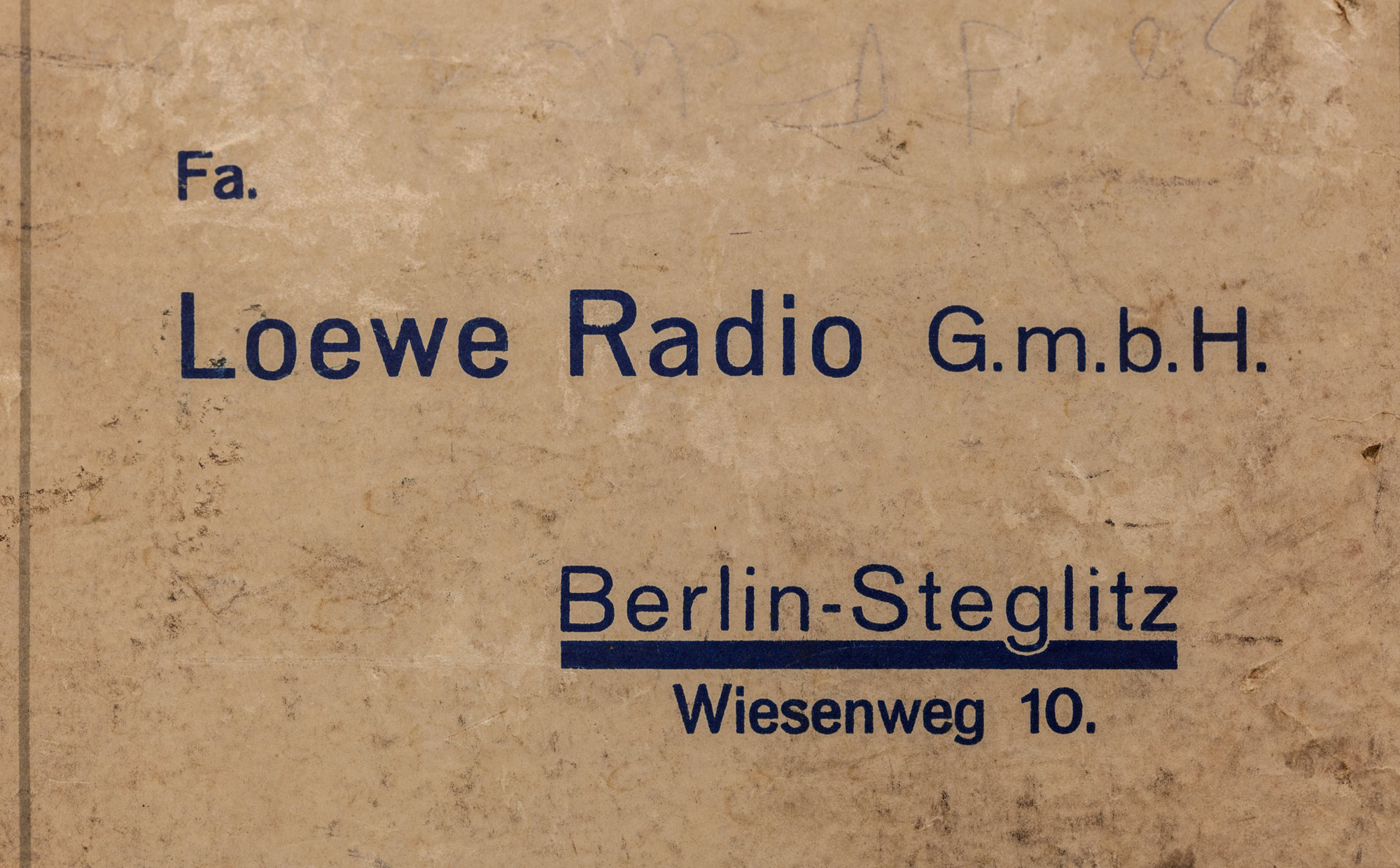
In January 1923, Dr. Siegmund Loewe established Radiofrequenz GmbH in Berlin-Friedenau alongside his brother David. Recognizing that early multi-tube radio receivers were exorbitantly expensive and mechanically cumbersome, Loewe engineered a monumental breakthrough in 1926: the 3NF multi-valve vacuum tube. By integrating three triodes, two capacitors, and four resistors into a single evacuated glass cylinder, Loewe created the direct conceptual ancestor of the modern integrated circuit, drastically lowering production costs and popularizing radio across Europe.
By 1930, Loewe’s laboratory had expanded into high-frequency image transmission. Working in tandem with young research physicist Manfred von Ardenne, Loewe achieved a historic milestone in 1931: transmitting continuous moving pictures using cathode-ray tubes without mechanical scanning discs. This breakthrough established Loewe as an indisputable pioneer of electronic broadcasting, cementing Berlin as an epicentre of twentieth-century telecommunications.
The Kronach Sanctuary: Bauhaus Aesthetics and High-End Heritage
Following wartime devastation and persecution under the Nazi regime, Loewe reconstituted its manufacturing headquarters in the historic Franconian town of Kronach, Upper Franconia, in 1948. Throughout the postwar decades, Loewe married relentless acoustic and visual innovation with minimalist German design, collaborating with Bauhaus-influenced industrial designers to create premium home entertainment systems that functioned as architectural furniture.
Today, Loewe’s Kronach campus remains an active center of German audio-visual craftsmanship. The brand’s centenary archive chronicles an unbroken thread of engineering idealism, proving that technological innovation reaches its highest expression when harmonized with timeless industrial form.
Fiera campionaria a Milano: innovazione tecnica ed elettronica
Immagini d'archivio storico dell'Istituto Luce che testimoniano l'evoluzione delle telecomunicazioni, dei ricevitori radiofonici e dell'ingegneria europea negli anni Venti e Trenta. (Fonte: Archivio Storico Istituto Luce Cinecittà)
Interactive 360° Heritage View: Loewe Global Headquarters & Manufacturing Campus
Historical Location: Industriestraße 11, 96317 Kronach, Bavaria, Germany (Coordinates: 50.2395, 11.341)
Sources
- S1 — Kilian, Andreas. Loewe: Innovationen im Rundfunkbau. Kronach, 2003. ISBN 978-3-00-011812-8.
- S2 — Borchert, Manfred. Geschichte der Rundfunktechnik in Deutschland. Franzis Verlag, 1998. ISBN 978-3-7723-4373-5.
Spotted an error? Write to editorial@culturalheritageonline.com and we correct it the same day.