
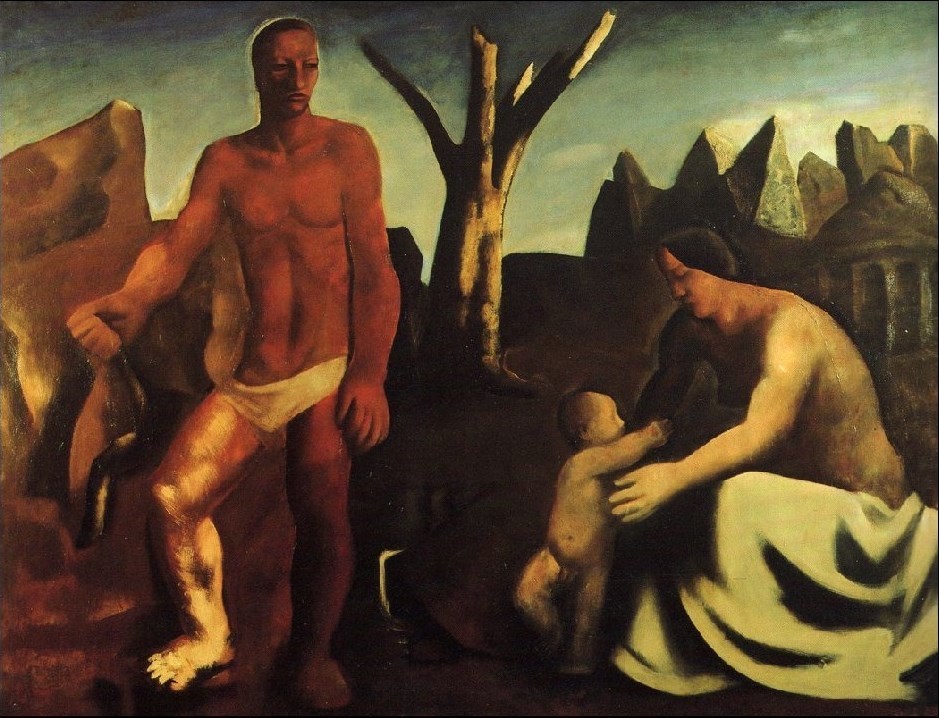
La Famiglia is a 1929 painting by Mario Sironi, an Italian Modernist artist known for his somber compositions built from massive, immobile forms. The work exemplifies Sironi’s mature style, developed across a career spanning painting, sculpture, illustration, and design.
Sironi was born in Sassari, Sardinia, in 1885 and spent his formative years in Rome, where he studied at the Accademia di Belle Arti. Early in his career, he worked in a Divisionist mode under Giacomo Balla’s influence, before developing the monumental aesthetic that defined his later practice. His artistic vocabulary drew on Modernist developments he encountered during visits to Germany and extended stays in Paris and Milan.
About Mario Sironi
Sironi (1885–1961) was a principal figure in Italian Modernism, active across multiple media. His work is distinguished by a brooding sensibility and sculptural approach to form, whether executed in paint or three dimensions. Throughout his career, he contended with severe bouts of depression, which inflected the gravity of his artistic vision.
Details
- Title: La Famiglia
- Creator: Mario Sironi
- Year: 1929
- Medium: Painting
- Movement: Italian Modernism
On video
Frequently asked questions
Who was Mario Sironi?
Mario Sironi (1885–1961) was an Italian Modernist painter, sculptor, illustrator, and designer. Born in Sassari, Sardinia, he studied at the Accademia di Belle Arti in Rome and was influenced early in his career by Giacomo Balla’s Divisionist method.
What characterizes Sironi’s artistic style?
Sironi’s work is marked by somber, monumental compositions built from massive, immobile forms. He developed this distinctive aesthetic through his engagement with Modernism and maintained it consistently across painting, sculpture, and design throughout his career.
When was La Famiglia created?
La Famiglia was painted in 1929, during the mature period of Sironi’s artistic practice when his characteristic style of weighty, immobile forms was fully developed.
Sources
- S1 — Pontiggia, Elena. Il Novecento Italiano. Abscondita, 2003. ISBN 978-88-8416-048-5.
- S2 — Ciucci, Giorgio. Gli architetti e il fascismo: architettura e città 1922-1944. Einaudi, 2002. ISBN 978-88-06-16310-5.
Spotted an error? Write to editorial@culturalheritageonline.com and we correct it the same day.


