
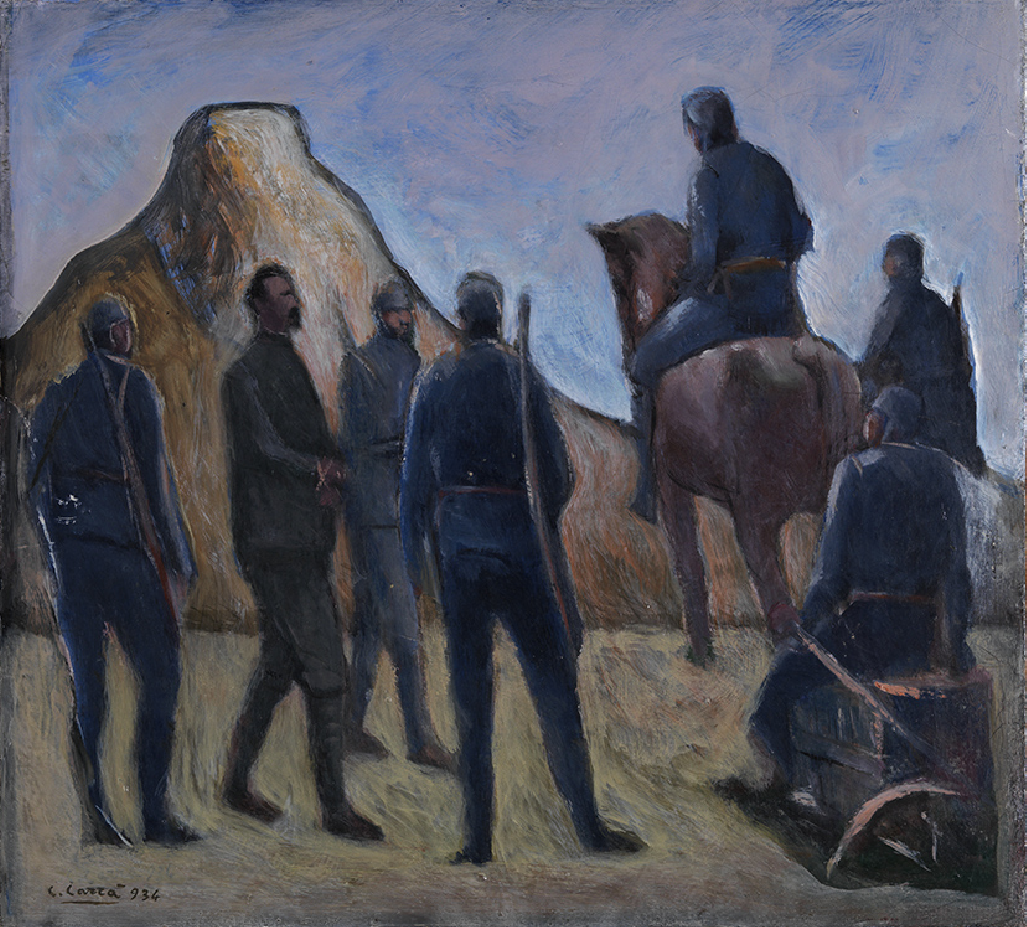
The Arrest of Cesare Battisti is a 1934 painting by Carlo Carrà, an Italian painter and leading figure of the Futurist movement that flourished in early twentieth-century Italy.
The work captures a pivotal moment in Italian political history. Cesare Battisti was a socialist politician and journalist whose arrest represented a significant episode in Italy’s experience during the First World War. Carrà’s treatment of the subject reflects his engagement with historical and narrative themes that occupied his practice in the 1930s, following the conclusion of his Futurist phase around the time of World War I.
About Carlo Carrà
Carrà (1881–1966) was born in Quargnento, Piedmont, and became a central figure in Italian modernism. After early work as a mural decorator, he studied at Brera Academy in Milan from 1906. In 1910 he signed the Manifesto of Futurist Painters alongside Umberto Boccioni, Luigi Russolo, and Giacomo Balla. He taught in Milan for many years and wrote extensively on art theory.
Details
- Artist: Carlo Carrà
- Date: 1934
- Subject: Cesare Battisti, Italian socialist politician and journalist
- Movement: Post-Futurism; historical narrative painting
On video
Frequently asked questions
Who was Cesare Battisti?
Cesare Battisti was an Italian socialist politician and journalist. His arrest occurred during the First World War and represents a significant moment in Italian political history.
What was Carlo Carrà’s artistic background?
Carrà was a leading Futurist who signed the Manifesto of Futurist Painters in 1910. He studied at Brera Academy in Milan and later taught there, eventually moving beyond Futurism to explore historical and narrative subjects.
When did Carrà move away from Futurism?
Carrà’s Futurist phase ended around the time World War I began. His subsequent work retained some Futurist concepts but increasingly focused on clearer historical and thematic concerns.
Sources
- S1 — Pontiggia, Elena. Il Novecento Italiano. Abscondita, 2003. ISBN 978-88-8416-048-5.
- S2 — Bossaglia, Rossana. Il Novecento italiano. Electa, 1995. ISBN 978-88-435-6178-0.
Spotted an error? Write to editorial@culturalheritageonline.com and we correct it the same day.


