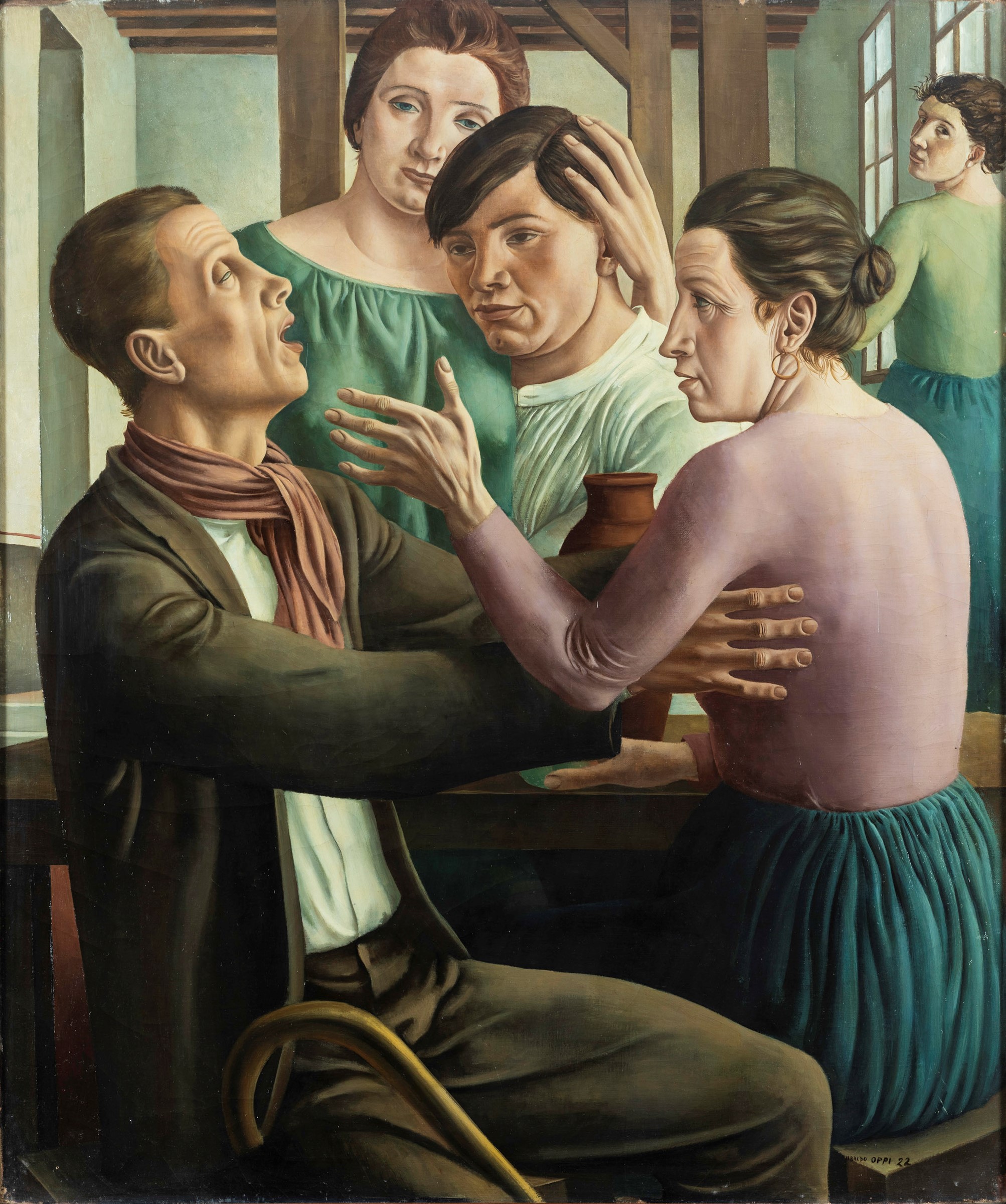
Il cieco e altre figure is a painting by Ubaldo Oppi created in 1922. The work exemplifies the neo-quattrocento realist style that defined Oppi’s artistic practice and the broader Novecento Italiano movement.
Oppi was among the founders of the Novecento Italiano in Milan, a movement that looked to Italian Renaissance precedent as a basis for modern figuration. His approach combined classical realism with contemporary sensibility, rejecting the experimental abstraction that dominated European avant-gardes in favour of legible, humanistic subject matter and formal discipline.
About Ubaldo Oppi
Born in Bologna in 1889, Oppi studied under Gustav Klimt in Vienna before establishing himself in Italian artistic circles. He exhibited at the Ca’ Pesaro in Venice in 1913 alongside other modernists, and participated in the Salon des Indépendants in Paris in 1921. His career unfolded across multiple European centres, synthesizing influences from Vienna, Paris, and Milan into a distinctly Italian modernist idiom.
Details
- Artist: Ubaldo Oppi
- Year: 1922
- Medium and style: Neo-quattrocento realist painting
- Movement: Novecento Italiano
On video
Frequently asked questions
Who was Ubaldo Oppi?
Ubaldo Oppi (1889–1942) was an Italian painter and co-founder of the Novecento Italiano movement in Milan. He trained under Gustav Klimt in Vienna and worked across Europe before establishing himself as a leading figure in Italian modernist realism.
What is the Novecento Italiano?
The Novecento Italiano was a movement centred in Milan that championed neo-quattrocento realist painting, drawing on Italian Renaissance tradition as a foundation for modern figuration and rejecting purely abstract approaches.
What subjects did Oppi typically paint?
Oppi painted in a figurative realist manner, as evidenced by works such as Il cieco e altre figure, which presents human subjects rendered with classical discipline and legible form.
Sources
- S1 — Pontiggia, Elena. Il Novecento Italiano. Abscondita, 2003. ISBN 978-88-8416-048-5.
- S2 — Ciucci, Giorgio. Gli architetti e il fascismo: architettura e città 1922-1944. Einaudi, 2002. ISBN 978-88-06-16310-5.
Spotted an error? Write to editorial@culturalheritageonline.com and we correct it the same day.