
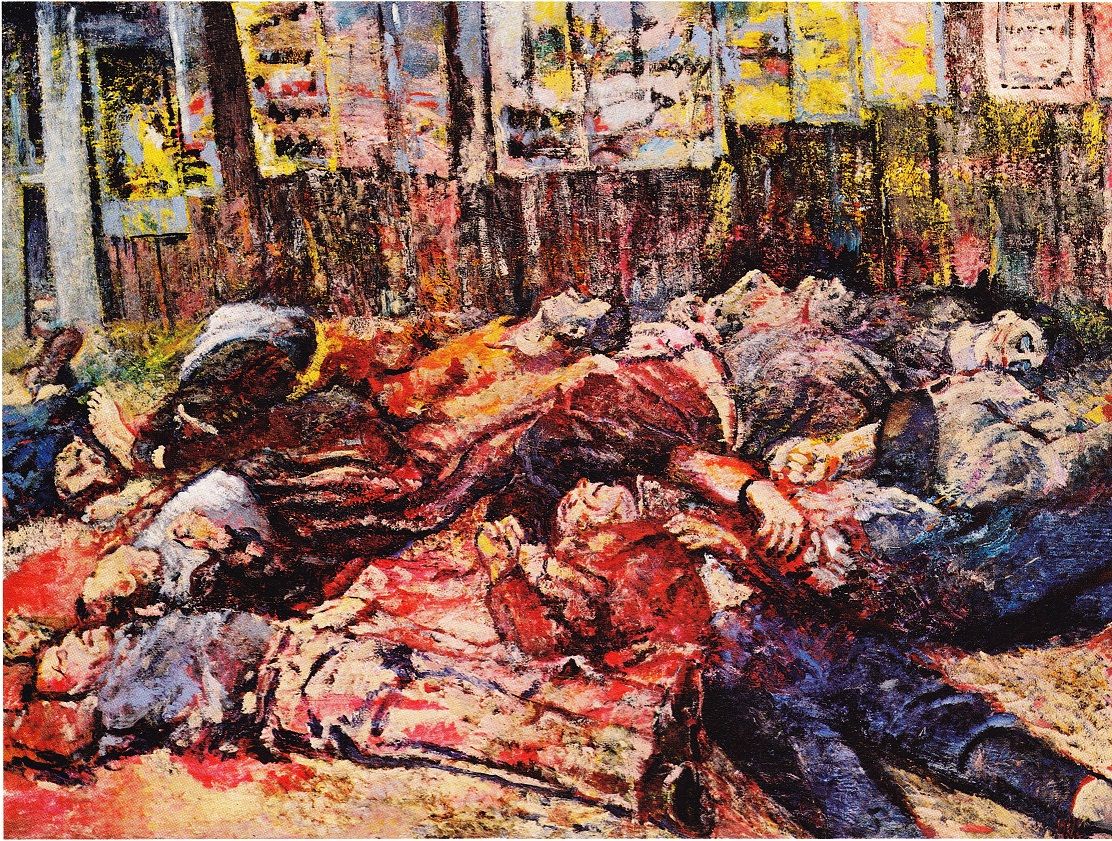
Guerra civile (The Martyrs of Piazzale Loreto) is a painting created by Italian artist Aligi Sassu in 1944. The work documents a moment of civil conflict during the final phase of World War II in Italy.
Sassu, born in Milan in 1912, developed his artistic practice through avant-garde movements of the interwar period. After studying at the Brera Academy of Fine Arts, he engaged with Futurism and co-authored the Manifesto della Pittura in 1928 alongside Bruno Munari, establishing principles of anti-naturalistic form that would inform his mature work. By the 1940s, Sassu had established himself as a significant modernist painter capable of addressing urgent historical subjects through the language of twentieth-century art.
The painting takes as its subject the events at Piazzale Loreto, a pivotal location in Italian wartime history. Working in 1944, during the period of civil war that accompanied Italy’s liberation and reconstruction, Sassu created a visual record of collective suffering and loss—a work that carries documentary weight alongside its modernist visual approach.
About Aligi Sassu
Aligi Sassu (1912–2000) was an Italian painter and sculptor born in Milan to a politically engaged family with roots in Sardinia and Emilia-Romagna. His engagement with avant-garde movements in the 1920s and 1930s positioned him to respond artistically to the turbulent events of the 1940s.
Details
- Artist: Aligi Sassu
- Date: 1944
- Medium: Painting
- Subject: The martyrs of Piazzale Loreto during Italian civil conflict
On video
Frequently asked questions
Who was Aligi Sassu?
Aligi Sassu (1912–2000) was an Italian painter and sculptor. Born in Milan, he studied at the Brera Academy of Fine Arts and co-authored the Manifesto della Pittura in 1928 with designer Bruno Munari, committing to anti-naturalistic forms and modernist practice.
What does the painting depict?
The work depicts the martyrs of Piazzale Loreto, a significant location during Italy’s wartime period. Created in 1944, it documents events from the Italian civil conflict accompanying the nation’s liberation and reconstruction.
What artistic movement did Sassu follow?
Sassu engaged with Italian modernism and Futurism in the 1920s and 1930s, developing principles of anti-naturalistic form. By 1944, he applied these modernist approaches to subjects of historical urgency and collective experience.
Sources
- S1 — Pontiggia, Elena. Il Novecento Italiano. Abscondita, 2003. ISBN 978-88-8416-048-5.
- S2 — Bossaglia, Rossana. Il Novecento italiano. Electa, 1995. ISBN 978-88-435-6178-0.
Spotted an error? Write to editorial@culturalheritageonline.com and we correct it the same day.


