
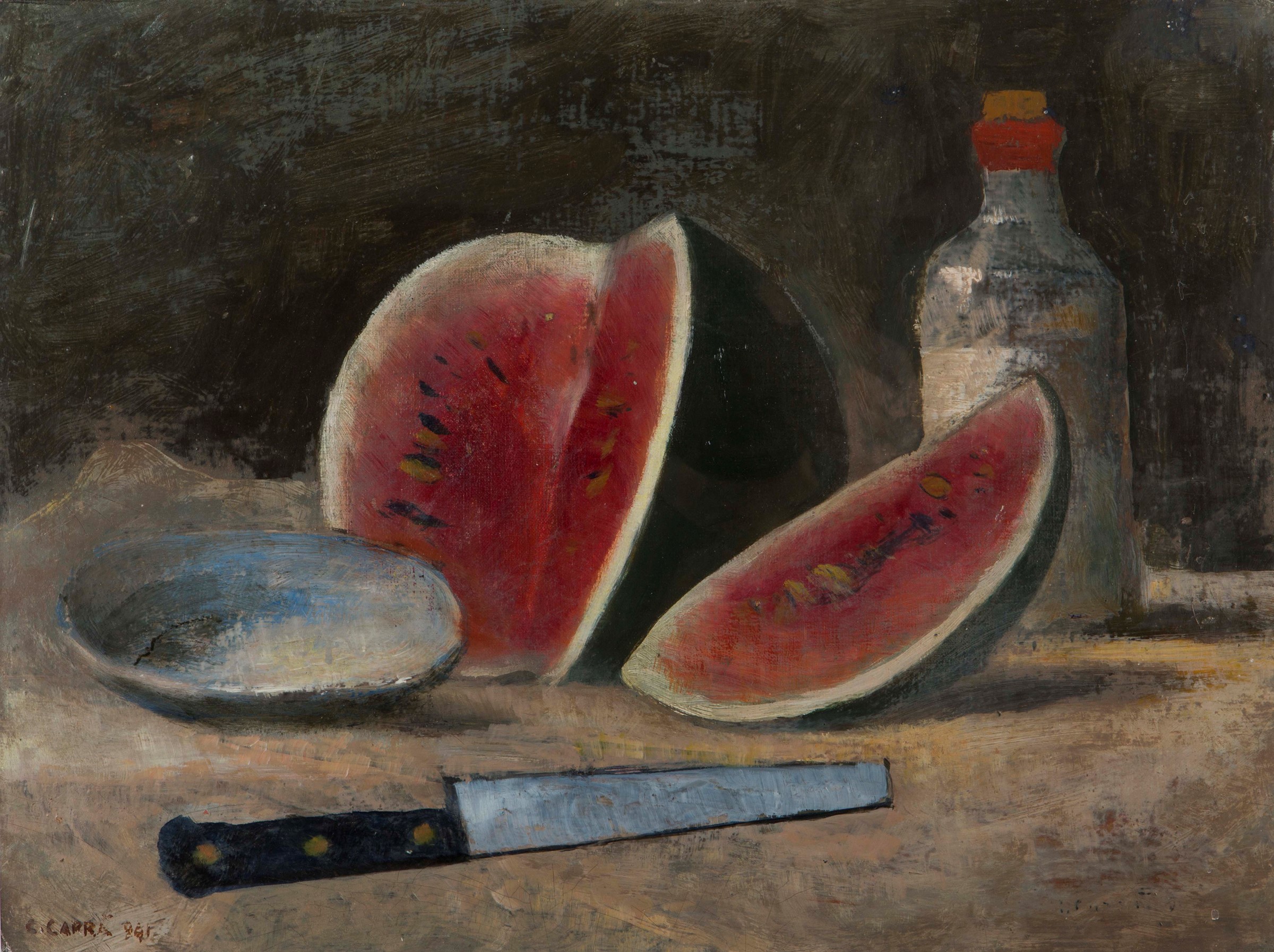
Cocomero is a painting by Carlo Carrà, completed in 1941. The work dates to the later phase of Carrà’s career, decades after his pioneering role in the Futurist movement.
Carrà was born in Quargnento, Piedmont, in 1881 and became a leading figure of Italian Futurism in the early twentieth century. He signed the Manifesto of Futurist Painters in 1910 alongside Umberto Boccioni, Luigi Russolo, and Giacomo Balla. After the First World War, his artistic practice evolved beyond strict Futurist principles, though he retained conceptual interests developed during that period. He spent many years teaching in Milan and continued to paint and write on art throughout his life until his death in 1966.
About Carlo Carrà
Carrà studied at the Brera Academy in Milan under Cesare Tallone and was exposed to contemporary French art during his time in Paris at the 1899–1900 Exposition Universelle. His early work as a mural decorator and his engagement with avant-garde movements shaped a distinctive approach to form and visual language that extended across his entire career.
Details
- Artist: Carlo Carrà
- Year: 1941
- Movement: Post-Futurism
Frequently asked questions
Who was Carlo Carrà?
Carlo Carrà was an Italian painter and a leading figure of the Futurist movement in early twentieth-century Italy. He signed the Manifesto of Futurist Painters in 1910 and later evolved his practice beyond Futurism while retaining key conceptual interests.
What was Carrà’s connection to Futurism?
Carrà was one of the founding signatories of the Futurist Painters’ Manifesto in 1910. His Futurist phase lasted until around the time of the First World War, after which his work developed in new directions.
Where did Carrà work?
Carrà spent many years teaching and working in Milan. He studied at the Brera Academy and maintained a long association with the city throughout his career.


