
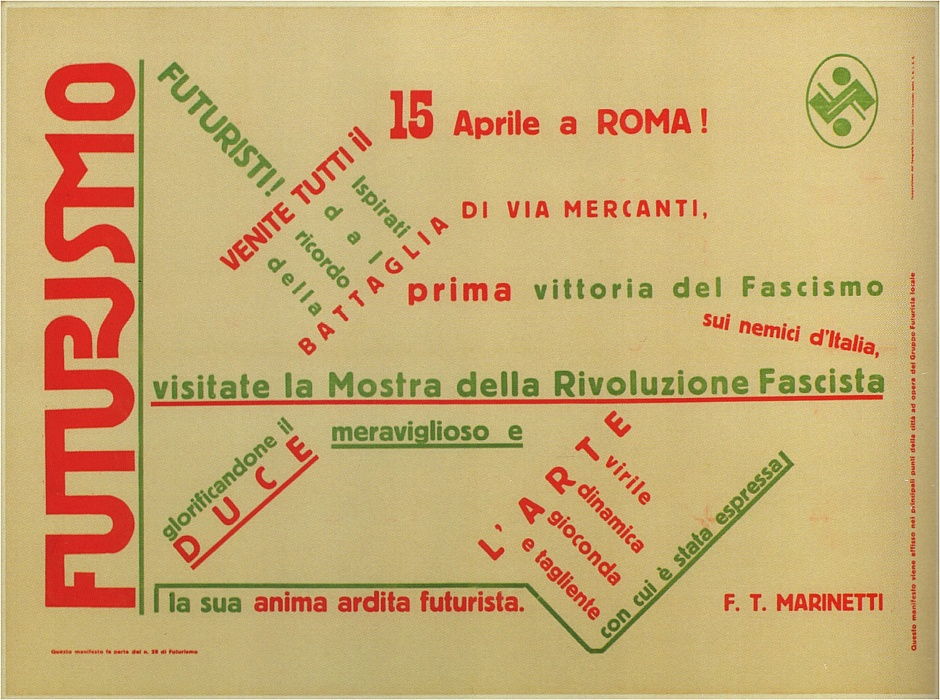
An advertising poster designed by Filippo Tommaso Marinetti in 1932, this work represents the application of Futurist principles to commercial communication. Marinetti, the Italian poet, editor and founder of the Futurist movement, brought his avant-garde sensibility to poster design during the interwar period.
Marinetti had gained international prominence through his 1909 Manifesto of Futurism, which called for the celebration of speed, violence and modernity. By 1932, when this poster was created, Futurism had evolved as both an artistic and cultural force in Italy. The poster exemplifies the movement’s dynamic approach to visual communication, translating Futurist aesthetics into a form intended for public display and commercial reach.
About Filippo Tommaso Marinetti
Marinetti was an influential figure in early twentieth-century art and literature. Beyond founding Futurism, he maintained connections to avant-garde circles, having been associated with the Abbaye de Créteil, an artistic and literary community, between 1907 and 1908. His theoretical writings and manifestos shaped European modernism and established frameworks for understanding art’s relationship to technology and speed.
Details
- Creator: Filippo Tommaso Marinetti
- Year: 1932
- Object type: Advertising poster
- Movement: Futurism
Frequently asked questions
Who designed this poster?
Filippo Tommaso Marinetti, the Italian poet and founder of the Futurist movement, designed this advertising poster in 1932.
What was Marinetti known for?
Marinetti is best known as the author of the Manifesto of Futurism, published in 1909, and as a co-author of the Fascist Manifesto in 1919. He was a central figure in establishing Futurism as a major artistic and literary movement.
What is Futurism?
Futurism was an avant-garde movement founded by Marinetti that celebrated modernity, speed, technology and dynamic energy, fundamentally challenging traditional artistic conventions.


