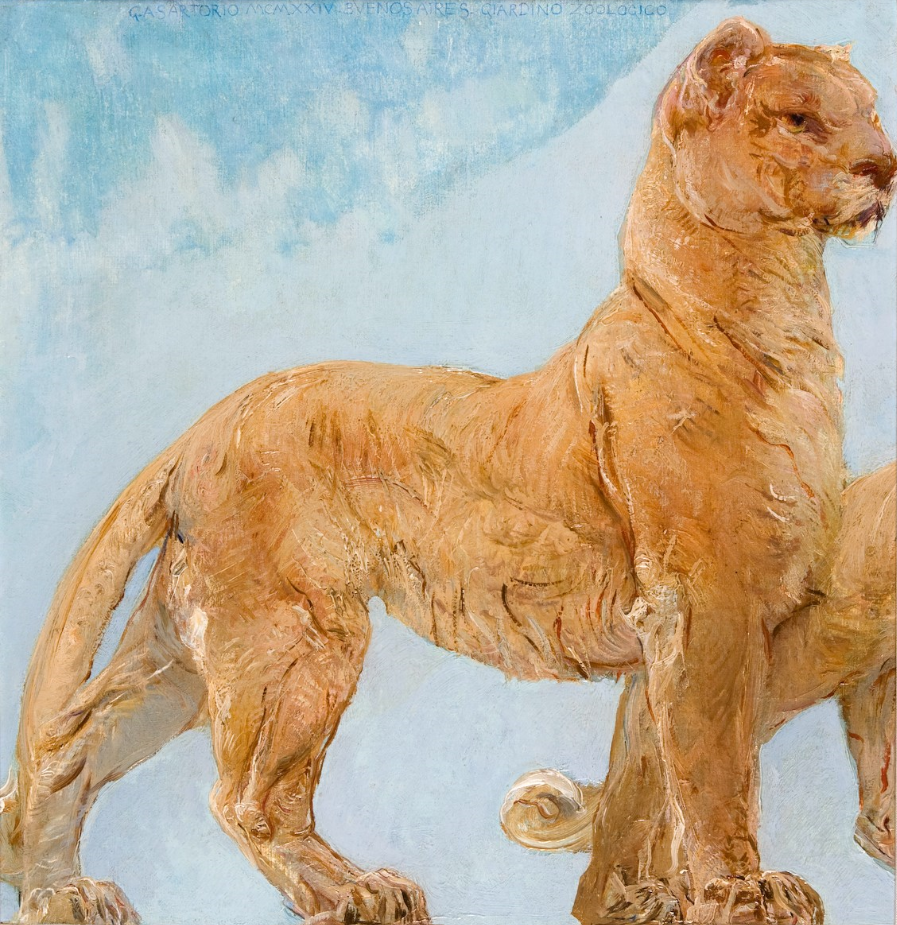
Leonessa is a painting by Italian artist Giulio Aristide Sartorio, completed in 1924. The work dates from the artist’s mature period, following his extensive travels through the Middle East, Japan and Latin America during the 1920s.
Sartorio’s career spanned from the late nineteenth century into the interwar era. After early recognition in Symbolist circles and participation in major international exhibitions—including the Paris Universal Exhibition of 1889, where he won a gold medal—he established himself as a prominent decorative painter. During the early 1900s, he created significant friezes for the Venice Biennale, major exhibitions in Milan, and Palazzo Montecitorio in Rome. Following World War I and his subsequent travels, Sartorio continued to develop his artistic practice, becoming a member of the Italian Royal Academy.
About Giulio Aristide Sartorio
Born in Rome in 1860, Sartorio trained at the Rome Institute of Fine Arts and developed connections with major literary and artistic figures of his time, including writer Gabriele D’Annunzio. He taught at the Weimar Academy of Fine Arts from 1896 to 1898 and maintained an international profile throughout his career until his death in 1932.
Details
- Artist: Giulio Aristide Sartorio
- Year: 1924
- Medium: Painting
- Period: Italian interwar period
On video
Frequently asked questions
Who was Giulio Aristide Sartorio?
An Italian painter and film director from Rome (1860–1932), Sartorio was trained at the Rome Institute of Fine Arts and became known for decorative fresco work and paintings. He won a gold medal at the Paris Universal Exhibition of 1889 and taught at the Weimar Academy before becoming a member of the Italian Royal Academy.
When was Leonessa created?
Leonessa was completed in 1924, during Sartorio’s later career following his extensive travels through the Middle East, Japan and Latin America during the 1920s.
What movements influenced Sartorio’s work?
Sartorio began his career within Symbolism, presenting a Symbolist work at the 1883 International Exposition of Rome, and was influenced by Pre-Raphaelite art after meeting those artists in England in 1893.
Sources
- S1 — Pontiggia, Elena. Il Novecento Italiano. Abscondita, 2003. ISBN 978-88-8416-048-5.
- S2 — Bossaglia, Rossana. Il Novecento italiano. Electa, 1995. ISBN 978-88-435-6178-0.
Spotted an error? Write to editorial@culturalheritageonline.com and we correct it the same day.