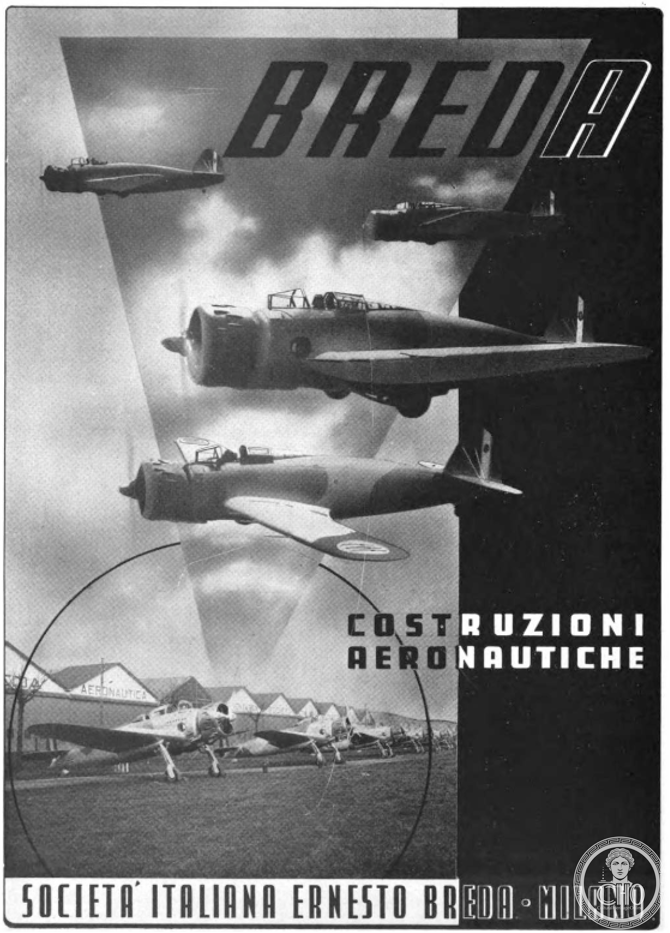
Four aircraft climb across the sheet from the lower left, one behind the other, cut out of their photographs and laid over a wedge of white light. Beneath them, in a circle, a second photograph: the same kind of machine drawn up in a row on grass, in front of a line of factory sheds with AERONAUTICA painted on the nearest gable. The trick is deliberate and it is the whole design — the aircraft are flying directly out of the place that made them.
The page is divided down the middle into a light half and a black half, with the wordmark BREDA set across the join so that its last letter reverses out of the dark. On the right, in the black, two lines of hollow capitals: COSTRUZIONI AERONAUTICHE. Along the bottom, in a heavy condensed face, the full company name: SOCIETÀ ITALIANA ERNESTO BREDA · MILANO.
The machines
The aircraft are single-engined low-wing monoplanes with radial engines and long glazed canopies over two crew positions — a pilot forward and a second man behind — and main wheels that hang partly below the wing rather than folding away into it. That last detail is the one worth pointing at: an aircraft whose undercarriage does not fully retract is an aircraft of the middle and later 1930s, and the arrangement was normal on the Italian assault and reconnaissance types of those years. The sheet does not name a type and we have not attributed one to it; the note that came with the scan proposes the Breda Ba.65, which is consistent with what is visible but is not written anywhere on the page.
An aircraft works inside a steel group
Breda’s aeronautical branch was one department of a very large and very mixed concern. The Società Italiana Ernesto Breda per Costruzioni Meccaniche was founded at Milan in 1886 by the Paduan engineer Ernesto Breda, and it worked simultaneously in mechanical engineering — railway rolling stock, aircraft, lorries, motorcycles, machine tools, agricultural and building machinery — and in steelmaking, metallurgy, shipbuilding and armaments. Aircraft came late, after the First World War, and ran through to 1945.
The design of the sheet is a statement about exactly that. Another advertiser would have shown the aircraft alone against the sky. This one insists on showing the sheds: the reader is meant to understand that the flying machines and the buildings are the same company, and that the company is big enough to own both halves of the picture. The companion sheet for the group’s foundry, which shows a pour and no product at all, makes the same argument from the other end of the process.
What is not settled
There is no signature on the page, no date and no printer’s line. The note that came with the scan proposes about 1937–40 and publication in the aeronautical press; the aircraft in the photographs are compatible with those years, but the dating is not documented and the article is published without an author.
About this image. The work is still protected by copyright: under Italian law (L. 633/1941) rights run for 70 years from the death of the author. Since the author has not been identified, that term cannot be considered expired, and the image is treated as fully protected. It is reproduced here for documentation, study and critical purposes only, under Art. 70 of L. 633/1941 and the fair-use provision of 17 U.S.C. §107. The scan was made by the collector from his own copy of the sheet, part of the period material he keeps in a private archive: owning the physical sheet is not the same as holding the rights to the work. The image is not offered for sale, no reproduction rights are granted, and any request concerning the work should be addressed to the rights holders. Cultural Heritage Online publishes this material to document it, with no celebratory intent; see our terms and the DMCA contact published there.
Sources
- S1 — Curami, Andrea, e Gianni Rocca. I Breda: Aerei e progetti della Società Italiana Ernesto Breda. La Bancarella Aeronautica, 1998. ISBN 978-88-88402-06-2.
- S2 — Castronovo, Valerio. L'industria italiana dall'Ottocento a oggi. Mondadori, 1980. ISBN 978-88-04-17765-4.
Spotted an error? Write to editorial@culturalheritageonline.com and we correct it the same day.