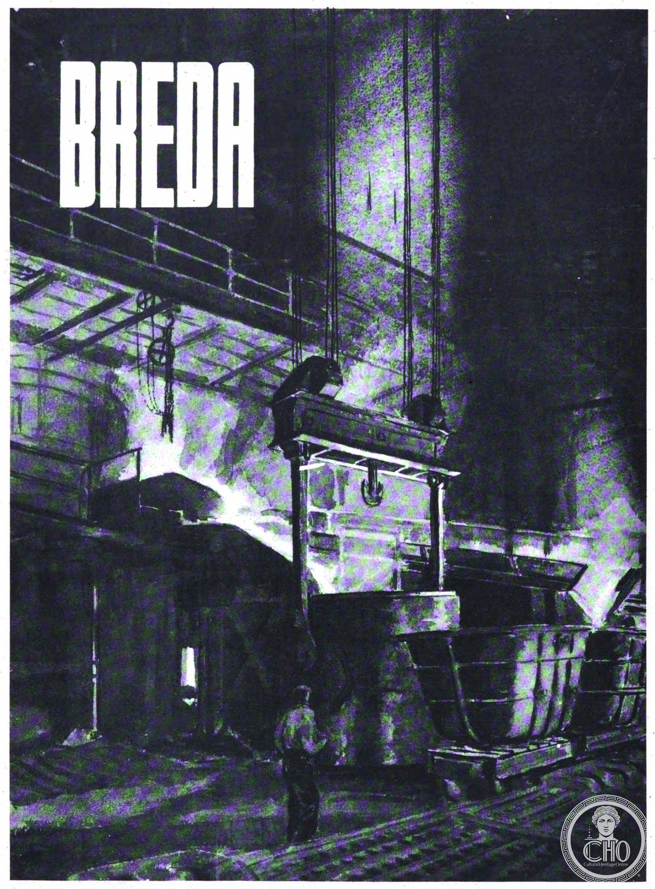
There is no product on this sheet. There is a shed with a roof too high to see, an overhead crane, two enormous ladles on a bogie, a white glare where the metal is running, and one man standing at the bottom of the picture with his back to us. In the top left corner, in a single heavy word: BREDA.
The drawing is done in a coarse tone that the printing has pushed towards a bluish black, so that everything is dark except the pour itself and the light it throws on the girders. The composition is entirely conventional and entirely effective: the diagonals of the crane cables, the mass of the ladles, the small figure put in at the foot for scale. It is the industrial sublime as the 1930s and 1940s understood it, and it is being used as a business card.
What is being advertised
The answer is: capacity. The Società Italiana Ernesto Breda per Costruzioni Meccaniche was founded at Milan in 1886 by Ernesto Breda, an engineer from the province of Padua, and by the years this sheet was printed it was one of the largest industrial groups in the country, working across mechanical engineering — railway rolling stock, civil and military aircraft, lorries, machine tools, agricultural and construction machinery — and across steelmaking, metallurgy, shipbuilding and armaments. Aircraft production had begun after the First World War and ran to the end of the Second.
A group of that shape does not sell one thing, and cannot draw one. What it can draw is the place where all of it starts: the furnace. The sheet says, in effect, that whatever the reader needs made, it will be made out of steel that Breda has poured itself. That was the argument of the vertically integrated firm, and in the years of autarky it was also a political argument, since the alternative to pouring your own steel was buying somebody else’s.
The man at the bottom
The figure is the only thing in the picture that is not machinery, and he is drawn small, dark and anonymous, in overalls, standing still. He is there because without him the ladles would have no size; the picture needs a man in order to be about steel. It is worth noticing how completely the composition subordinates him — and worth noticing that a foundry in 1940 was in fact full of men, doing the work that the sheet turns into weather.
What is not settled
Neither the date nor the hand is established. The note that came with the scan proposes about 1940–43 and publication in a magazine such as Lo Stile or L’Ala d’Italia; we have not been able to check that, and the sheet carries no signature, no date and no printer’s line. What it carries is the name, the subject and the manner, and those place it securely enough in the industrial advertising of the late 1930s and the war years. The article is published without an author.
About this image. The work is still protected by copyright: under Italian law (L. 633/1941) rights run for 70 years from the death of the author. Since the author has not been identified, that term cannot be considered expired, and the image is treated as fully protected. It is reproduced here for documentation, study and critical purposes only, under Art. 70 of L. 633/1941 and the fair-use provision of 17 U.S.C. §107. The scan was made by the collector from his own copy of the sheet, part of the period material he keeps in a private archive: owning the physical sheet is not the same as holding the rights to the work. The image is not offered for sale, no reproduction rights are granted, and any request concerning the work should be addressed to the rights holders. Cultural Heritage Online publishes this material to document it, with no celebratory intent; see our terms and the DMCA contact published there.
Sources
- S1 — Bigatti, Giorgio. La fabbrica delle macchine: L'Ernesto Breda e la grande industria meccanica a Milano. Guerini e Associati, 1999. ISBN 978-88-8335-062-7.
- S2 — Castronovo, Valerio. L'industria italiana dall'Ottocento a oggi. Mondadori, 1980. ISBN 978-88-04-17765-4.
Spotted an error? Write to editorial@culturalheritageonline.com and we correct it the same day.