Five addresses between the Opéra and the rue de Rivoli, where Art Nouveau went public in the department stores: the Galeries Lafayette, Printemps, the Café de la Paix, Maxim’s and Angelina.
Art Nouveau you can walk into
Paris did not build Art Nouveau so much as fit it inside. The great set pieces of the style in this city are interiors, entrances and shopfronts, and the department stores are where it went public: buildings designed to make a customer walk in out of curiosity and stay for the afternoon. The walk below takes five addresses within a kilometre of each other, along the boulevard Haussmann and round the Opéra. It is 2.6 kilometres and about two and a half hours with time to sit down.
Two department stores, two domes
The Galeries Lafayette on boulevard Haussmann is the one everybody photographs. The neo-Byzantine glass-and-steel dome was finished in 1912, and it is worth going in just to stand under it: the balconies ring the atrium, the light comes down through coloured glass, and for a minute the shop turns into a theatre. Entry is free, and from the roof you can see the Opéra.
Next door, Printemps was rebuilt by Paul Sédille in 1883 and then crowned in 1923 with a stained-glass cupola. The two stores were rivals, and they still are: it is worth going into both, since they are a minute apart and the domes are completely different answers to the same problem.

The corner of the Opéra
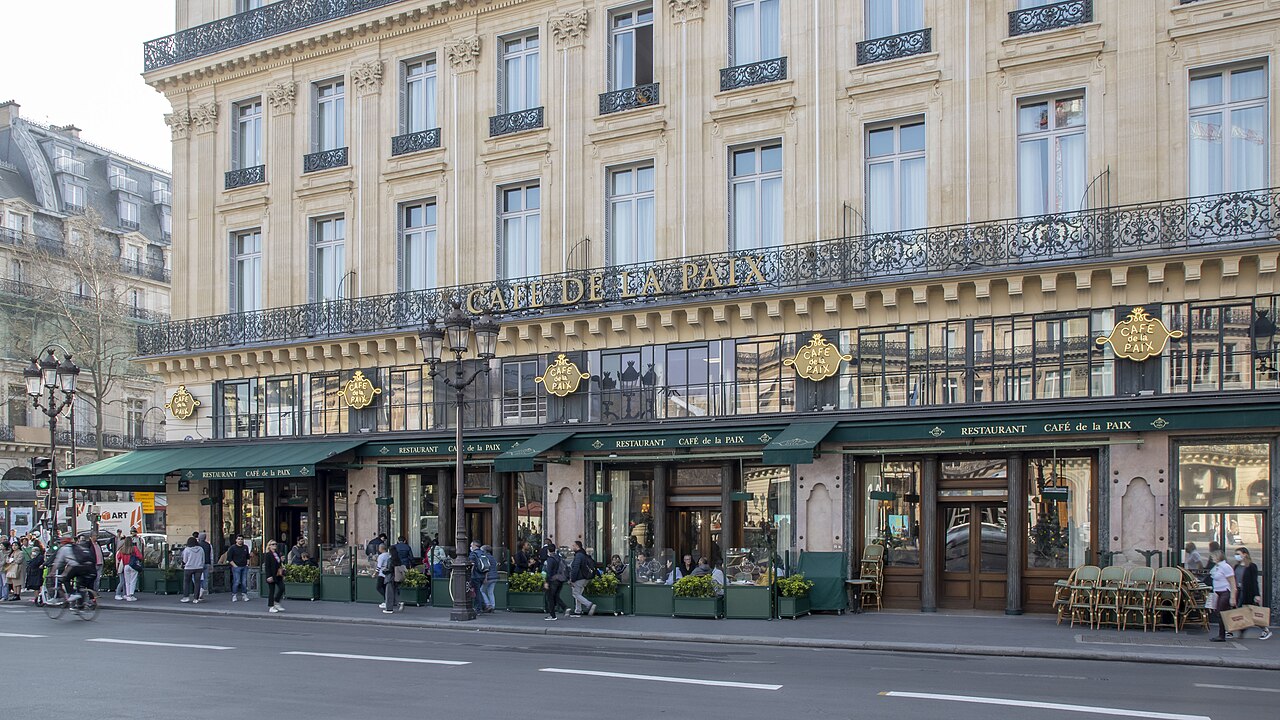
Walk down to the Place de l’Opéra and sit at the Café de la Paix. It opened on 30 June 1862 to serve the Grand-Hôtel, and the same architect, Alfred Armand, designed both in the Napoleon III style. The café faces Garnier’s opera house across the square it was built for, and the interior has been a historic monument since 1975: painted ceilings, gilt and mirrors, and waiters who have seen everything.
From the square, the walk turns into rue Royale to Maxim’s. The restaurant was given its Art Nouveau interior in 1899, for the Exposition of 1900: stained glass, mahogany and bevelled mirrors, in a building that looks small from the street. It is still a restaurant, and the dining room is the reason to book a table rather than photograph the door.

Tea at the end
The last stop is Angelina, at 226 rue de Rivoli. It opened in 1903, founded by the Austrian confectioner Antoine Rumpelmayer, and it has been a tea house for a very long time: the hot chocolate is the thing people queue for, and the room is the kind of interior the word Belle Époque was invented for. Sit down; the walk is over.
The full route, with the order of the stops and the distances, is on the Art Nouveau in Paris walking tour page. The department stores are busiest on Saturday afternoons; weekday mornings are quieter, and the light through the domes is better.

Sources
- Galeries Lafayette Haussmann · https://culturalheritageonline.com/places/galeries-lafayette-haussmann/
- Printemps Haussmann · https://culturalheritageonline.com/places/printemps-haussmann/
- Café de la Paix · https://culturalheritageonline.com/places/cafe-de-la-paix-paris/
- Maxim’s · https://culturalheritageonline.com/places/maxims-paris/
- Angelina · https://culturalheritageonline.com/places/angelina-paris-the-1903-tea-house-on-the-rue-de-rivoli/
- Art Nouveau in Paris walking tour · https://culturalheritageonline.com/itineraries/art-nouveau-paris-walking-tour/
Spotted an error? Write to [email protected] and we correct it the same day.