

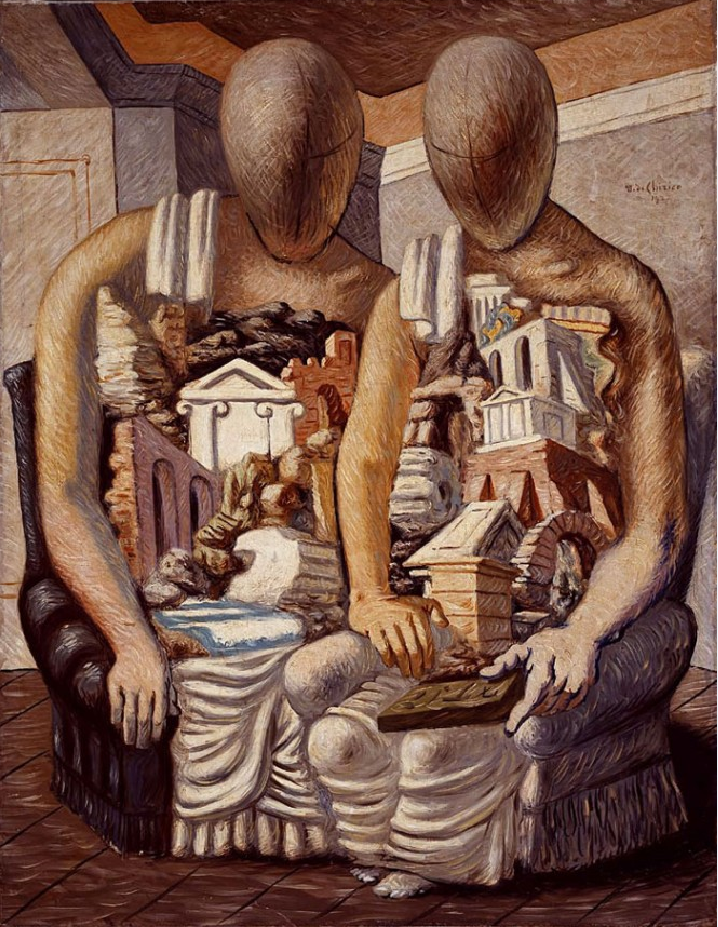
Archeologi is a painting by Giorgio de Chirico, created in 1927. The work exemplifies the metaphysical style that de Chirico developed and continues to refine throughout his career, employing the visual vocabulary for which he is renowned: classical architecture, enigmatic figures, and spatial disorientation.
The composition draws on de Chirico’s enduring preoccupations with Roman arcades, mannequins, and impossible perspective—elements that emerged from his philosophical alignment with Schopenhauer and Nietzsche, as well as his deep connection to classical mythology. These formal and conceptual concerns have shaped his influence on Surrealism and modern art more broadly since the founding of the scuola metafisica in the years before World War I.
About Giorgio de Chirico
De Chirico is a Greek-Italian artist and writer born in Volos, Greece. He founded the scuola metafisica art movement, which profoundly influenced Surrealist practitioners. His imagery consistently reflects philosophical inquiry and mythological resonance, establishing him as a pivotal figure in twentieth-century modernism.
Details
- Artist: Giorgio de Chirico
- Year: 1927
- Movement: Scuola metafisica (Metaphysical art)
- Medium: Painting
On video
Frequently asked questions
Who was Giorgio de Chirico?
Giorgio de Chirico was a Greek-Italian artist and writer born in Volos, Greece. He founded the scuola metafisica art movement before World War I, which profoundly influenced Surrealism.
What is the scuola metafisica?
The scuola metafisica is an art movement founded by de Chirico in the years before World War I. It is characterized by mysterious compositions featuring classical architecture, mannequins, long shadows, and disorienting spatial relationships, reflecting philosophical inquiry into the nature of reality.
What are the recurring elements in de Chirico’s work?
De Chirico’s best-known works feature Roman arcades, long shadows, mannequins, trains, and illogical perspective. His imagery reflects his affinity for the philosophy of Schopenhauer and Nietzsche, and for the mythology of his Greek birthplace.
Sources
- S1 — Pontiggia, Elena. Il Novecento Italiano. Abscondita, 2003. ISBN 978-88-8416-048-5.
- S2 — Bossaglia, Rossana. Il Novecento italiano. Electa, 1995. ISBN 978-88-435-6178-0.
Spotted an error? Write to the editors and we correct it the same day.
At auction this weekPaintings, drawings and sculpture change hands at auction every weekOils, works on paper and signed prints are open for bidding today on Catawiki, where an expert checks each lot before it goes live.See what is open on Catawiki →


Advertisement. Pictured, from the Cleveland Museum of Art (CC0) and not for sale: Modigliani, Renoir, Toulouse-Lautrec. How we handle this