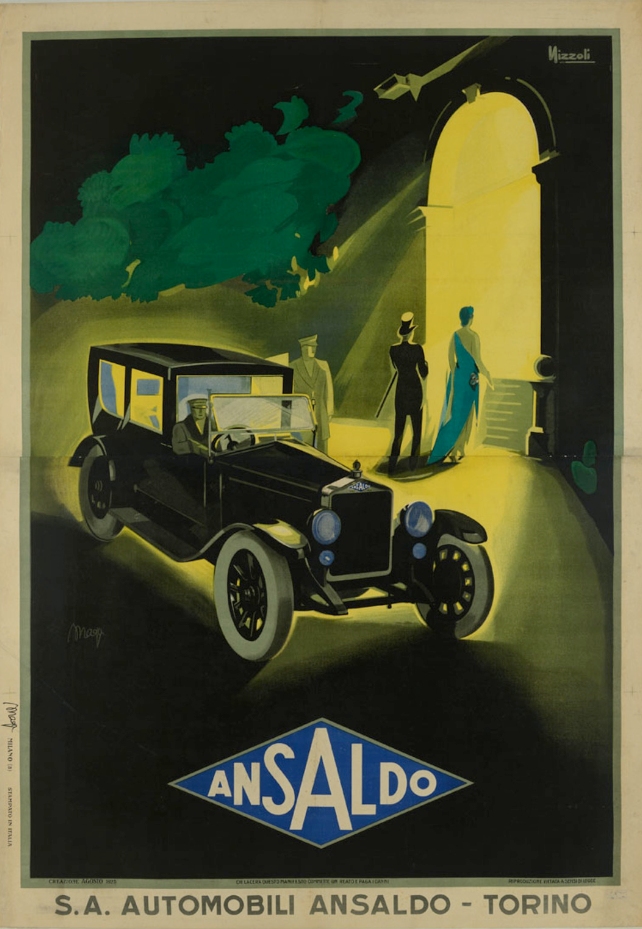
An advertising poster designed by Marcello Nizzoli in 1929, this work exemplifies the Italian graphic designer’s versatile engagement with avant-garde movements during the interwar years.
Nizzoli trained at the Accademia di Belle Arti in Parma, graduating in 1913, and subsequently established himself as a draughtsman in Milan. His early career was shaped by exposure to Futurism and the influential work of Fortunato Depero. By the 1920s, Nizzoli had become a sought-after designer for prominent commercial clients, creating poster advertisements for brands including Campari and Martini. During the fifteen years following World War I, he demonstrated facility across diverse avant-garde vocabularies—Futurism, Cubism, Viennese Secession, and Novecento Italiano—adapting these languages to appeal to his cultivated middle-class clientele. His graphic work of this period reflects the era’s intersection of artistic innovation and commercial design.
About Marcello Nizzoli
Nizzoli’s career extended far beyond graphic design. He would later become chief designer for Olivetti, the celebrated typewriter manufacturer, and gained widespread recognition for his work on the Lettera 22 portable typewriter in 1950. His ability to move fluidly between poster design, industrial design, and architecture established him as a defining figure in twentieth-century Italian design.
Details
- Designer: Marcello Nizzoli
- Year: 1929
- Object type: Advertising poster
- Movement: Futurism, Cubism, Novecento Italiano
Frequently asked questions
Who designed this poster?
Marcello Nizzoli (1887–1969), an Italian artist, architect, and graphic designer, created this work. He was known for his diverse practice across poster design, fashion accessories, and industrial design, and later became chief designer for Olivetti.
What artistic movements influenced this work?
Nizzoli’s early formation was shaped by Futurism and the work of Fortunato Depero. During the 1920s, he synthesized influences from Cubism, Viennese Secession, and Novecento Italiano, adapting them to suit commercial and middle-class taste.
What was Nizzoli’s broader significance in design?
Beyond his interwar poster work for clients such as Campari and Martini, Nizzoli became internationally recognized through his role as chief designer for Olivetti, where he designed the iconic Lettera 22 portable typewriter.
Sources
- S1 — Menegazzi, Luigi. Il manifesto italiano: 1882-1925. Electa, 1995. ISBN 978-88-435-5134-7.
- S2 — De Fusco, Renato. Storia del design. Laterza, 2002. ISBN 978-88-420-6623-1.
Spotted an error? Write to editorial@culturalheritageonline.com and we correct it the same day.