
Curated Itinerary
Bolzano 1919–1945: A Walking Tour of the Fascist City
Four buildings, 3.2 kilometres, two and a half to three hours. This itinerary traces the built legacy of Italian fascism in Bolzano — the most politically…
Take this route into Google Maps
From Monumento alla Vittoria — Bolzano’s Fascist Triumphal Arch by Marcello Piacentini (1928) to Palazzo delle Poste Bolzano — A Habsburg Post Office Altered by the Fascist Regime (1889 / 1930s), in the order we curated them.
➤ Turn on the navigator in Google MapsIt opens in the Google Maps app with every stop already loaded, in the order we put them in. From there the route is yours: pick how you travel — on foot, by bike, by public transport or by car — change where you start and where you end, drag the stops into a different order, and add places of your own along the way.
Bolzano 1919–1945: A Walking Tour of the Fascist City
Four buildings, 3.2 kilometres, two and a half to three hours. This itinerary traces the built legacy of Italian fascism in Bolzano — the most politically contested urban landscape in postwar Europe. The city was Austrian until 1919, German-speaking until the fascist Italianisation programme began in 1923, German-occupied from 1943 to 1945, and bilingual under the 1972 Second Statute of Autonomy since then. None of the buildings on this route have been demolished. Most are still in active use.
Get this route — explore at your own pace
The walk and the notes are open to everyone, right here. To take the route with you — the GPX and KML tracks for your phone — you need a CHO account, and a free one is enough. We do not sell these routes: we build them ourselves and give them to the people who read us.
Create a free accountAlready have one? Log in.
This route was built with the tools we give operators.
Guides, associations and cultural operators build their own routes here: pick the stops from the archive, add your notes, and the map, the GPX and the printable version come out on their own. Your programme gets a permanent page, your events go on the city pages people read while planning — and if you sell your route as a road-book or a virtual tour, you receive 80% of the price net of tax.
See how an operator account worksBefore you go
A word from your host
This is a walk through a city where the architecture of coercion never became the architecture of the past. Bolzano is the only major city in western Europe where a German-speaking majority lives under Italian national sovereignty — an arrangement imposed by the 1919 Treaty of Saint-Germain-en-Laye and contested ever since. The buildings you will see were not built for a neutral purpose: they were built to assert, to intimidate, to erase, and to replace. The train station replaced an Austrian original. The triumphal arch replaced a customs house. The party headquarters carried a bas-relief that weighed 95 tonnes and depicted the man who had told the city's majority population to emigrate or disappear. What makes Bolzano different from the standard "fascist architecture" itinerary is that the German-speaking population never left, and never agreed that any of it was their heritage. Walking through the city with that knowledge changes what you see.
Getting around
Bolzano is compact and entirely walkable; this itinerary covers approximately 3.2 kilometres in total and takes 2.5–3 hours including time at each stop. The city centre is pedestrianised. Bolzano/Bozen station is served by Trenitalia intercity trains from Verona (1h 40m), Trento (45m), and international Eurocity services from Innsbruck (1h) and Munich (2h 30m). By car: the A22 Autostrada del Brennero exits at Bolzano Nord or Bolzano Sud; paid parking is available at the station and at Piazza Walther. The itinerary can be done in any season, but spring and autumn are most comfortable for walking.
Step by step
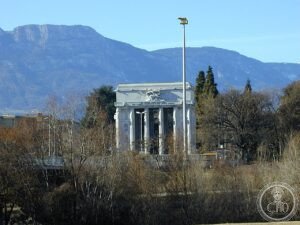
Monumento alla Vittoria — Bolzano’s Fascist Triumphal Arch by Marcello Piacentini (1928)
Begin at the rear entrance on Via del Brennero to enter the BZ '18–'45 museum in the crypt before seeing the exterior.
The storyMarcello Piacentini submitted his design for the Monumento alla Vittoria in 1924, the year Mussolini suspended parliament. The site chosen was the location where the Austrian customs house had stood — a deliberate act of substitution, replacing a border control point for the old empire with a triumphal arch for the new Italian power. The D'Annunzio inscription — "Hic patriae fines siste signa / Hinc ceteros excoluimus lingua legibus artibus" — provoked immediate protest from the German-speaking population, who read the phrase "we educated others" as a declaration that their language and culture were inferior. The inscription was proposed for removal as early as 1946 and has survived every subsequent political crisis. When the BZ '18–'45 museum was opened in the crypt in 2014, the exterior was deliberately left unchanged: the museum curators argued that contextualising the monument from within, while leaving the exterior legible, was more honest than alteration.
Insider tipMost visitors photograph the arch from the front, but the political weight is better read from the rear, on Via del Brennero, where the museum entrance is located and where you can see the crypt door and small plaques of post-war contextualisation. The statue above the arch is 'Vittoria Sagittaria' — firing an arrow northward toward Austria. This is the detail that made the monument permanently inflammatory to German-speaking Südtiroler.
A fitting stopCafés on the north side of Piazza della Vittoria. Café Colombo, a five-minute walk east toward Piazza Walther, is a good choice for coffee before starting the walk.

Stazione di Bolzano — Angiolo Mazzoni’s Railway Station for an Annexed City (1927-1929)
Walk west along Via Garibaldi toward the city centre after visiting the station.
The storyAngiolo Mazzoni was the most productive architect in fascist Italy's state infrastructure programme. Between the early 1920s and his departure for Colombia in 1949, he designed or oversaw the reconstruction of dozens of railway stations and hundreds of post offices, from Agrigento in the far south to Bolzano at the edge of the Alps. His approach was consistent: strip away the historical eclecticism of the previous century and replace it with a rationalist monumentalism — flat surfaces, controlled ornament, imposing scale — that communicated the efficiency and authority of the modern fascist state. At Bolzano, the political stakes were higher than elsewhere: this was a city that had been Austrian a decade earlier, and the station was the first significant piece of Italian state architecture that arriving travellers from the north would encounter. The sculptor Ehrenhöfer was Austrian, which raises questions about the degree of cultural flexibility the regime was willing to exercise at the frontier, where Italian nationalist assertion had to coexist with the practical reality of a German-speaking workforce and artistic community.
Insider tipThe St Christopher fountain is inside the main hall, in a corner that most passengers pass without noticing; it is one of the quieter Ehrenhöfer pieces in the station. The masks on the external cornices are best seen by standing at the far end of the platform access and looking back along the roofline. The clock tower is most legible from the Piazza della Stazione forecourt, in the late afternoon when the low sun hits the stone from the west.
A fitting stopSeveral bars and a café operate inside the station concourse. For a better option, walk north on Via Garibaldi toward Piazza Walther, where cafés line the square.

Casa del Fascio (Bolzano) — Mussolini’s Bas-Relief and the Hannah Arendt Counter-Monument (1939-1942)
Read the Arendt installation and the infopoint panels before examining the Piffrader relief from across the piazza.
The storyHans Piffrader was born in Klausen/Chiusa, in what is now South Tyrol, in 1888 — a subject of the Austro-Hungarian Empire who became, under annexation, an Italian citizen. He studied in Vienna and Munich and built a career as a figurative sculptor in the interwar period. His commission for the Casa del Fascio bas-relief, executed between 1939 and 1942, was the largest work of his career and the most politically compromised. The relief depicts Mussolini on horseback delivering the Roman salute — a leader who had, at that precise moment, offered Piffrader's community the choice of emigration or cultural erasure through the Optionszwang. Whether Piffrader's motives were opportunistic, coerced, or genuinely ideological is not documented in accessible sources; what remains is the 95-tonne result. The Hannah Arendt quotation installed in 2017 — 'No one has the right to obey' — was chosen specifically because Arendt's analysis of totalitarianism addressed the moral failure of individuals who participated in regimes by following orders. It is addressed to the figures in the relief, and by extension to their sculptor.
Insider tipThe relief is best read from the far side of Piazza del Tribunale, where the full 36-metre width is visible as a coherent composition. From the colonnade directly below, only fragments are legible. The original fascist motto above Mussolini's head — 'Credere, Obbedire, Combattere' — is partially visible in some lighting conditions; look for the carved lettering in the band immediately above the central panel. The Arendt installation is most dramatic at dusk, when the neon letters are fully lit against the stone facade.
A fitting stopPizzeria/trattoria options on Via dei Portici, 3 minutes south. For a lighter option, the bar in Piazza Walther (5 minutes east) has outdoor seating.

Palazzo delle Poste Bolzano — A Habsburg Post Office Altered by the Fascist Regime (1889 / 1930s)
Final stop — the post office closes at 19:05 on weekdays; the exterior and piazza are accessible at any hour.
The storyThe Palazzo delle Poste illustrates the quieter mode of fascist urban intervention: not the commissioning of new monumental buildings but the physical modification of existing ones. The glass dome that Albert Canal built in 1889 — a prestige feature of the Austro-Hungarian postal palace — was demolished in the 1930s to allow for a fourth floor. The logic was administrative: more office space was needed as the Italian state's presence in the region expanded. But the visual logic was also political. The dome was the most identifiably Habsburg element of the building, an architectural form associated with Vienna and with the culture of the empire the regime had displaced. Its removal did not make the building look Italian — the Ringstraße neo-Renaissance base is still clearly visible — but it made the building look less Austrian. The fourth floor, plain and undistinguished, sits above the original cornice like a correction. The explanatory panel that the municipality has since installed documents this history without moralising: it simply states what the building was, what was changed, and when.
Insider tipThe contrast between the original Canal floors and the 1930s addition is most clearly visible at the roofline: look for the original cornice, which stops cleanly at the third floor, with the fourth floor's smaller windows and simpler stonework visible above it. Inside the post office (accessible during business hours), the main hall retains some sense of the original proportions, though the interior has been substantially altered. The trilingual panel on the exterior — Italian, German, Ladin — is the most accessible summary of the building's layered history available in situ.
A fitting stopPiazza Parrocchia has a café on its southern side. The Walther restaurant, five minutes west on Piazza Walther, serves South Tyrolean food and is a good end-point for the itinerary.
Download for tour navigation
🔒 The walk and the notes are open to everyone on this page. The files to take with you — the stop list as a PDF, and the GPX and KML tracks for your phone — come with a CHO account, and the free one includes them.
Walk it with the navigator on
It opens in the Google Maps app with every stop already loaded, in the order we put them in. From there the route is yours: pick how you travel — on foot, by bike, by public transport or by car — change where you start and where you end, drag the stops into a different order, and add places of your own along the way.