

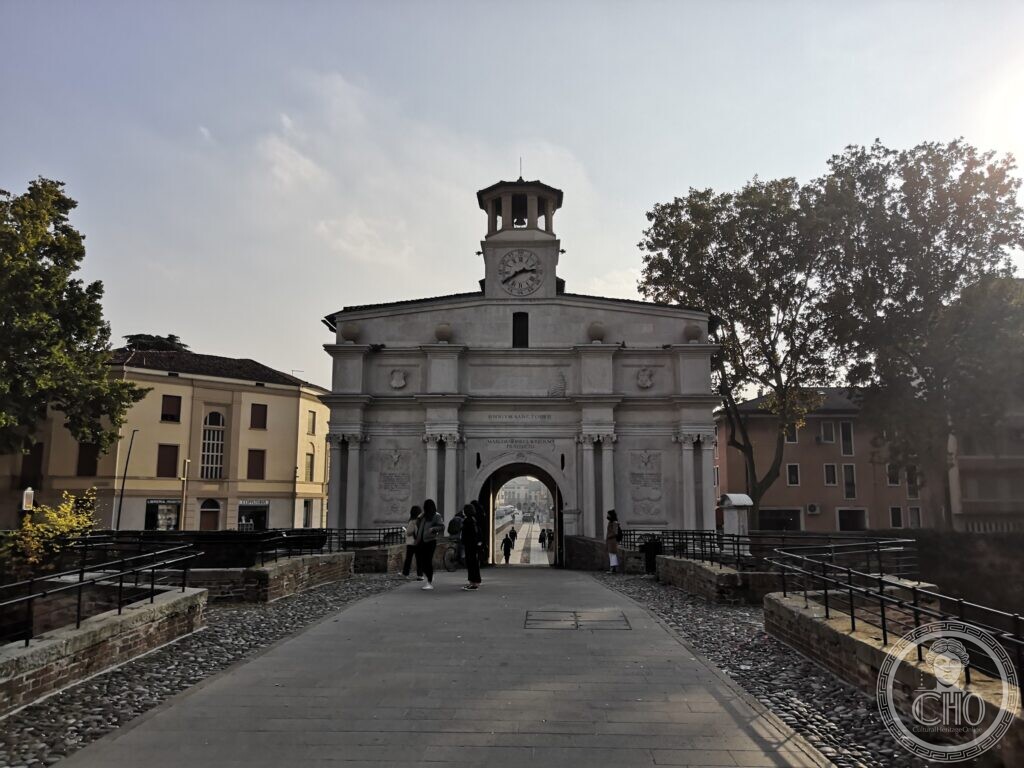
The gate where Padua met the boats from Venice: an Istrian stone front of 1518 by Guglielmo de Grigi with a clock tower on top, the arms of the city and of the Doge, and beside it the staircase on the Piovego where passengers boarded the burchi for the Brenta.
At a glance
Porta Portello stands on the Piovego canal at the eastern edge of Padua’s Venetian walls, where the road from the city crosses the water towards Venice. The architrave inside the arch names it Pons Omnium Sanctorum, the gate of All Saints, but it has always been called Portello, after the small river port that was moved in 1534 to the quay beside the new gate. It was built in 1518, commissioned by the Venetian governor Loredan and designed by Guglielmo de Grigi, known as il Bergamasco; from the start it was meant less for war than for trade. Eight columns on pedestals rise from the water of the Piovego on the outer front, and a small tower with a clock sits on the roof.
Key facts
- Built: 1518 (a plaque under a capital gives 1534, the year the river port was moved here)
- Architect: Guglielmo de Grigi, il Bergamasco; commissioned by Loredan, governor of Padua
- Official name: Porta Ognissanti; the frieze reads «Omnium Sanctorum», and below it the inscription names a Loredan as prefect
- Material: Istrian stone; eight columns on pedestals rising from the Piovego
- Arms: of the city of Padua and of Doge Leonardo Loredan over the arch; a turreted castle, symbol of Venetian rule on the mainland, where a lion of St Mark would have stood
- Beside it: the sixteenth-century staircase on the canal, the boarding place for the Brenta; the shrine of Santa Maria dei Barcaioli, 1790
- GPS: 45.4097, 11.8927 · Open in Google Maps (OpenStreetMap)
History
When Venice rebuilt the walls of Padua in the sixteenth century, the gates were the showpieces of the new circuit, and the one towards Venice was the most used of all. Porta Portello went up in 1518 to the design of Guglielmo de Grigi, the Bergamasque architect who also worked on the gates and walls of Treviso, as the entrance from the river port on the Piovego, the main waterway to Venice. The old port, the portello that gave the gate its name, was moved in 1534 to the quay beside it; two staircases in the Venetian manner let the boats coming from Venice by way of the Brenta tie up at the gate, and historical sources speak of some eighty boats a day docking here.
The quarter outside the gate, Borgo Portello, was the quarter of the boatmen, who had their own guild; beyond the bridge the shrine of Santa Maria dei Barcaioli, of 1790, was where passengers heard mass before boarding the burchi for Venice. The gate’s scenic front drew painters, Canaletto among them. In the twentieth century the open ground inside the walls, where the Venetians had planned a new castle that was never built, became the site of the university’s scientific quarter. The staircase on the canal was restored a few decades ago and is once more the boarding point for river excursions along the Brenta.
What you see
From the bridge, as in the photograph, the gate is a tall front of white Istrian stone in two orders. Below, paired columns on high pedestals frame the round arch and two panels with inscriptions; the frieze carries the words «Omnium Sanctorum» and, beneath it, the dedication to the Loredan prefect. Above, a plain attic with three cartouches, the two arms of Padua and of the Doge at the sides and the castle in the middle, and over it the small square tower with the clock face and an open lantern with the bell. Through the arch the street runs straight into the city. Carved into the stone of the parapet, two gaming boards, a chessboard and a nine men’s morris, remember the boatmen who waited here.
Nearby
- Ponte Portello — the bridge over the Piovego in front of the gate
- Palazzo di Ingegneria — Daniele Donghi’s engineering school in the university quarter inside the walls
Sources
- Turismo Padova, Porta Portello: Pons Omnium Sanctorum, the port moved in 1534, the construction of 1518 commissioned by the governor Loredan and designed by Guglielmo Grizi, the Istrian stone and the eight columns, the clock tower, the castle in place of the lion, the arms of Padua and of Doge Leonardo Loredan, the shrine of 1790 and the mass before boarding, the staircase, the gaming boards
- Magico Veneto, Le mura veneziane e le porte cinquecentesche di Padova: the gate of 1518 by Guglielmo de Grigi il Bergamasco, who also worked at Treviso; the two staircases for the boats from Venice by the Brenta; the river port on the Piovego; the Castello Nuovo never built and the university quarter; Canaletto
- Italia.it (Ministero del Turismo), The Portello staircase: the sixteenth-century gate in Istrian stone for defence, civil and commercial use, the eighty boats a day, the boatmen’s guild of Borgo Portello, the restoration of the staircase and its present use for river navigation
- Stefano Vigolo, photographs of 21 October 2020: the inscriptions read from the photograph
Find it on the map
See this place and what’s around it →📷 Become a Cultural Heritage Online photographer
Share your photos of places: they stay published under your name as the author. The more they're seen, the more you get noticed — and soon a contest will reward the most appreciated photos.
Log in or sign up free to add a photoIs this page about you?
This page is read by travellers and heritage enthusiasts who find it on Google. Tell us how you are connected to this place and we will take it from there.