

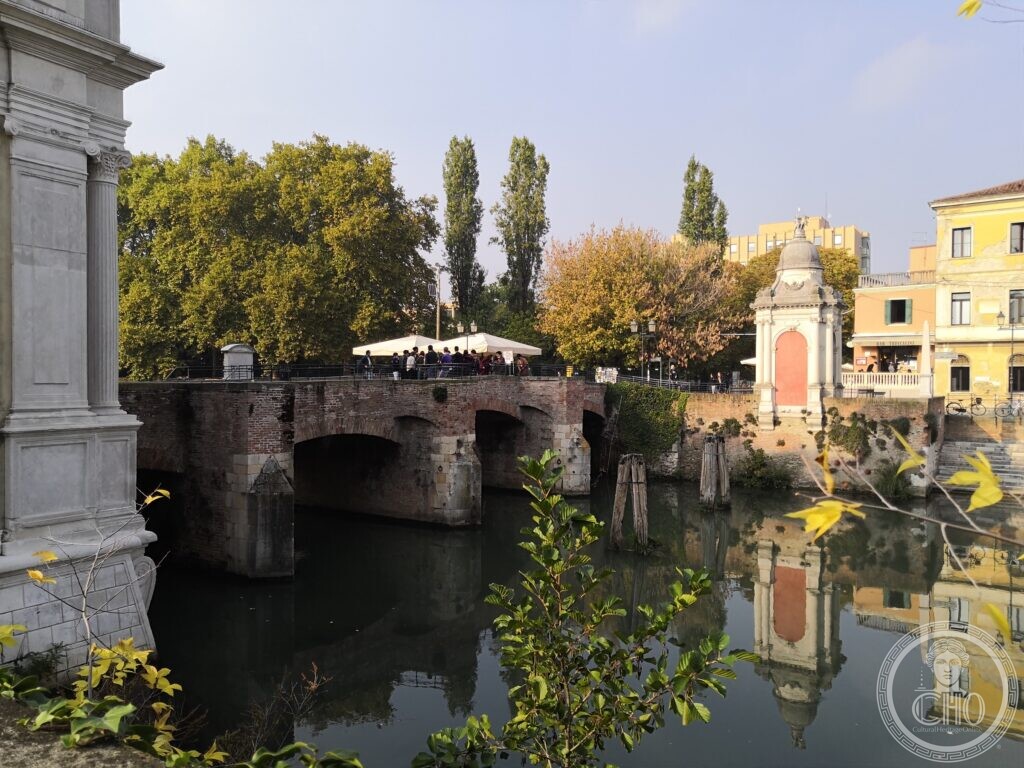
Three brick arches carry the road from Porta Portello over the Piovego to the quarter of the boatmen, with the small domed shrine of 1790 on the far bank where passengers heard mass before sailing to Venice.
At a glance
The Ponte Portello crosses the Piovego canal immediately in front of Porta Portello, the city gate of 1518 on the eastern side of Padua’s Venetian walls. It is the eighteenth-century bridge described by the tourism sources, which OpenStreetMap records under the gate’s official name as Ponte Ognissanti: three segmental arches in brick on stone cutwaters, with a cobbled roadway and low parapets. Beyond it opens Borgo Portello, the old quarter of the boatmen; on the bank to the right stands the shrine of Santa Maria dei Barcaioli, of 1790, and along the canal run the staircases where the boats for Venice tied up.
Key facts
- Crosses: the Piovego canal, in front of Porta Portello
- Date: eighteenth century (the tourism sources; no precise year found)
- Structure: three brick arches on stone cutwaters, as seen in the photograph
- On the far bank: the shrine of Santa Maria dei Barcaioli, 1790
- GPS: 45.4099, 11.8927 · Open in Google Maps (OpenStreetMap)
History
The Piovego was Padua’s main waterway to Venice, and the Portello its river port: the gate of 1518 was built as the entrance from the quay, the port itself was moved to the gate in 1534, and historical sources count some eighty boats a day docking at the staircases on the canal. The bridge that joins the gate to the far bank is the eighteenth-century one that the sources describe in front of the gate, carrying the road out of the city into the borgo of the boatmen, who had their own guild here. On the bank beyond it the shrine of Santa Maria dei Barcaioli went up in 1790, so that travellers could hear mass before boarding the burchi that would take them down the Brenta to Venice. The staircase by the bridge was restored a few decades ago and is again the boarding point for river excursions.
What you see
From the foot of the gate, as in the photograph, the bridge shows its three brick arches springing from stone-faced piers with pointed cutwaters, their brickwork patched and darkened by the water. The parapet is low, and the roadway above carries a market stall under white umbrellas. On the far bank, reflected in the still canal, the shrine of the boatmen: a small white Baroque front with a red door, a dome and a statue on top, set against the yellow houses of the borgo and the tall poplars and plane trees of the riverside walk. In the foreground the Istrian stone pier and Corinthian capital of the gate.
Nearby
- Porta Portello — the gate of 1518 at the head of the bridge
- Palazzo di Ingegneria — the university quarter inside the walls
Sources
- Italia.it (Ministero del Turismo), The Portello staircase: the eighteenth-century bridge in front of the gate, the river port with some eighty boats a day, the boatmen’s guild of Borgo Portello, the restored staircase and its present use
- Turismo Padova, Porta Portello: the port moved in 1534, the shrine of Santa Maria dei Barcaioli of 1790 and the mass before boarding the burchi for Venice along the Brenta
- Magico Veneto, Le mura veneziane e le porte cinquecentesche di Padova: the Piovego as the main river route to Venice and the two staircases for the boats
- OpenStreetMap, Ponte Ognissanti, Padova: the name on the map and the position
Find it on the map
See this place and what’s around it →📷 Become a Cultural Heritage Online photographer
Share your photos of places: they stay published under your name as the author. The more they're seen, the more you get noticed — and soon a contest will reward the most appreciated photos.
Log in or sign up free to add a photoIs this page about you?
This page is read by travellers and heritage enthusiasts who find it on Google. Tell us how you are connected to this place and we will take it from there.