
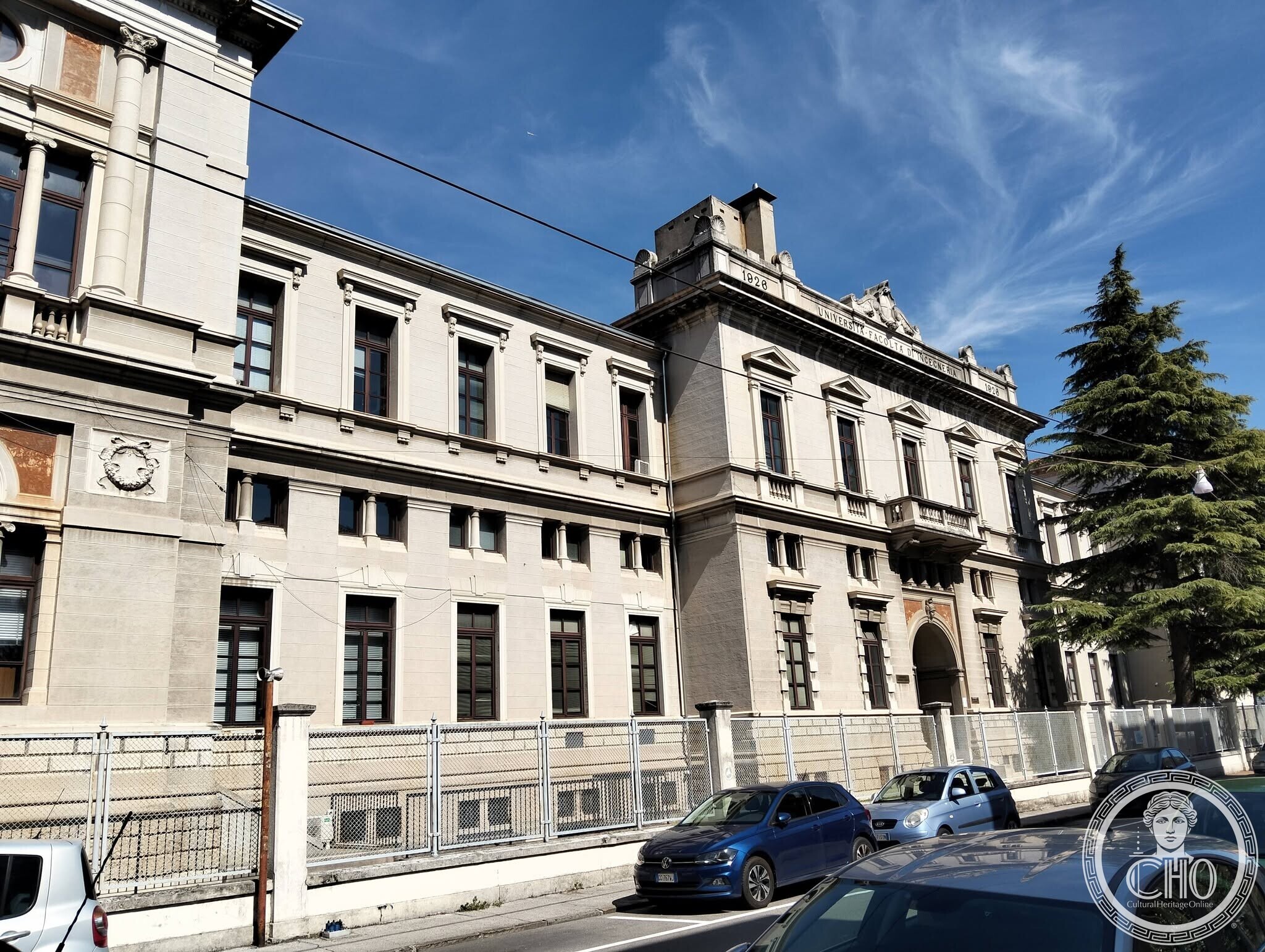
Begun in 1912 and finished in stages until 1933, the Engineering complex on via Marzolo is the largest university building Daniele Donghi designed for Padua. One wing on the street still carries the date it was completed: 1926.
At a glance
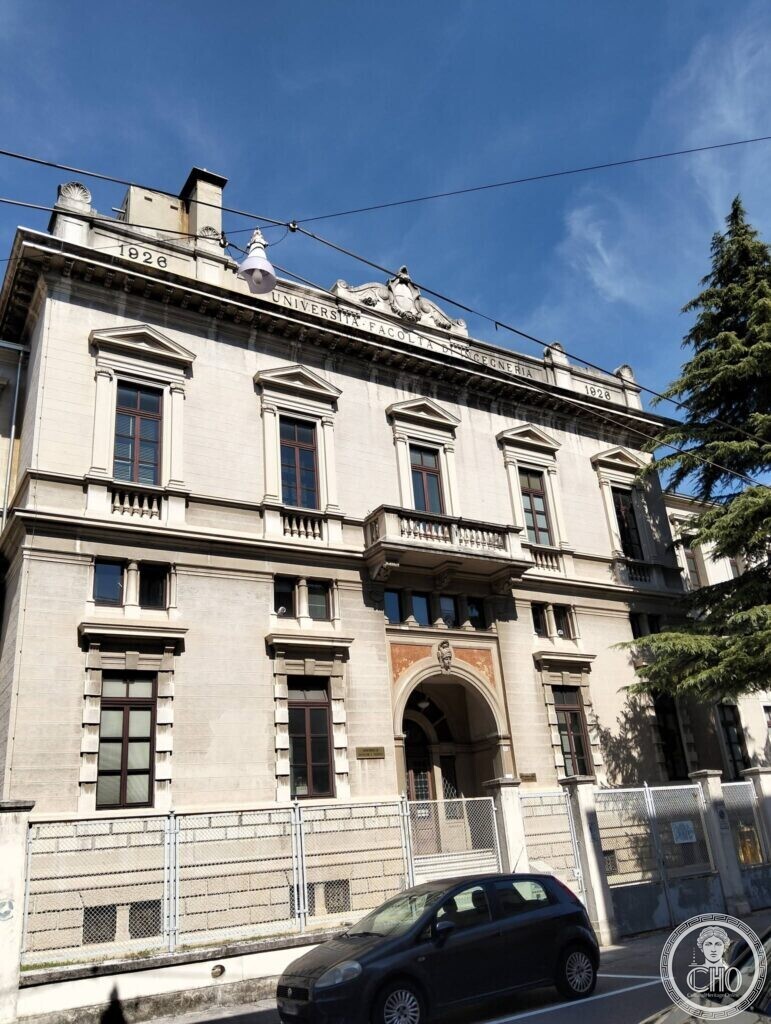
The complex of the Faculty of Engineering of the University of Padua stands at via Francesco Marzolo 9, in the area east of the historic centre that the university chose for its expansion in 1904. It was designed by the engineer Daniele Donghi (Milan 1861 – Padua 1938), professor of technical architecture at the university from 1910, and built in successive phases between 1911 and 1933 around two courtyards. The attic of the wing that projects towards via Marzolo bears the inscription Università · Facoltà di Ingegneria with the date 1926 on either side of a carved coat of arms. The building still houses engineering departments of the university.
Key facts
- Designed by: Daniele Donghi, engineer and professor of technical architecture in Padua
- Site chosen: 1904, in the university’s expansion area
- Works begun: October 1912, interrupted by the First World War
- Construction: in phases, 1911–1933; the school moved here from Palazzo Cavalli, which it used until 1929
- Date on the via Marzolo wing: 1926
- Inside: wall paintings by the Paduan artist and decorator Giovanni Vianello
- Catalogued: Ministry of Culture general catalogue, record 0500365239 («complesso di ingegneria, 1912–1970»), State property
- GPS: 45.40950, 11.88942 · Open in Google Maps
History
In 1904 the University of Padua chose an area beyond the Piovego, east of the old town, for the new scientific institutes it needed. The engineering school was one of the first buildings planned there, and Donghi, who had joined the university in 1910, was given the project. Work started in October 1912 and was interrupted by the war; the school was in use by 1920, but the complex kept growing, and the university’s own account of its twentieth-century buildings dates the construction in phases from 1911 to 1933. The old seat in Palazzo Cavalli, by the Porte Contarine, stayed in service until 1929.
In the following decades the complex was altered many times, with additions and new internal arrangements that, in the university’s words, largely cancelled its original character. What survives most clearly is the street front, and the wall paintings that Giovanni Vianello made inside at different moments.
What you see
From via Marzolo, a long front of two storeys in a pale stone colour, with rusticated ground-floor piers and tall rectangular windows. On the right a wing steps forward: on its upper floor the windows have triangular pediments and a central balcony on brackets; above runs the inscription Università · Facoltà di Ingegneria, with a coat of arms in the middle and the date 1926 cut on either side. The arched entrance below carries a mask on the keystone. At the far left, the corner of an older part of the complex shows Ionic columns and a round oculus. A chain-link fence and a row of cedars separate the building from the street.
Nearby
- Torre della Rotonda — the water tower of 1923–1925 over a war grave, in the same district
- Palazzo Liviano — Gio Ponti’s university building of 1937–1943
Sources
- Università di Padova — Palazzi novecenteschi: the complex built in phases between 1911 and 1933 on Donghi’s design, around two courtyards; the later additions; the wall paintings by Giovanni Vianello
- Elvira Poli e il suo tempo — Donghi e l’Università (University of Padua): Donghi’s biography and chair from 1910, the site chosen in 1904, works begun in October 1912 and interrupted by the war, completion 1915–1920, Palazzo Cavalli in use until 1929
- Catalogo generale dei Beni Culturali — complesso di ingegneria, Padova, 1912–1970: address, dates, attribution to Daniele Donghi, State property
- The date 1926 and the inscription are read on the building itself, in the photographs on this page
Find it on the map
See this place and what’s around it →📷 Become a Cultural Heritage Online photographer
Share your photos of places: they stay published under your name as the author. The more they're seen, the more you get noticed — and soon a contest will reward the most appreciated photos.
Log in or sign up free to add a photoIs this page about you?
This page is read by travellers and heritage enthusiasts who find it on Google. Tell us how you are connected to this place and we will take it from there.