
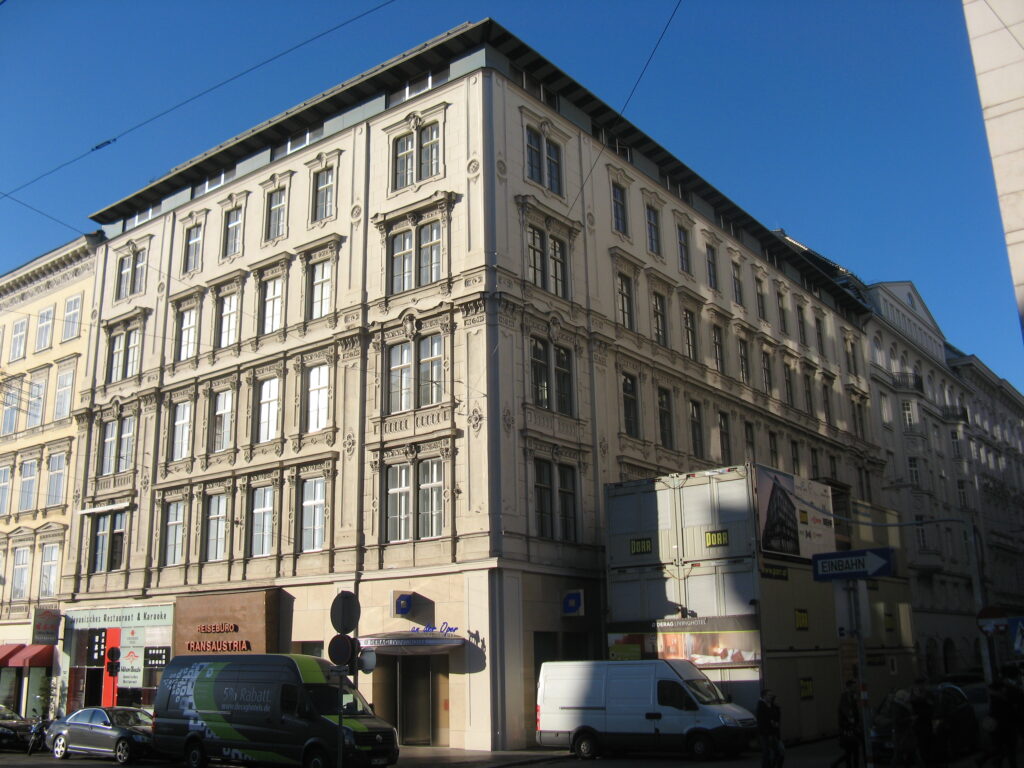

An apartment house begun while the city walls were still coming down, on the corner of Kärntner Straße and Elisabethstraße, a few steps south of the Opera. The architectural lexicon of Vienna counts it among the oldest buildings of the whole Ringstraße development. It is not a listed monument, and it has been home to a theatre director, a bookseller who sold Karl Kraus’s tickets, and today the Living Hotel an der Oper.
At a glance
When the fortifications of Vienna were demolished at the end of the 1850s, Kärntner Straße was carried across the levelled ditch towards the river Wien. The corner house at Kärntner Straße 44 and Elisabethstraße 1 was one of the first to rise there: the Architektenlexikon Wien dates it to 1860 and names the architect Wilhelm Westmann, with Karl Lesk as the builder. The Vienna newspapers give it as an inhabited address from 1864. Among its residents were Franz von Dingelstedt, director of the Court Opera and then of the Burgtheater, and his wife, the singer Jenny Lutzer, whose funeral left from the house in 1877. From 1913 the building held the bookshop of Richard Lányi, which sold the tickets for Karl Kraus’s public readings.
Key facts
- Where: Kärntner Straße 44 / Elisabethstraße 1, 1010 Vienna (Innere Stadt), Austria
- Built: 1860, according to the Architektenlexikon Wien 1770–1945; the City of Vienna’s building-period map places it in the period 1860–1883
- Architect: Wilhelm Westmann (1813–1881); builder Karl Lesk
- Type and style: corner apartment house (Miethaus) of early historicism
- Protection: not on the list of protected monuments of the Federal Monuments Office; it lies inside the City of Vienna’s “Ringstraße” protection zone (Schutzzone)
- Residents and tenants: Franz von Dingelstedt and Jenny Lutzer (1870s); the railway pioneer Joseph Stummer von Traunfels, who died at Elisabethstraße 1 in 1891; the bookshop of Richard Lányi (1913–1938)
- Current use: hotel (Living Hotel an der Oper) and shops
- Coordinates: 48.201642, 16.368702 · open in Google Maps
History
In 1861 Kärntner Straße was extended beyond the old Kärntnertor, over the filled-in city ditch, as far as the river Wien. The house on the corner with Elisabethstraße was designed by Wilhelm Westmann, a Viennese architect who had studied under Pietro Nobile at the Academy and spent most of his career teaching drawing at the trade school that later became the Höhere Technische Lehranstalt. The Architektenlexikon Wien knows only two buildings by him, both in the new Ringstraße zone: this apartment house of 1860 and the larger apartment palace at Kärntner Ring 17 of 1861–1863. It describes the Elisabethstraße house as still wholly in the language of early historicism, a compact cubic block whose flat projecting bays and restrained decoration give it a sober character, and it places both works among the oldest buildings of the Ringstraße development.
The house was lived in by 1864, when the Wiener Zeitung’s register of deaths gives the address “Stadt, Elisabethstraße 1”; a Viennese dancing school advertised at Kärntnerstraße 44 in 1868, and the photographers Dr. Székely & Massak printed “Elisabethstrasse No 1” on their cards, together with the prize medal of the Paris exhibition of 1867. The most prominent tenant was Franz von Dingelstedt, director of the Court Opera from 1867 to 1870, a period that included the opening of the new opera house on the Ring in May 1869, for which he wrote the prologue, and then of the Burgtheater until his death in 1881. The Wien Geschichte Wiki records Kärntner Straße 44 as one of his Viennese homes. His wife, the soprano Jenny Lutzer, a member of the Court Opera from 1837 to 1843, died in October 1877; the Neues Wiener Tagblatt announced that her funeral would leave on 5 October from the home of the deceased, Kärntnerstraße 44. The railway pioneer and architect Joseph Stummer von Traunfels died at Elisabethstraße 1 in 1891.
In 1913 the bookseller Richard Lányi took over the bookshop of Robert Friedländer, which the Wien Geschichte Wiki places at Kärntner Straße 44. Lányi also ran a ticket office, and from December 1915 the shop handled the advance sale of tickets for Karl Kraus’s public readings. After the Anschluss of March 1938 the shop was looted, and in May 1938 it was taken over by Johannes Katzler, a member of the SA, as an “Aryan” firm; according to the same source he emptied the business and refused to pay the agreed price, and the firm came to an end in 1943. A shop front designed in 1932 by Helmut Camillo Wagner-Freynsheim for the firm Benesch is also recorded at number 44. Kärntner Straße lost many of its buildings in 1945, but this house was not among those the Wien Geschichte Wiki lists as destroyed or damaged. Today it is the Living Hotel an der Oper.
What you see
The photograph shows the building from across the corner. Above the street the house rises four full storeys in pale render. The corner is set slightly forward and framed by tall, flat pilaster strips that run through the upper floors, and the windows are grouped in pairs. On the first two floors above the shops each pair sits under a carved pediment or straight cornice, with small heads and cartouches at the centre, and between the windows round medallions and rosettes are set into the wall. Decorative bands with small panels run under the sills. The upper floors are plainer, with simpler window frames.
The street level and the roof are clearly later: the ground floor is faced in smooth pale stone with large shop windows, including a Japanese restaurant and a travel agency in 2014, and the hotel entrance sits near the corner under a curved canopy lettered “an der Oper”. At the top, a set-back storey with a projecting flat roof edge has replaced the original roof. A German Wikipedia article on Elisabethstraße, drawing on the Dehio handbook, also mentions a carriage entrance with a rib vault and open access galleries in the courtyard; these are not visible in the photograph.
Practical information
- The building is a hotel with shops on the ground floor; the interiors are for guests.
- Both fronts can be seen from the street at any time; the best view of the corner is from the opposite side of Kärntner Straße.
- The house is not a listed monument; it is protected only as part of the Ringstraße protection zone.
Getting there
The house stands on the stretch of Kärntner Straße between the Ring and Karlsplatz. Karlsplatz station (U1, U2 and U4) is a couple of minutes away, and the trams on the Ringstraße stop by the Opera, just to the north.
Nearby
- Vienna State Opera, opened in 1869 under Dingelstedt’s direction, about 150 metres to the north.
- Friedrichstraße 4, Hans Prutscher’s Secessionist block of the years before the First World War, in the same block.
- Karlsplatz Stadtbahn Pavilions by Otto Wagner, about 200 metres to the south-east.
- Café Museum, with its interior by Adolf Loos, and the Secession Building, a short walk to the west.
Do you know more?
On this page we have published what the architectural lexicon of Vienna, the city’s building records and the period newspapers tell us about this house. We have not found the name of the family who commissioned it in 1860, a description of its original roof and ground floor, or photographs of the house before the modern shopfronts and the new top storey. If you know something — a name, a date, the people who lived here, an old photograph of the corner, a document, a book that mentions it — write to Sofia, who looks after these pages.
Write to Sofia or send a message on WhatsApp
Please start your message with the title of this page, so it reaches the right file. Every contribution is checked against independent sources before it goes on the page, and we always say where a piece of information came from.
Sources
- Architektenlexikon Wien 1770–1945, Architekturzentrum Wien, “Wilhelm Westmann”: work “Wohnhaus, Elisabethstraße 1 / Kärntner Straße 44, 1010 Wien, 1860”, planner Wilhelm Westmann, execution Karl Lesk; the assessment of the house as early historicist and among the oldest buildings of the Ringstraße development; biography of the architect.
- City of Vienna, Open Government Data: building-period map (Bauperiodenplan, building code 342: “1860–1883”, Gründerzeit corner apartment house), address register (Kärntner Straße 44 and Elisabethstraße 1 as one building) and protection zones (“Ringstraße”).
- Bundesdenkmalamt, list of protected monuments for Vienna, Innere Stadt, as published in the German Wikipedia Denkmalliste: no entry for Kärntner Straße 44 or Elisabethstraße 1.
- Wien Geschichte Wiki, “Kärntner Straße”: extension of the street in 1861, the 1932 shop front at number 44, the war damage of 1945; “Franz Dingelstedt” (residence at Kärntner Straße 44, dates of his directorships, Jenny Lutzer); “Buchhandlung Richard Lányi”; “Joseph Stummer von Traunfels” (died at Elisabethstraße 1).
- ANNO, Austrian National Library newspaper archive: Wiener Zeitung, 16 April 1864 (death register, Stadt, Elisabethstraße 1); Fremden-Blatt, 17 April 1868 (dancing school, Kärntnerstraße 44); Neues Wiener Tagblatt, 4 October 1877 (funeral of Jenny Dingelstedt-Lutzer from Kärntnerstraße 44).
- Wikimedia Commons, “Elisabethstraße 1, Vienna”: carte-de-visite of Dr. Székely & Massak, Elisabethstrasse No 1 (Fortepan 90143).
- Wikipedia (de), “Elisabethstraße (Wien)”, citing the Dehio-Handbuch Wien, I. Bezirk (2003): description of the corner bay, window pediments, vaulted entrance and courtyard galleries.
- OpenStreetMap / Nominatim: position, returned as Living Hotel an der Oper, 44, Kärntner Straße, Innere Stadt, Wien.
Find it on the map
See this place and what’s around it →📷 Become a Cultural Heritage Online photographer
Share your photos of places: they stay published under your name as the author. The more they're seen, the more you get noticed — and soon a contest will reward the most appreciated photos.
Log in or sign up free to add a photoIs this page about you?
This page is read by travellers and heritage enthusiasts who find it on Google. Tell us how you are connected to this place and we will take it from there.