
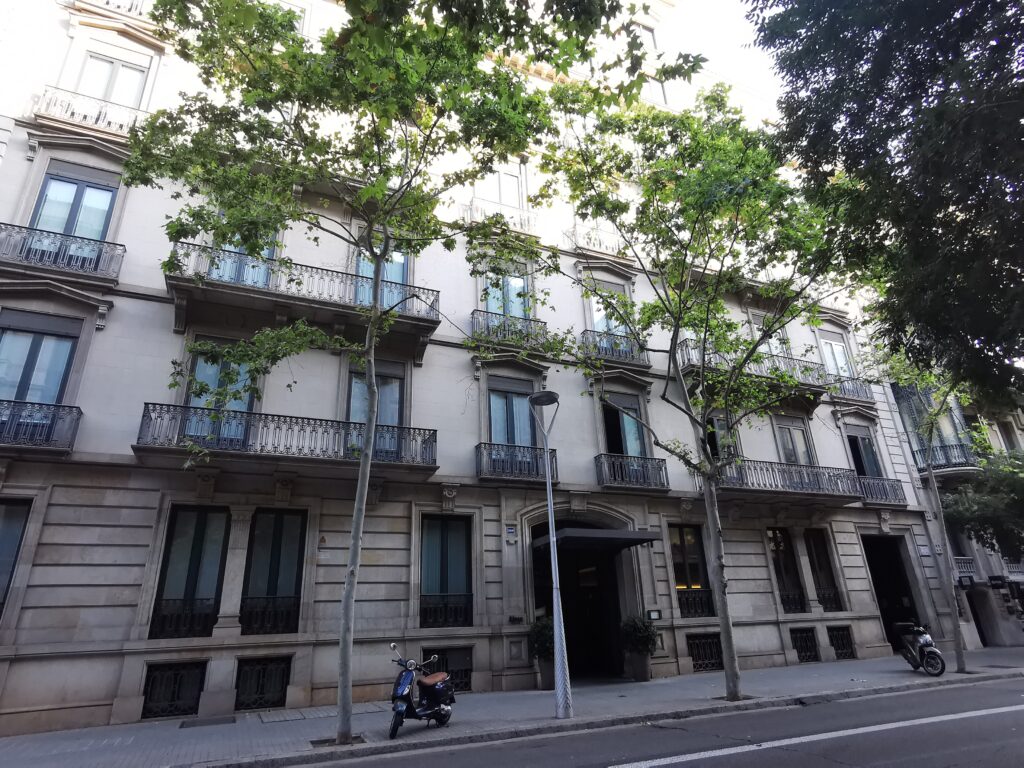

A large apartment-house front on Carrer de Mallorca, a few steps from Passeig de Gràcia, that housed the Barcelona offices of Solvay Ibérica before it was bought in 2005 and turned into the Alma hotel. The building has no protection of its own, and its history is thinly documented. This page sets out what the records say, where they disagree, and what is still unknown.
At a glance
Numbers 269–271 of Carrer de Mallorca stand in the Dreta de l’Eixample, in the street grid that Ildefons Cerdà planned for the extension of Barcelona. The architects who converted the building into a hotel describe it as typical Eixample architecture of the late nineteenth century; the hotel calls it an early twentieth-century building. The Spanish cadastre, on the other hand, records 2011 as the year of the building. The three dates do not contradict each other as much as they seem to: the architects’ own account says that the load-bearing walls were replaced by a metal structure and that two new façades were built, work on a scale that would explain a new cadastral date. What we do not know is how much of the old building survives behind the street front, or when and by whom that front was first built. The City of Barcelona does not list the building individually; it falls only under the protections that cover the whole Eixample.
Key facts
- Where: Carrer de Mallorca 269–271, 08008 Barcelona (Dreta de l’Eixample, district of l’Eixample)
- Street: marked with the letter J on Cerdà’s plan; named Carrer de Mallorca on 19 December 1863, from the street-name proposal drawn up by Víctor Balaguer
- Original building: date and architect unknown. “Late nineteenth century” according to the architects of the conversion; “early 20th century” according to the hotel
- Earlier use: offices of Solvay Ibérica, according to the architects and to the design press
- Conversion: bought by Alma Hotels in 2005; rebuilt inside by Habitan Architects (Elena Hachuel and Yoel Karaso) with the interior designers of Corium Casa (Nori Furlan and Paco Llonch)
- Hotel since: late 2010, according to a 2021 press profile
- Cadastre: year 2011; 7,150 m² built on a plot of 1,705 m²; use “leisure and hospitality” (cadastral reference 0131213DF3803A)
- Protection: none of its own. Not in the City’s Catalogue of Architectural Heritage nor in the Inventory of the Architectural Heritage of Catalonia; covered only by the Eixample-wide protections 1486 (Conjunt especial de l’Eixample) and 3211 (Sector de conservació de l’Eixample)
- Coordinates: 41.394496, 2.163261 · open in Google Maps
History
Carrer de Mallorca is one of the long streets of Cerdà’s Eixample, the extension of Barcelona beyond its medieval walls. On the plan it was only the letter J; it received its present name in December 1863, when the city adopted the list of street names proposed by the writer Víctor Balaguer, and it recalls the island of Mallorca, conquered by James I in 1229.
For number 269–271 itself we have found no record of the original construction: no architect, no first owner, no date. The City’s heritage catalogue has no entry for it, and neither has the Catalan inventory of architectural heritage, which lists most of the documented houses of the neighbourhood. We have not consulted the building-permit files kept by the Arxiu Municipal Contemporani de Barcelona, which are not online and are the most likely place to hold the answer.
The later history is clearer. The architects of Habitan write that in 2005 Alma Hotels bought “the former headquarters of Solvay Iberica”, a building “typical Eixample style of the late nineteenth century, with a large garden in the courtyard”; a 2013 article in Diario Design also says that the building had housed the offices of Solvay Ibérica. The conversion, according to Habitan, included “the replacement of the load-bearing wall structure by metal pillars and the construction of two new facades”. The part of the building facing Carrer de Mallorca was, in the architects’ words, “rehabilitated using the original language to reinforce the classic Eixample atmosphere”, while the new front towards the garden inside the block was designed in a contemporary manner. The architects give the project as 6,822 m² for the client Alma Hoteles.
The hotel opened at the end of 2010, according to a 2021 profile in The New Barcelona Post, and the cadastre dates the building to 2011, which is consistent with a complete rebuilding of the interior. Whether the stone street front is the original one, restored, or a reconstruction in the old style is something none of the sources we read states plainly. The hotel says that its garden, inside the block, has been restored in keeping with Cerdà’s original idea of green courtyards at the heart of each block; we have no independent record of what the courtyard looked like before.
What you see
The photograph shows a long front of pale stone, partly hidden by the plane trees of the street. The ground floor is built of rusticated stone laid in horizontal bands, with tall windows and, below them, small openings closed by iron grilles that light the basement. At the centre is the main entrance: a broad arch with moulded surrounds and a projecting keystone carved with initials that are only partly legible in the photograph. A flat black canopy now shelters the door. The blue house-number plate beside it reads 269, and the name of the hotel is fixed to the stone at the foot of the left jamb. Further right, a second, square-headed doorway with a moulded frame opens onto the street.
The upper floors are smooth and pale. The windows have moulded surrounds and small cornices on brackets, and they are grouped in pairs behind long wrought-iron balconies that rest on stone consoles, alternating with single balconies. Higher up the front continues with further rows of balconies and ends in a cornice, which the trees hide in this view. Nothing in the photograph tells whether the stone is original or new; the rebuilding described by the architects left the street front in what they call its “original language”.
Practical information
- The building is a hotel, Alma Barcelona; the interiors and the garden are for guests.
- The street front can be seen from the pavement of Carrer de Mallorca. The best view of the upper floors is from the opposite side of the street, in winter, when the plane trees are bare.
- The building has no heritage protection of its own; what is described here is its documented history, not a listed interior.
Getting there
Carrer de Mallorca 269–271 is a few steps from Passeig de Gràcia, in the heart of the Eixample. The Metro stations Diagonal (lines 3 and 5) and Passeig de Gràcia (lines 2, 3 and 4) are both within walking distance along Passeig de Gràcia.
Nearby
- Banca Catalana Building, Passeig de Gràcia 84, the bank building of 1965–68 facing La Pedrera, about 70 metres away.
- Casa Enric Batlló, Josep Vilaseca’s brick-and-stone house at the corner of Passeig de Gràcia and Carrer de Mallorca, about 120 metres away.
- Casa Milà (La Pedrera), Antoni Gaudí’s apartment house on Passeig de Gràcia, about 150 metres away.
- Palau Montaner, Carrer de Mallorca 278 at the corner of Carrer de Roger de Llúria, by Josep Domènech i Estapà and Lluís Domènech i Montaner (1889; 1891–96), a cultural asset of local interest (BCIL), about 200 metres along the street.
Do you know more?
On this page we have published what can be seen and what we were able to verify. We could not find who designed this building, when it was first built, who the initials on the keystone belong to, when Solvay Ibérica moved in, or whether the stone front on Carrer de Mallorca is the original one or was rebuilt in 2005–2010. If you know something (a name, a date, a building permit, the family who lived there, an old photograph, a book that mentions it), write to Sofia, who looks after these pages.
Write to Sofia or send a message on WhatsApp
Please start your message with the title of this page, so it reaches the right file. Every contribution is checked against independent sources before it goes on the page, and we always say where a piece of information came from.
Sources
- Ajuntament de Barcelona, Catàleg del Patrimoni Arquitectònic (Open Data BCN, dataset patrimoni-arquitectonic-protegit): no entry for Carrer de Mallorca 269–271; the site lies inside the protected areas 1486 (Conjunt especial de l’Eixample) and 3211 (Sector de conservació de l’Eixample).
- Wikipedia (ca), Llista de monuments de l’Eixample de Barcelona (dreta), compiled from the Inventari del Patrimoni Arquitectònic de Catalunya: no entry for this address; entry IPA-40424 for Palau Montaner.
- Dirección General del Catastro, cadastral reference 0131213DF3803A (Carrer de Mallorca 269): year 2011, 7,150 m² built, plot 1,705 m², use leisure and hospitality.
- Habitan Architects, “Alma Barcelona High End Hotel”: purchase of the former Solvay Ibérica headquarters in 2005, late-nineteenth-century Eixample building, replacement of the load-bearing walls, two new façades, treatment of the street front; client, size and authors of the project.
- Mariola Montosa, “Hotel Alma Barcelona: aires de clasicismo y modernidad”, Diario Design, 30 May 2013: former offices of Solvay Ibérica; the part facing Carrer de Mallorca keeps the style of the Eixample; Habitan and Studio Coriumcasa.
- Bernat Dedéu, “El alma del Eixample”, The New Barcelona Post, 20 March 2021: opening at the end of 2010; Elena Hachuel and Yoel Karaso of Habitan.
- Alma Barcelona, “About us”, official site: the owner’s description of an early-twentieth-century building and of the garden restored after Cerdà’s plan.
- Wikipedia (ca), Carrer de Mallorca: the letter J on Cerdà’s plan and the naming of the street in 1863.
- OpenStreetMap / Nominatim: position, returned as 269-271, Carrer de Mallorca, la Dreta de l’Eixample, Barcelona.
Find it on the map
See this place and what’s around it →📷 Become a Cultural Heritage Online photographer
Share your photos of places: they stay published under your name as the author. The more they're seen, the more you get noticed — and soon a contest will reward the most appreciated photos.
Log in or sign up free to add a photoIs this page about you?
This page is read by travellers and heritage enthusiasts who find it on Google. Tell us how you are connected to this place and we will take it from there.