
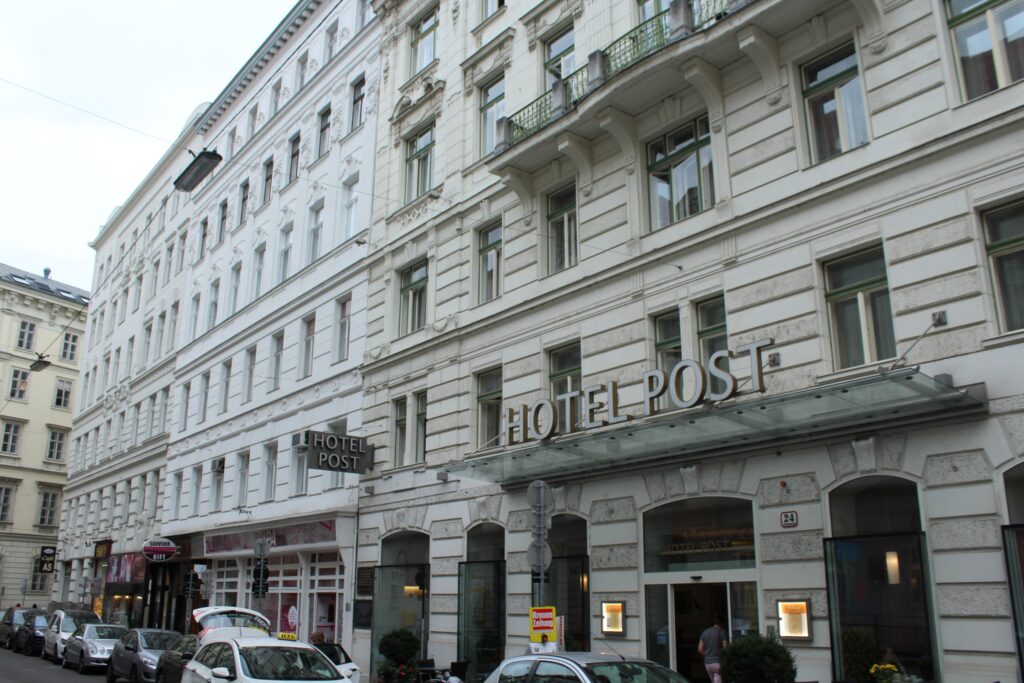

A hotel building of the turn of the century on one of the oldest streets of Vienna, with a concert hall in its basement that has been the home of the Wiener Kammeroper since 1961. Janáček stayed here in 1918 for the Vienna premiere of Jenůfa.
At a glance
The building stands at the eastern end of the Fleischmarkt, the old meat market street of medieval Vienna, on the corner of Drachengasse. It was built at the start of the twentieth century to designs by the architect Carl Caufal (1861–1929): the Architektenlexikon Wien dates it to 1901, other sources to 1902. It replaced an earlier inn on the same plot, the Hotel Rabl. Inside, on the Drachengasse side, the hotel’s concert hall was adapted in 1959 for the Wiener Kammeroper, the chamber opera company, which has played there since 1961. Two memorial plaques on the facade recall the composer Leoš Janáček and the founding of the first white-collar union in Austria.
Key facts
- Where: Fleischmarkt 24 / Drachengasse, 1010 Vienna (Innere Stadt), Austria
- Architect: Carl Caufal
- Built: 1901 (Architektenlexikon Wien); 1902 in other sources
- Style: late historicism in neo-Baroque forms; Secession-style foyers and hall in the theatre
- Theatre: the former hotel concert hall, adapted by Josef Czurda in 1959, home of the Wiener Kammeroper since 1961
- Memorial plaques: Leoš Janáček (2004); founding of the Verein der kaufmännischen Angestellten, 14 January 1892 (1992)
- Current use: hotel and theatre
- Coordinates: 48.210119, 16.378238 · open in Google Maps
History
The Fleischmarkt is one of the oldest streets of the medieval extension of Vienna: the City of Vienna’s history wiki traces its name to 1220, when it was the market and the seat of the butchers. Inns have lined it for centuries. The best known, at number 28, was the house “Zum weißen Ochsen”, which became the hotel “Zur Stadt London” in 1822 and counted Leopold Mozart with his children in 1762, Frédéric Chopin in 1830, Franz Liszt and Richard Wagner among its guests. That hotel was pulled down in 1902, and in the same year, according to the history wiki, the “Hotel Post” opened at number 24. Accounts of the Hotel Post sometimes attach those guests to it; according to the history wiki they belong to the neighbouring house, not to this building.
Number 24 had its own inn before the present building: a plaque on the facade records that on 14 January 1892 the Verein der kaufmännischen Angestellten, the first trade union organisation of salaried employees in Austria, was founded here “in the former Hotel Rabl”. The new building by Carl Caufal, a Viennese architect of apartment and commercial houses, was a hotel with a concert hall. It was originally known as the Czech House (Tschechisches Haus), the seat of Czech associations in Vienna, among them the Czech National Council, the Slavonic Society and the Sokol gymnastics movement of Lower Austria. A second plaque, placed in 2004 by the Austrian-Czech Society, records that Leoš Janáček stayed here when his opera Jenůfa had its Vienna premiere at the Court Opera on 16 February 1918.
In 1959 the architect Josef Czurda adapted the hotel’s concert hall, on the Drachengasse side, for the Wiener Kammeroper, founded by the conductor Hans Gabor in 1953 (1954 in some accounts). The company moved in in 1961, specialising in rarely performed operas, and singers such as Walter Berry and Eberhard Waechter began their careers on its stage. In 2012 the Theater an der Wien took over the company.
What you see
The photograph looks along the Fleischmarkt at the front of number 24. The facade is rendered white. The ground floor is rusticated in broad bands and opened by round arches, one of them the hotel entrance under a flat glass canopy carrying the letters HOTEL POST; the house number 24 is fixed beside it. Above, the upper floors are articulated with pilasters and framed windows with moulded ornament, and small balconies with green iron railings rest on stone consoles.
The building is a typical piece of the late-historicist street front of Vienna around 1900, restrained on the outside. The richest part is out of sight: the Kammeroper’s foyers, staircase and auditorium, entered from Drachengasse, are decorated in the Secession style with lavish stucco. The rectangular hall has a mirror vault, a flat ceiling rising from coved edges, and a balcony-like gallery running around it, and seats more than three hundred people.
Practical information
- The building is a working hotel; the facade and plaques are visible from the Fleischmarkt at any time.
- The Kammeroper hall can only be seen during performances or events held there.
- The two memorial plaques are on the Fleischmarkt front.
- Ten minutes covers the exterior; combine it with a walk along the Fleischmarkt and the Griechengasse.
Getting there
Schwedenplatz station (lines U1 and U4, and trams along the Danube Canal) is a few minutes’ walk away. From Stephansplatz the walk north-east through the old town takes about ten minutes.
Nearby
- The Greek Orthodox Church of the Holy Trinity and the old inn Griechenbeisl, a short walk west along the Fleischmarkt.
- Otto Wagner’s Österreichische Postsparkasse on Georg-Coch-Platz, about 200 metres to the east.
- The Anker Clock on the Hoher Markt, about ten minutes’ walk to the west.
Sources
- Architektenlexikon Wien 1770–1945, “Carl Caufal”, Architekturzentrum Wien: “1901 Hotel Post, Wien 1, Fleischmarkt 24 (former concert hall, Kammeroper since 1961)”.
- Wien Geschichte Wiki, “Zur Stadt London” and “Fleischmarkt”, City of Vienna: the neighbouring hotel at number 28, its guests, its demolition in 1902 and the opening of the Hotel Post at number 24 in the same year; the age of the street.
- Drachengasse and Wiener Kammeroper (German Wikipedia): Caufal’s neo-Baroque building of 1902, the Czech House, Czurda’s 1959 adaptation, the Secession interior of the hall, the company’s history. Wikipedia is used here only alongside the sources above.
- Memorial plaques at Fleischmarkt 24, inscriptions as recorded in the German Wikipedia list of memorial plaques in Vienna’s Innere Stadt: Leoš Janáček, 2004; Verein der kaufmännischen Angestellten, 1992.
- Hotel Post Wien: the hotel today.
Find it on the map
See this place and what’s around it →📷 Become a Cultural Heritage Online photographer
Share your photos of places: they stay published under your name as the author. The more they're seen, the more you get noticed — and soon a contest will reward the most appreciated photos.
Log in or sign up free to add a photoIs this page about you?
This page is read by travellers and heritage enthusiasts who find it on Google. Tell us how you are connected to this place and we will take it from there.