
_-_Parkhotel_Sch%C3%B6nbrunn.JPG)
Across the road from the gardens of Schönbrunn stood the dance hall where Johann Strauss the younger made his debut. In 1907 a restaurateur replaced it with a grand hotel with its own ballroom, and the hotel is still there.
At a glance
The Parkhotel Schönbrunn stands on Hietzinger Hauptstraße, facing the western edge of the Schönbrunn palace grounds. It was built in 1907–1908 to plans by the architect Arnold Heymann for the restaurateur Paul Hopfner, as “Hopfners Parkhotel Schönbrunn”, on the site of Dommayer’s Casino, one of the great dance venues of Biedermeier Vienna. The hotel is often described as the emperor’s guest house; the City of Vienna’s history wiki is more precise and states that official guests of the court were not lodged here. It was a private grand hotel, with a ballroom, cafés and dining rooms on the ground floor, and it counted Thomas Edison among its guests in 1911.
Key facts
- Where: Hietzinger Hauptstraße 10–14, 1130 Vienna (Hietzing), Austria
- Architect: Arnold Heymann
- Built: 1907–1908, for Paul Hopfner; building cost three million crowns
- Earlier on the site: a coffee house of 1787, then Dommayer’s Casino, opened on 24 June 1833
- Fires: 26 August 1915 and 7 January 1963
- Current use: hotel with a historic ballroom
- Coordinates: 48.18681, 16.30216 · open in Google Maps
History
In 1787 a waiter named Dick built a coffee house in a garden opposite the Kaiserstöckl, the small palace at the edge of the Schönbrunn grounds. It became a favourite afternoon stop for the Viennese, and from 1815 a horse-drawn coach ran from here into the city. In 1823 the business passed to Ferdinand Dommayer, then 23 years old. By 1832 he had bought and demolished the neighbouring cottages, and the Liechtenstein building director Josef Leistler built him a casino with a large ballroom, opened on 24 June 1833.
Dommayer’s Casino became one of the stages of the Viennese waltz. Johann Strauss the elder premiered music here, Joseph Lanner conducted here for the last time on 22 March 1843, and on 15 October 1844 Johann Strauss the younger made his debut here with his own orchestra, to great success. After Dommayer’s death in 1858 his son Franz ran the business. The property then passed to the well-known Viennese restaurateur Paul Hopfner (the city’s history wiki gives 1889 in one entry and 1899 in another), who kept it from being broken up into building plots.
In 1907 Hopfner had the whole site rebuilt, together with a large part of Dommayer’s garden and the neighbouring plot at number 10, to plans by Arnold Heymann, at a cost of three million crowns. The new Parkhotel Schönbrunn had a ball and concert hall, a café, dining rooms and reception rooms on the ground floor and guest rooms above. A relief over the entrance recalls its predecessor, showing carriages drawn up in front of Dommayer’s establishment. Dining or staying “at Hopfner’s” became a mark of elegance. Thomas Edison stayed here during a visit to Vienna in 1911; a plaque at number 14, unveiled on 18 November 1951, records it.
A major fire broke out on 26 August 1915. In 1924 the hotel passed to the Hübner family. In 1941 it was turned into a military hospital, and in 1945 it was requisitioned first by the Soviet and then by the British occupying forces. After it was released it was renovated and extended several times; a second large fire, started by welding work in the roof, broke out on the evening of 7 January 1963.
What you see
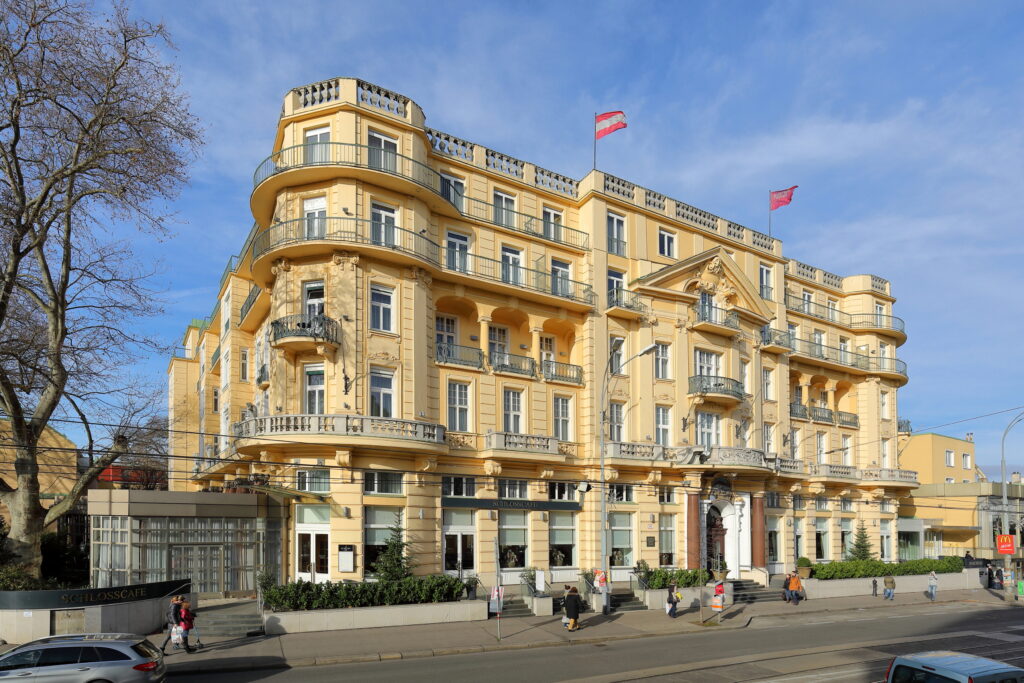
The photograph shows the main front on a clear winter day. The building is a long block in cream and pale yellow, several storeys high under a balustraded roofline. At the left corner a rounded bay rises through the upper floors, wrapped in curved balconies with iron railings, and a second, smaller curved bay appears at the right end. The upper floors are stepped back in places into deep loggias with arched openings.
At the centre a projecting section is crowned by a carved gable, with a pair of flags above the roof. The entrance below is framed by dark red polished columns and approached by a few steps; above the door, though too small to read in this view, is the relief of carriages at Dommayer’s. In front of the left wing a low modern glass pavilion houses the hotel’s café, and on the right the hedges and pavement of Hietzinger Hauptstraße lead towards the corner with the tram tracks.
Practical information
- The building is a working hotel; the front is visible from Hietzinger Hauptstraße at any time.
- The historic ballroom is still used for traditional Viennese balls and events.
- The Schönbrunn palace park is directly across the road; the hotel is best seen from the park side of the street.
- Allow ten minutes for the exterior, or combine it with a walk through Hietzing and the palace gardens.
Getting there
Hietzing station on the U4 underground line is a few minutes’ walk away, next to Otto Wagner’s court pavilion. Several tram lines also stop at Hietzing. From the city centre the U4 takes about fifteen minutes.
Nearby
- Schönbrunn Palace and its park, across the road.
- The Hofpavillon Hietzing, Otto Wagner’s private station for the emperor, about 300 metres to the east.
- The Kaiserstöckl, the small palace opposite the hotel at the edge of the Schönbrunn grounds.
- The parish church of Maria Hietzing, a short walk along the street.
Sources
- Wien Geschichte Wiki, “Schönbrunner Parkhotel”, City of Vienna: Heymann’s plans, Hopfner, the 1907–1908 construction and its cost, the relief, the fires, the occupation years, Edison and the statement that official court guests were not lodged here (after Felix Czeike’s district guide to Hietzing).
- Wien Geschichte Wiki, “Dommayers Casino”: the 1787 coffee house, Ferdinand Dommayer, Leistler’s casino of 1833, Lanner’s last concert and the debut of Johann Strauss the younger on 15 October 1844.
- 1133.at, “Von Dommayers Casino zum Parkhotel Schönbrunn”: local history of the site in Hietzing.
- Austria Trend Hotels, Parkhotel Schönbrunn: the hotel today and its ballroom.
Find it on the map
See this place and what’s around it →📷 Become a Cultural Heritage Online photographer
Share your photos of places: they stay published under your name as the author. The more they're seen, the more you get noticed — and soon a contest will reward the most appreciated photos.
Log in or sign up free to add a photoIs this page about you?
This page is read by travellers and heritage enthusiasts who find it on Google. Tell us how you are connected to this place and we will take it from there.