
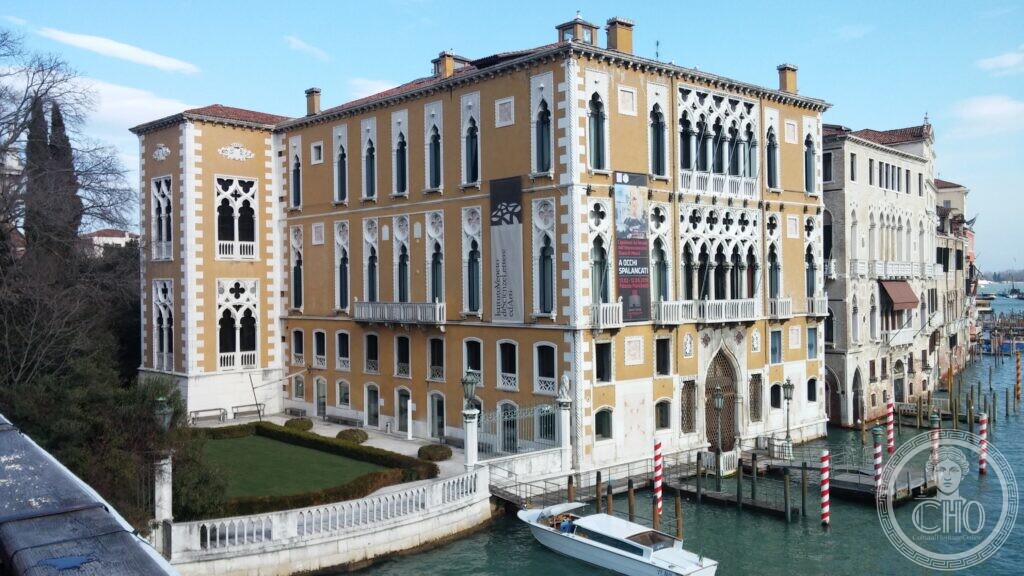
A fifteenth-century Gothic palace on the Grand Canal that the nineteenth century rebuilt in its own idea of the fifteenth. Camillo Boito did the work; the garden beside it is one of the few on this stretch of water.
At a glance
Palazzo Cavalli-Franchetti stands on the Grand Canal beside the Ponte dell’Accademia, on the San Marco side. It was built in the second half of the fifteenth century in Gothic style for the Marcello family, changed hands repeatedly in the nineteenth century, and was restored twice in fifty years, the second time so thoroughly that much of what you see is neo-Gothic rather than Gothic. Since 1999 it has belonged to the Istituto Veneto di Scienze, Lettere ed Arti, which holds exhibitions and events in it.
Key facts
- Built: second half of the 15th century, in Gothic style, for the Marcello family
- 1847: bought by the young Archduke Federico Ferdinando of Habsburg-Teschen
- Later: passed to Henri, Count of Chambord, who had Giovanni Battista Meduna restructure it
- 1878: bought by Baron Raimondo Franchetti; radical restoration directed by Camillo Boito, much of it in neo-Gothic
- Boito’s staircase: carved marble, metalwork and eclectic furnishing, the best-known thing inside
- Garden: a large one along the side front — a rarity on the Grand Canal
- Today: owned since 1999 by the Istituto Veneto di Scienze, Lettere ed Arti
- GPS: 45.43200, 12.32981 · Open in Google Maps
History
The palace was built for the Marcello in the later fifteenth century, and for three and a half centuries it was one Venetian Gothic palace among many. Its nineteenth century was busier than its fifteenth. In 1847 it was bought by Archduke Federico Ferdinando of Habsburg-Teschen, then still a young man; afterwards it went to Henri, Count of Chambord, the Bourbon claimant to the French throne, who commissioned Giovanni Battista Meduna to restructure it.
In 1878 Baron Raimondo Franchetti bought it and his family set about a restoration of a different order, directed by Camillo Boito — architect, theorist of restoration, and brother of the composer Arrigo. Much of the building came out of that work neo-Gothic: not a forgery, exactly, but a nineteenth-century reading of what a fifteenth-century palace ought to look like, carried out by the man who was then writing the rules for how such work should be done. The staircase he designed, with its carved marbles and metalwork, is what people remember from inside.
What you see
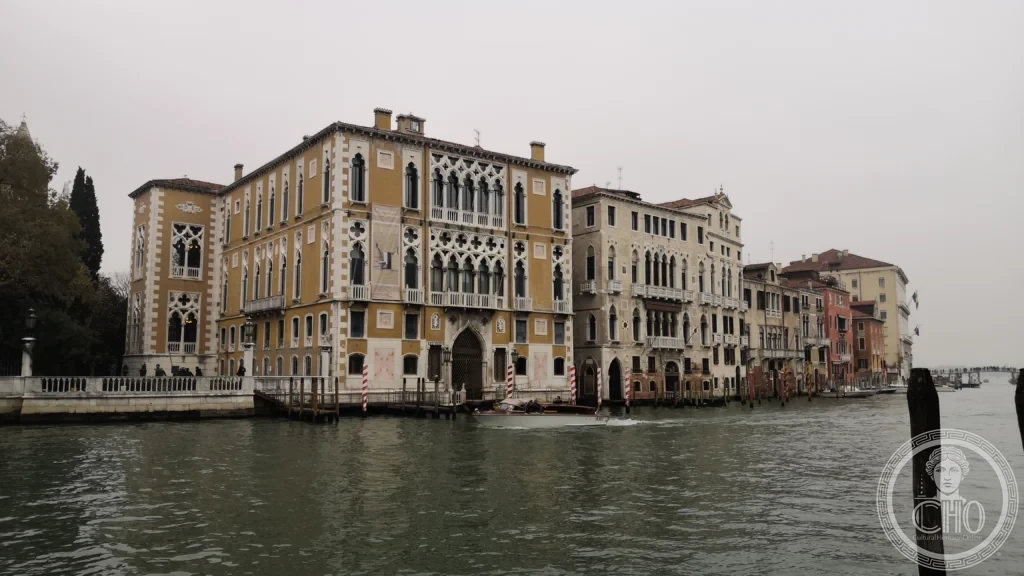
Two tiers of white traceried windows set in an ochre wall, the upper one a long row of pointed lights with quatrefoils above, laid across the front like a band of lace. At the left the wall drops away to a walled garden with clipped hedges, which on this canal is almost more conspicuous than the palace: the Grand Canal is built to the water’s edge nearly everywhere, and an open lawn reads as an absence. Striped mooring poles stand in the water at the foot of the wall, and the Accademia bridge is a few metres upstream.
Nearby
- The Ponte dell’Accademia — immediately alongside
- Palazzo Loredan — the Istituto Veneto’s other house, on Campo Santo Stefano
- Campo Santo Stefano — behind the palace
Sources
- Wikipedia (Italian), Palazzo Cavalli-Franchetti: the fifteenth-century Gothic construction for the Marcello, the purchase of 1847 by Archduke Federico Ferdinando, the Count of Chambord and Giovanni Battista Meduna, the purchase by Raimondo Franchetti in 1878 and the Boito restoration in neo-Gothic with its staircase, the garden along the side front, and the ownership of the Istituto Veneto since 1999
Gallery
Find it on the map
See this place and what’s around it →📷 Become a Cultural Heritage Online photographer
Share your photos of places: they stay published under your name as the author. The more they're seen, the more you get noticed — and soon a contest will reward the most appreciated photos.
Log in or sign up free to add a photoRequest to use these images
Each photograph is offered by the person who took it — the seller is the photographer named on the image; Cultural Heritage Online runs the payment and delivers the file on their behalf. Buying gives you the right to use the image in your own project — a website, an article, a presentation — with the file and a written licence. Read the Terms of Sale.
What you receive. The file as it is held in our archive: the photographer's own original, without the Cultural Heritage Online watermark, unretouched and not enlarged. This is a working archive built over many years by many people, so the files differ — some were taken recently, others years ago with the equipment of their time. Older pictures are usually smaller: a camera from fifteen or twenty years ago simply recorded fewer pixels than a phone does today, so the resolution is lower and the print comes out smaller. We say so rather than hide it. The size, weight, format and year of each one are printed below it, and the print size is given at 300 dpi. Nothing is upscaled to make a number look better. Where the picture on this page has been cropped for the layout, the file you receive is the full frame, which may be wider or taller than what you see here.
2621
Sold by Stefano Vigolo
€3.00
4608 × 2592 px · JPG · 6.9 MB
prints 39 × 22 cm at 300 dpi · taken 2019
Is this page about you?
This page is read by travellers and heritage enthusiasts who find it on Google. Tell us how you are connected to this place and we will take it from there.