Returning from Hollywood in 1927, Salvatore Ferragamo bypassed industrial assembly lines to anchor his bespoke workshop in Florence, turning wartime leather shortages into patented cork wedges and timeless fashion monuments.
In the spring of 1927, twenty-nine-year-old Salvatore Ferragamo (1898–1960) stepped aboard an ocean liner in New York bound for Italy. For twelve years, the shoemaker from the small Campanian village of Bonito had lived the American Dream: in Santa Barbara and Hollywood, he had operated the “Hollywood Boot Shop,” creating bespoke footwear for the silent screen’s brightest luminaries—Mary Pickford, Douglas Fairbanks, and Rudolph Valentino. Yet California, with its mass-production factories, could not supply what Ferragamo hungered for: hands capable of treating leather as a fine art.
Ferragamo chose Florence. Bypassing his native South and industrial Milan, he arrived on the banks of the Arno because Tuscany possessed six centuries of unbroken leather-tanning, gilding, and artisanal shoemaking traditions dating back to the medieval guilds. Settling in a workshop on Via Mannelli with sixty hand-craftsmen, he incorporated his Florentine business in 1927.
The anatomy of the arch and the cork revolution
Ferragamo did not consider shoemaking a decorative cosmetic craft; he approached it as orthopaedic architecture. While in California, he had studied human anatomy, chemical engineering, and mathematics at the University of Southern California. He discovered that the human body’s weight falls vertically onto a tiny strip of bone in the foot’s arch: support that arch with a rigid steel shank, and the toes are liberated from pinching.
His greatest aesthetic revolution was born of necessity. When international economic sanctions were imposed on Italy in 1935, high-grade leather and steel for arch shanks became unavailable. Refusing to close his workshops, Ferragamo began experimenting with indigenous Tuscan materials: raffia, hemp, cellophane, and sardine-can wire. In 1937, he noticed how Sardinian wine bottle corks were buoyant yet resilient. Gluing layers of compressed cork together, he carved out the space between heel and sole, patenting the wedge heel (*zeppa di sughero*). It became one of the most widely imitated shoe silhouettes of the twentieth century.
Palazzo Spini Feroni: Fortress of fashion
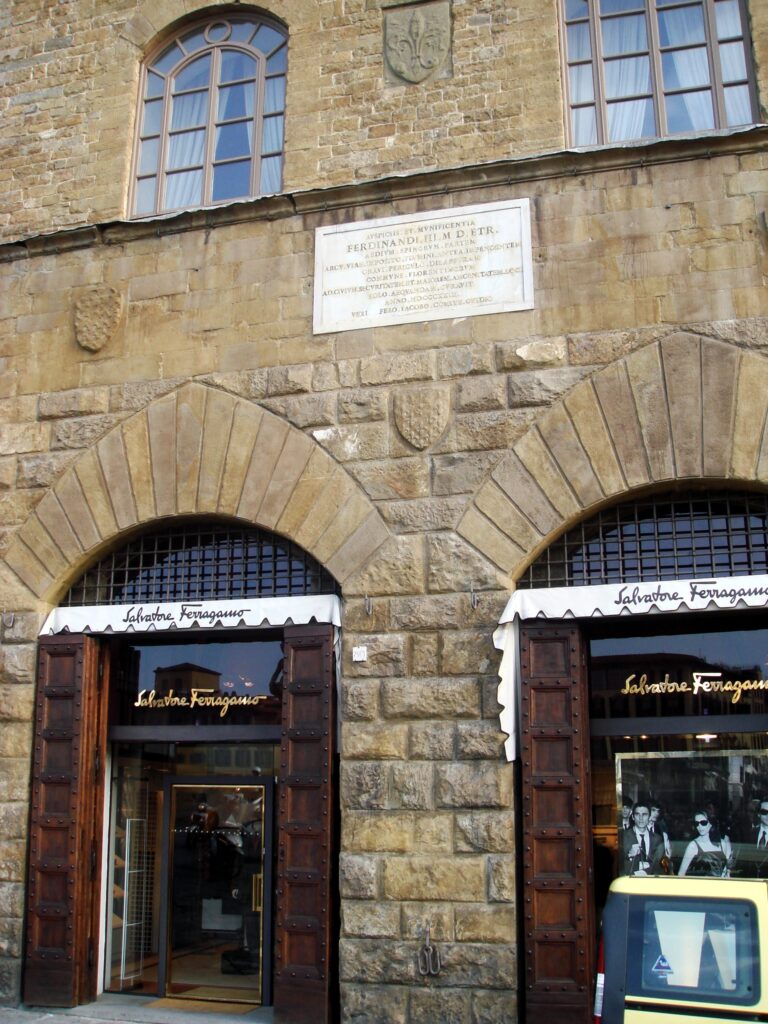
In 1938, Ferragamo took an audacious step: he purchased the colossal Palazzo Spini Feroni, a fourteenth-century crenellated fortress standing on Piazza Santa Trinita overlooking the Arno. Converting the ground floor into an opulent salon furnished with Renaissance tapestries and Tuscan walnut counters, he made Florence the primary destination for international royalty, cinema stars, and heads of state seeking bespoke luxury.
Following Salvatore’s death in 1960, his widow Wanda Miletti Ferragamo and their six children transformed the atelier into a global fashion maison, expanding into leather goods, silk scarves, and ready-to-wear without ever relinquishing family ownership.
What remains today
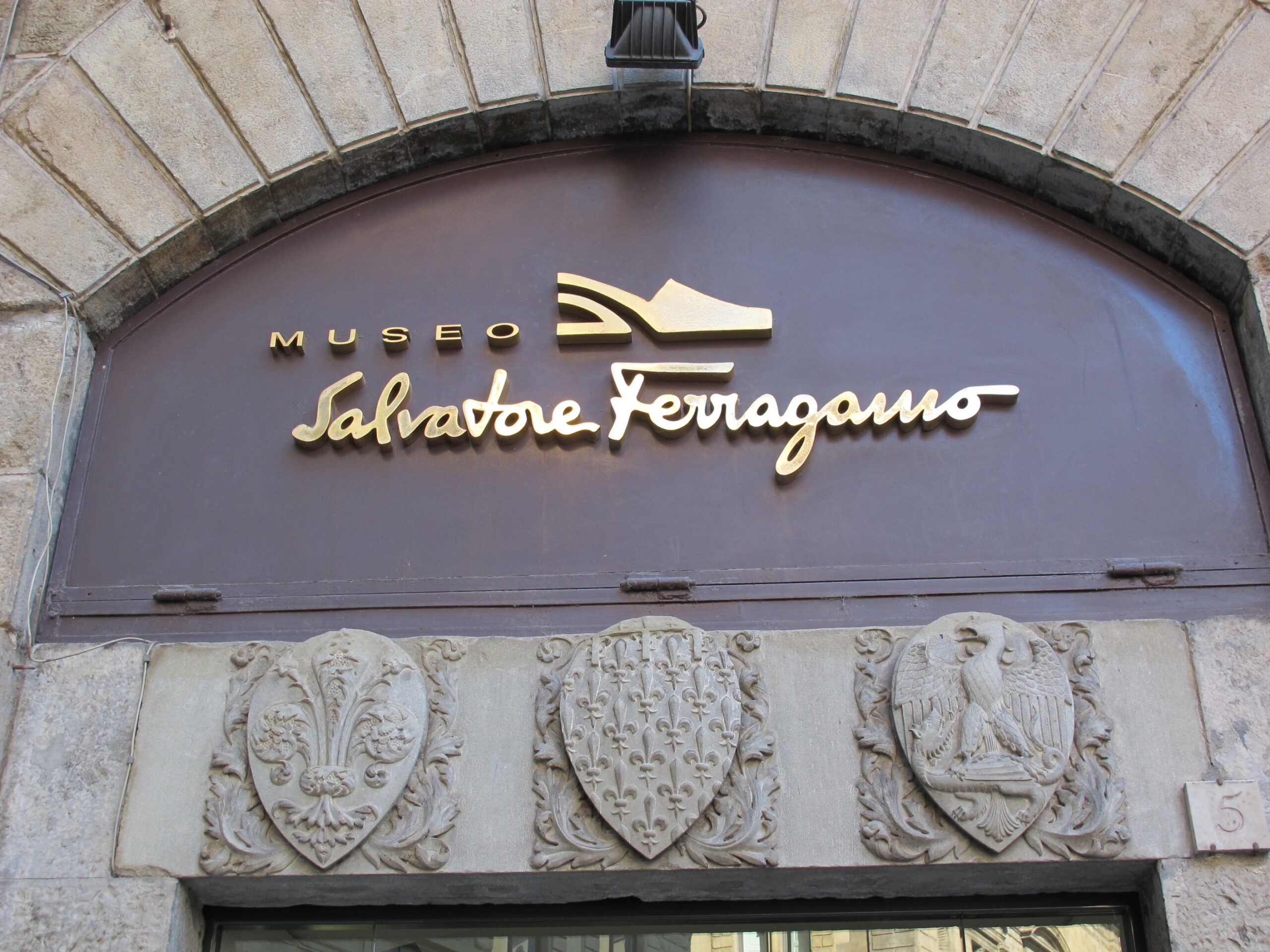
Palazzo Spini Feroni remains the global headquarters of Salvatore Ferragamo. In its vaulted basement and Gothic chambers, the Museo Salvatore Ferragamo conserves an archive of over fourteen thousand original shoe models, patent documentation, and the personalized wooden lasts carved for Audrey Hepburn, Sophia Loren, and Marilyn Monroe. Walking from Via Tornabuoni across the Santa Trinita bridge, the stone battlements stand as an enduring tribute to the moment when a Hollywood shoemaker returned to Renaissance Florence to prove that comfort and high art could be carved from a block of cork.
Historic Views & Archives
From the Archives: Historical Newsreels
Artigianato in Italia: mostra delle calzature e creazioni di moda
Fascinating period newsreel illustrating the ingenuity of Italian footwear artisans: hand-stitching uppers, working alternative autarkic materials such as cork and raffia, and staging runway presentations.
Visiting the Site: Street View & Modern Geography
Palazzo Spini Feroni stands directly at the head of the Santa Trinita bridge on the north bank of the Arno. Originally built in 1289, its soaring stone battlements and Gothic halls contain the Museo Salvatore Ferragamo, exhibiting the original wooden shoe lasts carved for Greta Garbo, Audrey Hepburn, and Marilyn Monroe.
Historic Address: Palazzo Spini Feroni, Piazza Santa Trinita 5 & Via de’ Tornabuoni 2, 50123 Firenze, Italy
Sources
- Salvatore Ferragamo, Shoemaker of Dreams: The Autobiography of Salvatore Ferragamo, London, Harrap, 1957
- Stefania Ricci (ed.), Salvatore Ferragamo: The Art of the Shoe (1927–1960), Milan, Skira, 2010
- Treccani, Dizionario Biografico degli Italiani, entry on Salvatore Ferragamo (Vol. 46)
- Museo Salvatore Ferragamo, Archivio Storico e Brevetti Ferragamo, Florence