

Brussels lost most of its great cafés to the twentieth century. This one survived by never closing, and by letting each decade leave something behind on the way through.
At a glance
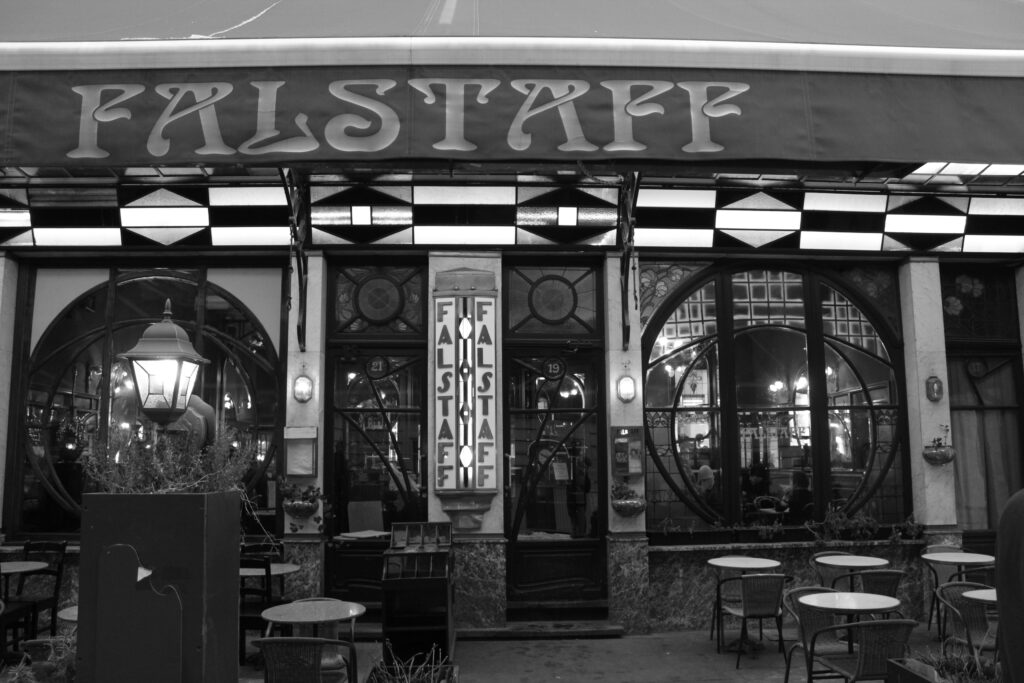
Le Falstaff occupies the ground floor of a large nineteenth-century classical building at rue Henri Maus 17, on the flank of the Brussels Stock Exchange. The café opened in 1903, and its woodwork and glass are the work of Émile Houbion, a joiner who had worked with Victor Horta. What makes it unusual is that it was never frozen: the Art Nouveau shopfront acquired an Art Deco canopy and an Art Deco sign, and the interior layers Art Nouveau over nineteenth-century eclecticism without trying to reconcile the two. It was listed as a monument in October 2000 and is still a working café and restaurant.
Key facts
- Opened: 1903
- Decoration: Émile Houbion, joiner, a collaborator of Victor Horta
- Styles: Art Nouveau shopfront and glass; Art Deco canopy and sign; eclectic interior
- Setting: Ground floor of a nineteenth-century classical building, beside the Bourse
- Address: Rue Henri Maus 17, 1000 Brussels
- GPS: 50.847726, 4.349937 — View on Google Maps
- Protected: Listed as a monument in October 2000
- Still in use: Café and restaurant
History
The café took its name from Shakespeare’s fat knight and opened in 1903, in the years when the streets around the Bourse were the commercial centre of a confident city. Houbion, who came to the job as a carpenter rather than an architect, had worked alongside Horta, and the curved timber and glass of the shopfront carry that training plainly.
The Art Deco elements — the canopy in American glass, the vertical sign — came later, and they are the reason the building is worth reading carefully. A purist would call them an intrusion. In practice they record what actually happened to Brussels café culture between the wars, and they are now protected alongside the rest. The listing of October 2000 covers the ensemble, layers and all.
Very few of the grand cafés that once lined this quarter are still doing the job they were built for. Le Falstaff is one of them, which is why the regional heritage authorities describe it as a rare surviving witness rather than simply a fine facade.
What you see
Two rounded shop windows bow outward on either side of the door, their frames carrying Art Nouveau ornament, with stained glass set into the upper corners where the curve meets the lintel. Above them the marquise projects in American glass, an Art Deco addition, and the vertical sign that carries the name is Art Deco too. The effect from the pavement is of one shopfront speaking in two accents.
Inside, the mixture continues. Stained glass, ironwork and joinery define the rooms, but they sit against an interior that is essentially nineteenth-century and eclectic, the kind of space a large café needed before anyone had decided what a modern one should look like. Go in the late evening, when the room is full and the lamps are doing the work the daylight does through the windows at noon.
Practical information
- A working café and restaurant, not a museum — you can simply go in and sit down
- Open late; the interior is best seen outside peak meal service if you want to look at it properly
- The shopfront is visible from the street at any hour and is worth a detour on its own
- Pair it with Le Cirio, the other listed Brussels café of the period, two minutes away on the far side of the Bourse
Getting there
Rue Henri Maus runs along the south-western side of the Bourse, in the Pentagon, the historic core of Brussels. Bourse and De Brouckère are the nearest metro and tram stops, and the Grand-Place is a three-minute walk east through the surrounding lanes. Brussels-Central station is about ten minutes on foot.
Nearby
- Le Cirio — the other great listed café beside the Bourse, two minutes away
- Grand-Place — the UNESCO-listed square, three minutes east
- Galeries Royales Saint-Hubert — Cluysenaar’s glazed arcade of 1847
- Hotel Métropole — the 1895 grand hotel on place De Brouckère
- Belgian Comic Strip Center — Horta’s Magasins Waucquez of 1906
Sources
- Admirable Art Nouveau / Admirable Facades (admirable-artnouveau.brussels), official Brussels-Capital Region programme, entry « Falstaff Tavern » — date, decorator, description of shopfront, canopy, stained glass and interior, listing of October 2000
- Brussels-Capital Region, architectural heritage inventory (monument.heritage.brussels) — protected status of the rue Henri Maus ensemble
- Wikidata Q3516289 — identification and address
- OpenStreetMap Nominatim — coordinates verified against rue Henri Maus 17
Find it on the map
See this place and what’s around it →📷 Become a Cultural Heritage Online photographer
Share your photos of places: they stay published under your name as the author. The more they're seen, the more you get noticed — and soon a contest will reward the most appreciated photos.
Log in or sign up free to add a photoIs this page about you?
This page is read by travellers and heritage enthusiasts who find it on Google. Tell us how you are connected to this place and we will take it from there.