
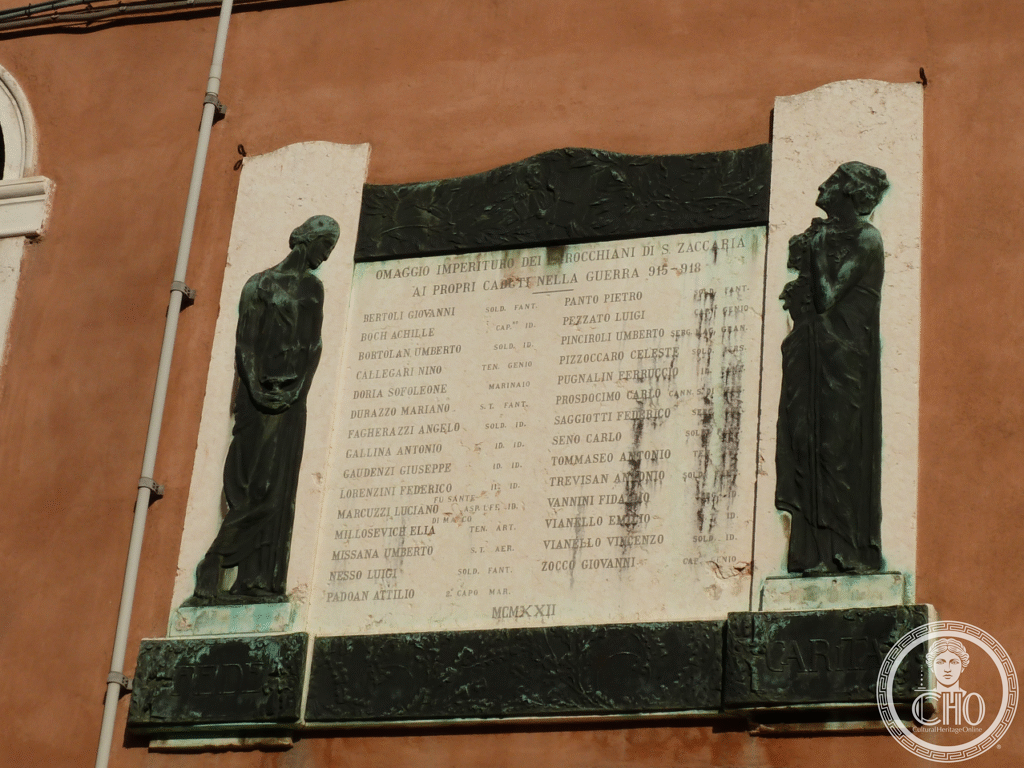
Twenty-nine men of one parish, each with his rank beside his name, under two bronze figures called Faith and Charity — on the wall of a private house in Campo San Provolo.
At a glance
A stone tablet framed by bronze on a red-rendered house front in Campo San Provolo, a few steps from the church of San Zaccaria. Two bronze female figures stand on plinths at either side, draped to the feet, the one on the left with her head bowed, the one on the right looking upward; the plinths are lettered FEDE and CARITÀ, Faith and Charity. A bronze band across the top carries foliage, the lion of Saint Mark and a shield with a cross. Between the figures, the parish of San Zaccaria honours twenty-nine of its men killed in the First World War, in two columns, each name followed by his rank — infantryman, sergeant, sapper, gunner, sailor, airman. At the foot, the year: MCMXXII.
Key facts
- Unveiled: 1922, the year cut at the foot of the tablet
- Materials: stone tablet with bronze plates and reliefs
- Figures: two allegorical women in bronze, on plinths lettered FEDE and CARITÀ
- Names: twenty-nine, fifteen in the left column and fourteen in the right, each with the man’s rank and arm of service
- Dedication: Omaggio imperituro dei parrocchiani di S. Zaccaria ai propri caduti nella guerra 915–918
- Location: Campo San Provolo, Castello 4700, on the wall of a private house
- GPS: 45.43498, 12.34264 · Open in Google Maps
History
In the years after 1918 nearly every Venetian parish put up its own roll of honour, usually paid for by a parish committee and set where the neighbourhood would pass it daily rather than inside the church. San Zaccaria chose the wall of a house in Campo San Provolo, the small square that opens off the way to the church, and its committee commissioned something more ambitious than a plaque: a composition in stone and bronze, with two standing allegories and a crowning band bearing the lion of Saint Mark.
The dedication is characteristic of its moment and is worth reading as written: omaggio imperituro dei parrocchiani — the undying homage of the parishioners — not of the parish or the city. The dates are abbreviated to 915–918, as they often were in those years, when nobody needed to be told which century was meant. What sets this memorial apart from most is the ranks: beside each name stands the man’s place in the army or the navy, from sold. fant. to ten. genio, marinaio, cann. and s. ten. aer. — infantry, engineers, navy, artillery, air service. In a parish of a few hundred households, that list is a cross-section of how one Venetian quarter was distributed across the whole of the Italian war.
The two figures are named by their plinths rather than by their attributes. Faith and Charity are the two theological virtues that fit a memorial; the third, Hope, is missing, and the composition makes no room for it. The two women do not mirror each other: Faith, on the left, stands with her head bowed and her hands clasped low, in mourning; Charity, on the right, lifts her face upward, her hands gathered at her breast.
What you see
The whole composition is mounted flat on a red wall, and the bronze has gone dark green against it. Water has run down the face of the stone over a century, staining the right-hand column of names; several are now hard to read from the ground. The upper bronze band is cut in an uneven, deliberately rough edge along its top, with the winged lion at its centre. Below the tablet, three bronze panels run across the base, the outer two bearing the words of the virtues.
Nearby
- San Giorgio dei Greci — two minutes east
- Hotel Savoia & Jolanda — on the Riva degli Schiavoni, two minutes south
- War Memorial of the San Nicola da Tolentino Parish — the same year, at the other end of the city
Sources
- Pietre della Memoria, Lapide ai Caduti nella Grande Guerra della parrocchia di San Zaccaria (Venezia) (census record 177299, compiled by Jonathan Glixon) — pietredellamemoria.it: the address at Castello 4700 and the setting on a private house, the materials, the lion of Saint Mark and the shield, the figures of Faith and Charity, the date 1922; the record counts twenty-eight names, the stone in the photograph carries twenty-nine
- Ministero della Cultura, Catalogo generale dei Beni Culturali, lapide commemorativa, record 0500724844 — catalogo.beniculturali.it: Campo San Provolo, Castello 4700; bronze and marble; 1922; attributed only to a Venetian workshop of the twentieth century (“ambito veneziano”), with no author named
- The monument itself, read from the contributed photograph: the dedication in full, the ranks beside the names, the lettering of the plinths and the condition of the stone
Two things we could not confirm. The photographs came to us with the sculptor given as Raffaele Romanelli and the unveiling as 10 December 1922. The Florentine sculptor of that period is Raffaello Romanelli (1856–1928), and no source we could find attributes this memorial to him or to anyone else: the census record for the monument leaves the author blank, the national catalogue of the Ministry of Culture gives only “Venetian workshop, twentieth century”, and the stone itself gives only the year. We have therefore not put a name or a day on this page, and we have asked the photographer for his source. If he has one, we will add it and credit him.
Find it on the map
See this place and what’s around it →Record researched and written by Carla Szathvary for Cultural Heritage Online, 2026.
📷 Become a Cultural Heritage Online photographer
Share your photos of places: they stay published under your name as the author. The more they're seen, the more you get noticed — and soon a contest will reward the most appreciated photos.
Log in or sign up free to add a photoIs this page about you?
This page is read by travellers and heritage enthusiasts who find it on Google. Tell us how you are connected to this place and we will take it from there.