
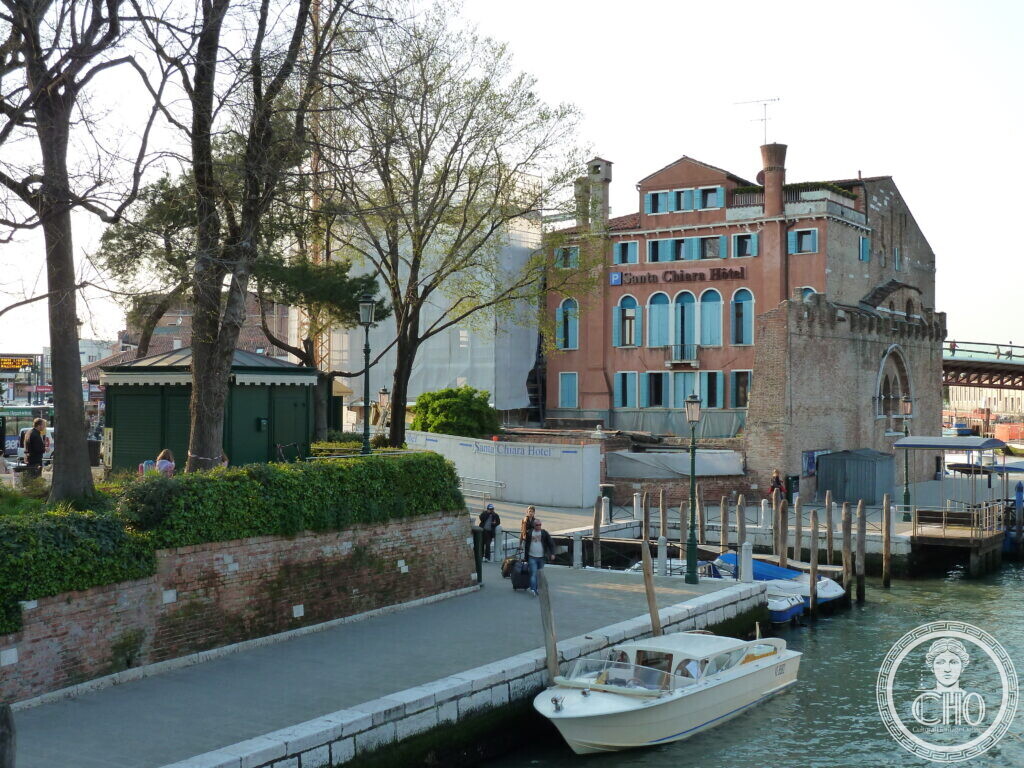
An island given to a Franciscan nun in 1236 became a monastery, then a military hospital, then the ground Piazzale Roma and the Rio Novo were built over. A brick range with a blocked Gothic arch is what survives.
At a glance
At the very edge of Venice, where the causeway traffic stops and the city begins, a pink building with blue shutters carries the name Santa Chiara — and so does the quay it stands on. Both are named after the Franciscan monastery that occupied this ground from the thirteenth century until Napoleon closed it. The convent church was pulled down in 1819; the rest was eaten away in the twentieth century, first by the new road terminal at Piazzale Roma and then by the cutting of the Rio Novo in 1933. What remains of the monastery buildings is split between two occupiers: the main range is used by the Venice police headquarters, and a surviving portion — the brick wall with the blocked pointed arch and the crenellated parapet visible in the photograph — is part of the hotel.
Key facts
- Foundation: the island was given in 1236 by Giovanni Badoer to Costanza Calbo, a Franciscan nun, so that a monastery could be built on it
- First dedication: the church was titled Santa Maria Mater Dei before being dedicated to Saint Clare
- Fire and rebuilding: destroyed by fire in 1574; rebuilt and consecrated in 1620
- Suppression: church and convent closed in 1806 under Napoleonic rule, the nuns moved to Santa Croce in 1807, the church demolished in 1819 and the island turned into a military hospital
- What was lost: altarpieces by Antonio Vassilacchi, Palma il Giovane and Giovanni Battista Lorenzetti; a polyptych by Paolo Veneziano from the church is now in the Gallerie dell’Accademia
- The cut of 1933: the Rio Novo canal and the expansion of Piazzale Roma removed much of what was left
- Today: the main monastery range houses the questura; the hotel has occupied its part of the complex since 1950
- GPS: 45.43854, 12.31952 · Open in Google Maps
History
In 1236 a Venetian patrician, Giovanni Badoer, gave an island at the western edge of the lagoon city to Costanza Calbo, a nun of the Franciscan observance, for the building of a monastery. The community that grew there belonged to the order then still called the Damianites, after San Damiano in Assisi; their church, first dedicated to Santa Maria Mater Dei, took the name of Saint Clare soon afterwards, and gave it to the island, the quay and eventually to the hotel.
Fire destroyed the church in 1574. It was rebuilt and reconsecrated in 1620, with five altars and paintings by Antonio Vassilacchi, Palma il Giovane and Giovanni Battista Lorenzetti; older still was a polyptych by Paolo Veneziano, which survived the suppression and hangs today in the Gallerie dell’Accademia. That suppression came in 1806: the Napoleonic administration closed church and convent, the nuns were transferred to the monastery at Santa Croce in 1807, and the building was stripped. In 1819 the church was demolished and the island given over to a military hospital.
The real erasure, though, was modern and civic rather than political. When Venice built its road terminal at Piazzale Roma in the 1930s and cut the Rio Novo through in 1933 to shorten the water route to the Grand Canal, the surviving conventual buildings were partly dismantled to make room. What stands today is therefore older than the canal beside it — which is the opposite of how the site reads at first glance, with the bus station on one side and a modern annexe on the other.
What you see
Two buildings joined at the corner. On the left, four floors of pink render with pointed windows and blue shutters, a roof terrace planted with hedges, and the hotel sign across the third floor. On the right, an older brick range: a wide pointed arch blocked with masonry, a small barred window inside it, and above, a low crenellated parapet. That arch and that wall are the convent. In the photograph, taken in 2013, scaffolding and sheeting cover the building immediately behind; the white balustrade and the walkway on the right belong to the Ponte della Costituzione, which crosses the Grand Canal a few metres away.
Practical information
- The building is in use as a hotel and is not open to visitors, but the whole front can be seen from the Fondamenta Santa Chiara and from the Ponte della Costituzione
- The hotel states that it has operated here since 1950 and that it is the only hotel in Venice reachable by car, with its own parking
- The adjoining monastery range is a police building; it is not visitable
Getting there
At Piazzale Roma, where the road bridge from the mainland ends: two minutes from the bus terminal and the People Mover, and at the foot of the Ponte della Costituzione, which leads over the Grand Canal to the railway station.
Nearby
- Ponte della Costituzione — the Calatrava bridge, immediately beside it
- Ponte Papadopoli — Miozzi’s 1933 bridge over the Rio Novo, the canal that took away the rest of the convent
- San Nicola da Tolentino — five minutes east
Sources
- Canal Grande di Venezia — catalogo illustrato, entry Ex Convento di Santa Chiara — canalgrandevenezia.it: the 1236 donation, the fire of 1574 and consecration of 1620, the closure of 1806, the survival of the monastery range as a police building, and the hotel occupying preserved parts of the convent
- Conoscere Venezia, Isola di Santa Chiara — the donation by Giovanni Badoer to Costanza Calbo, the first dedication to Santa Maria Mater Dei, the transfer of the nuns to Santa Croce in 1807, the demolition of the church in 1819 and the military hospital
- Hotel Santa Chiara, official site — the sixteenth-century monastery fabric, operation as a hotel since 1950, and the claim to be the only hotel in Venice reachable by car
- On the lost church and its paintings: Elena Khalaf, La chiesa scomparsa di Santa Chiara a Venezia. Le vicende architettoniche, il polittico di Paolo Veneziano, la comunità religiosa e i suoi benefattori nel Medioevo, Centro Studi Antoniani, Padua 2024, 367 pp., ISBN 978-88-95908-32-8 — the standing monograph on the lost church
- The building itself, read from the contributed photograph: the blocked Gothic arch, the crenellated parapet and the join between convent and hotel
Find it on the map
See this place and what’s around it →Record researched and written by Carla Szathvary for Cultural Heritage Online, 2026.
📷 Become a Cultural Heritage Online photographer
Share your photos of places: they stay published under your name as the author. The more they're seen, the more you get noticed — and soon a contest will reward the most appreciated photos.
Log in or sign up free to add a photo