
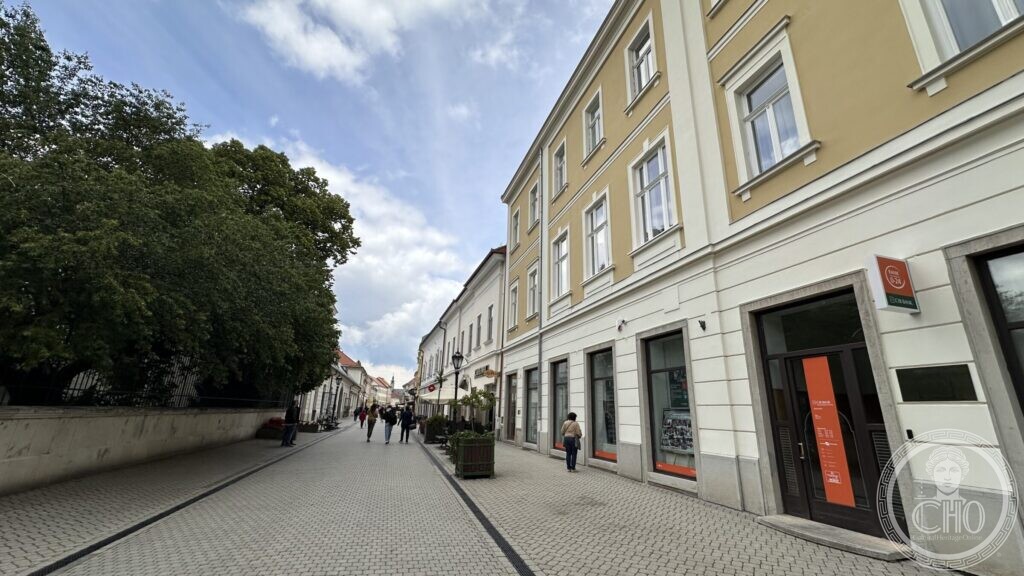
Eger, Hungary · the main street · seventeen protected houses along it
At a glance
Széchenyi István utca is where Eger does its business and always has. It runs north from the Lyceum, past the gate of the Archbishop’s Palace, past the Cistercian church, and it is paved end to end for walking. A county monograph written at the beginning of the twentieth century called it the town’s main street, «where the liveliest traffic pulses as around a centre», and listed what stood along it: the chapter’s tenement with its neat shops, three savings banks, the printing house, the post and telegraph office, the officers’ casino and the Eger Club. Seventeen of its houses are in the national register of protected monuments.
Key facts
- Eger’s main street, pedestrianised, running roughly north from Eszterházy tér
- Seventeen addresses on the street are protected monuments, among them the Archbishop’s Palace complex at 1–3 (register number 2029), the Érsekudvar at 5 (2030), the Kilián house at 7, the Fekete house at 11, the Cistercian church at 15 and its monastery at 17, and the Jesuit college at 19
- At the beginning of the twentieth century the street carried the Heves County Savings Bank, the Eger Savings Bank, the Agrarian Savings Bank, the Eger printing company, the post and telegraph office, the officers’ casino and the Eger Club
- Named after István Széchenyi (1791–1860)
- Coordinates of the view in the photograph: 47.90097, 20.37456
What you see

A wide paved corridor of small grey setts with two dark drainage lines running down it, wide enough that it reads as a square stretched long. On the left, for the first stretch, there is no building at all — a stone parapet and an iron railing, with the trees of the Archbishop’s garden leaning over them, which is why the street feels open on one side and closed on the other. On the right the fronts come straight down to the pavement: two and three storeys, ochre and white, plain window surrounds, shopfronts and bank branches at ground level, a wrought-iron lantern here and there. Cafés put their tables out where the railing ends. Far down the perspective, above the roofs, a church tower.
It is not a monumental street and it was never meant to be. The great set pieces of Eger — the basilica, the Lyceum, the castle — stand at its ends or above it. What runs between them is a working high street, and the protected houses stand in the row with the phone shops without any fuss about it.
Practical information
- Pedestrian for its central stretch; the basilica and the Lyceum are at the southern end, Dobó István tér and the castle a short walk to the east.
- The Archbishop’s Palace, at number 3, is open to visitors and its garden and ground floor are free.
Sources
- Samu Borovszky (ed.), Magyarország vármegyéi és városai, Heves county volume — «Egernek ez a főutczája; itt lüktet, mint középpont körül, a legélénkebb forgalom», and the list of institutions along the street
- Műemlékjegyzék, the Hungarian register of protected monuments, Eger — the seventeen protected addresses on Széchenyi utca and their register numbers
- Műemlékem.hu — Érseki palota, Széchenyi u. 1–3 (2029) and Érsekudvar, Széchenyi u. 5 (2030)
Record researched and written by Luigi De Marchi for Cultural Heritage Online, 2026.
Find it on the map
See this place and what’s around it →📷 Become a Cultural Heritage Online photographer
Share your photos of places: they stay published under your name as the author. The more they're seen, the more you get noticed — and soon a contest will reward the most appreciated photos.
Log in or sign up free to add a photo