

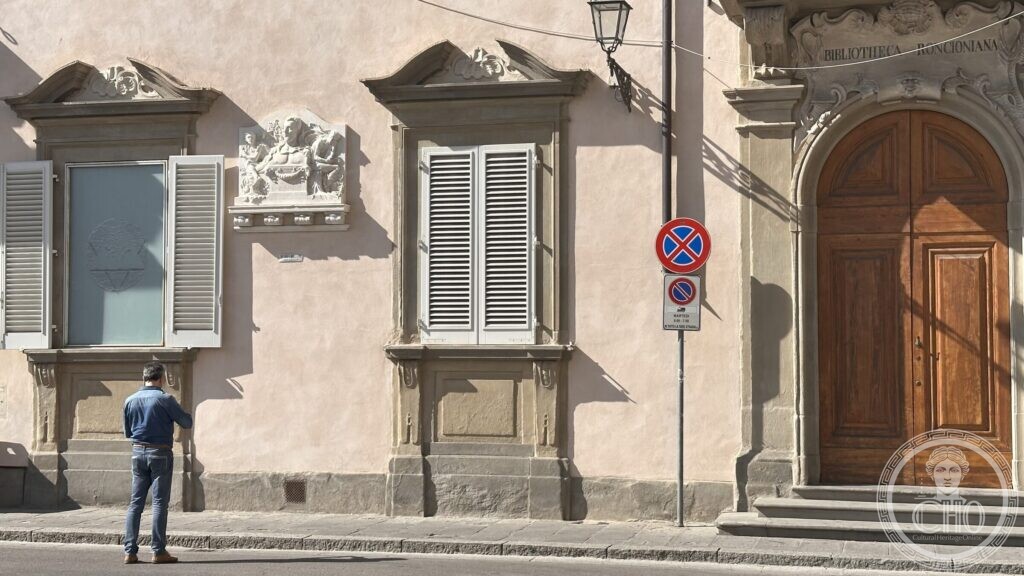
Prato, Tuscany · a library since 1722 · in a building designed to be one
At a glance
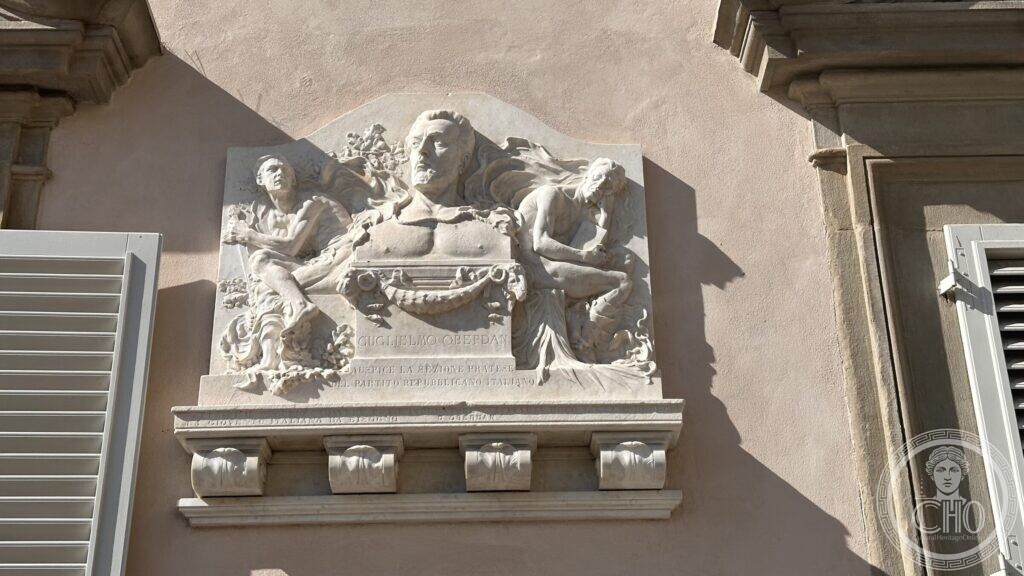
In his will of 1676 Marco Roncioni, a Prato nobleman of Pisan descent, set aside part of his estate to found «una pubblica libraria» — a public library, open for the study of «ogni sorta d’arte, lettere, scienza e professione». It opened in 1722, and in 1766 it moved into a palace built for the purpose. It is still there, still open, and still the oldest library in Prato. On the front, between two windows, somebody later fixed a marble relief to Guglielmo Oberdan.
Key facts
- Address: Piazza San Francesco 27, 59100 Prato
- 1676 — the will of Marco di Emilio Roncioni (1600–1677) endows a public library
- 1722 — the library opens, provisionally housed
- 1751–1766 — Palazzo Roncioni is built, probably to a design by Antonio Saller, later altered by Francesco Arrighi and Stefano di Rigo; the library moves in in 1766
- Inside: a frescoed entrance hall, a reading room whose vault was painted by Luigi Catani in 1789, the original timber shelving, and a pair of sixteenth-century Mercator globes
- Manuscripts from the thirteenth to the nineteenth century in three collections — Roncioni, Cesare Guasti, Caccini–Del Vernaccia — with nineteenth-century periodicals
- On the façade, a marble relief to Guglielmo Oberdan, put up by the Prato section of the Italian Republican Party
- Coordinates: 43.87965, 11.09613
What you see
A long pale front on the square, of the sober Tuscan kind: stone-framed windows with broken segmental pediments, a heavy stone plinth, a round-arched doorway under a carved cartouche with BIBLIOTHECA RONCIONIANA cut into the architrave. That inscription is the point. Most old libraries are in buildings that were something else first — a convent, a palace, a school. This one was put up as a library and says so on the door.
The Oberdan relief
To the left of the doorway, set between two windows on its own moulded bracket, is a marble panel in high relief. In the middle, rising out of a plinth, is the head and bare torso of Guglielmo Oberdan, the Trieste irredentist executed by Austria in 1882. Two figures flank him: on the left a young man with a torch, on the right a woman with loose hair leaning on the stone. Across the plinth, in Roman capitals, GUGLIELMO OBERDAN; under it, AUSPICE LA SEZIONE PRATESE DEL PARTITO REPUBBLICANO ITALIANO — at the instigation of the Prato section of the Italian Republican Party.
Along the cornice below runs a line of Oberdan’s own words. It is worn, and we will not guess at what we cannot read: what survives is LA GIOVENTÙ ITALIANA HA BISOGNO… and, at the far end, the signature G. OBERDAN. Above it a second, older line is almost gone; the few letters still legible belong to the phrase about throwing one’s own body between Italy and Austria.
What we do not know
Who carved the relief, and when. We could not find it in the national catalogue of historic and artistic property, and the local sources we could reach name neither a sculptor nor a date. The dedication by a party section rather than by the city suggests a private subscription, which is exactly the kind of thing that leaves little paper. If you know the sculptor, the year, or the full text on the cornice, start your message with the title of this page and write to us, or send it on WhatsApp to +1 307 445 9906. Everything we are sent is checked against independent sources before it goes on the page, and we say where it came from.
Photographs

Practical information
- A working library open to readers; the reading room and the historic rooms are visitable, and opening hours are published by the library
- The relief and the doorway are on a public square and can be seen at any time
- Piazza San Francesco is five minutes from Piazza del Comune and the Palazzo Pretorio museum
Sources
- Biblioteca Roncioniana, its own history page — the 1676 will of Marco di Emilio Roncioni, the words «una pubblica libraria», the 1722 opening, the 1766 move, the palace of 1751–1766 «probabilmente su progetto di Antonio Saller» altered by Francesco Arrighi and Stefano di Rigo, the Catani vault of 1789, the Mercator globes and the manuscript collections
- Comune di Prato and Città di Prato, library pages — address and public status
- Catalogo generale dei Beni Culturali — searched for the Oberdan relief; the Oberdan record returned for this search is the Trieste monument by Attilio Selva and Umberto Nordio, not this one
- The inscriptions are transcribed from the photographs, 9 October 2025
Record researched and written by Luigi De Marchi for Cultural Heritage Online, 2026.
Find it on the map
See this place and what’s around it →📷 Become a Cultural Heritage Online photographer
Share your photos of places: they stay published under your name as the author. The more they're seen, the more you get noticed — and soon a contest will reward the most appreciated photos.
Log in or sign up free to add a photoIs this page about you?
This page is read by travellers and heritage enthusiasts who find it on Google. Tell us how you are connected to this place and we will take it from there.