
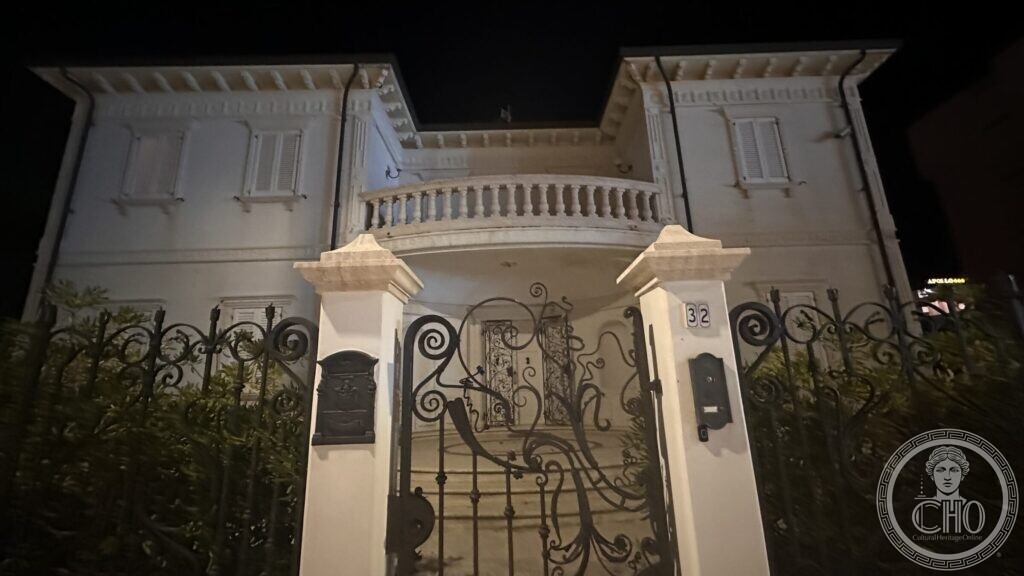
A hundred years ago this was a stretch of dunes. Then a master builder from Rimini put up the first villas, and the bourgeoisie of Bologna came down to the sea — bringing ironwork like this with them.
At a glance
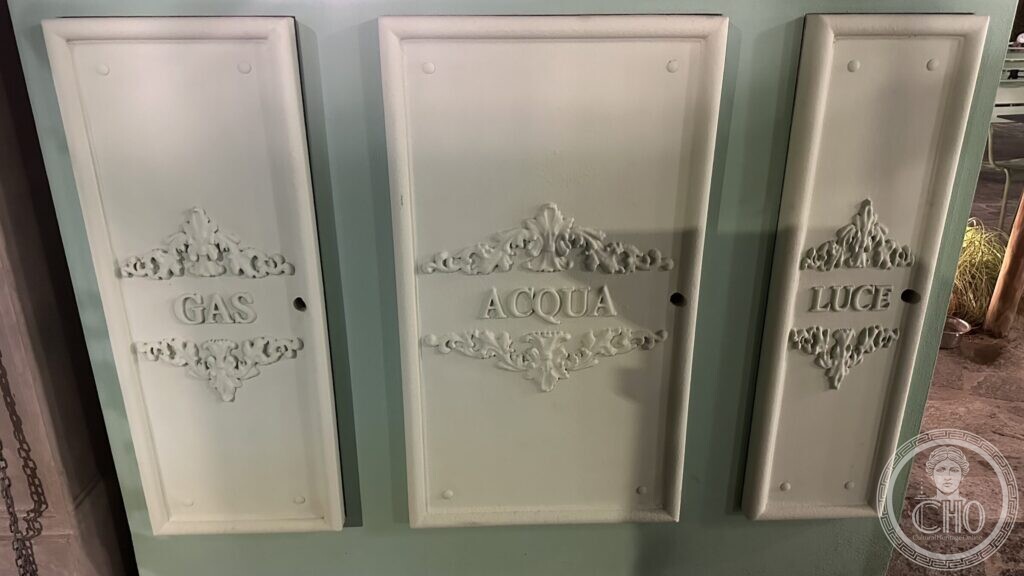
Viserbella is the seaside strip north of Rimini that went up in the first decades of the twentieth century, when Viserba next door was already a fashionable resort. Most of what was built here was demolished after the Second World War to make room for hotels, but pieces survive along the seafront road. At number 32 of viale Porto Palos a villa keeps a wrought-iron pedestrian gate in full Art Nouveau whiplash — scrolls, tendrils and a swelling curve that fills the whole opening — and a little further along the same street, three cast-iron meter doors marked GAS, ACQUA and LUCE carry the same vocabulary at the scale of a utility cupboard.
Key facts
- Where: viale Porto Palos, the seafront road of Viserbella, Rimini
- The villa: number 32; two floors, a curved stone balcony on the first floor, an arched loggia below
- The gate: wrought iron, Art Nouveau, with a panel of scrollwork below the bars
- Who built Viserbella: the master builder Raffaele Mussoni made the first villas here, beginning with those of the accountant Giulio Cesare Gamberini and the Friulian artist Augusto Aviano
- Viserba, next door: developed by the Bologna engineer Giambattista Bavassano with local master builders, among them Sante Polazzi
- Name, architect and date of this villa: not established. See the note below.
- Coordinates: 44.093250, 12.530400 — Google Maps
History
Manlio Masini gave his book on this place a title that says everything about it: Viserbella. Da squallida distesa di dune a nuovo Eden dell’Adriatico — from a bleak stretch of dunes to a new Eden of the Adriatic. The transformation happened within a generation. Viserba went first: the Bologna engineer Giambattista Bavassano drove the building of villas and villini there from the turn of the century, working with local master builders, among them Sante Polazzi. A few years later it was Viserbella’s turn, and the master builder Raffaele Mussoni put up the first villas — starting with the houses of the accountant Giulio Cesare Gamberini and of the Friulian artist Augusto Aviano.
The clients were not local. They were nobles, professionals, officers, landowners and industrialists, mostly from Bologna but also from other Italian cities, and the surnames recur through the local literature: Baschieri, Bertarelli, Buzzi, Campogrande, Drei, Lanfranchi, Luttichau, Manfredi, Merenda, Nigrisoli, Pezzi, Piccinini, Pirzio-Biroli, Protti, Rabbi, Rasponi, Rodoni, Salvetat, Scaglietti, Schiavio, Strinasecchi, Sturani, Venturini. Among the celebrated villas still standing is Villa Bonci, the permanent home of the tenor Alessandro Bonci from Cesena, who died there in the summer of 1940 at seventy.
Then the resort ate itself. Hundreds of these buildings were demolished after the war to put up hotels and boarding houses, and what survives on the Romagna coast is a series of fragments rather than an intact quarter. That is the right way to look at a gate like this one: not as an ornament on a house, but as a surviving piece of a vanished street.
What we have not established. We have found no record naming this villa, its architect or its date. The style of the ironwork belongs to the first fifteen years of the twentieth century, and the building sits squarely in Mussoni’s Viserbella, but a resemblance is not an attribution and we are not going to turn one into the other. If you know the house — its family, its builder, its year — please write to us.
What you see
The villa presents a symmetrical front of two floors, rendered pale, with a stone balcony curving out over the entrance on a shallow arch, carried on a balustrade of turned stone. Behind the balcony a recessed loggia; on either side, shuttered windows under moulded cornices. It is a careful, unshowy composition of the kind built in hundreds along this coast — and, like most of them, it keeps its best work at the front gate.
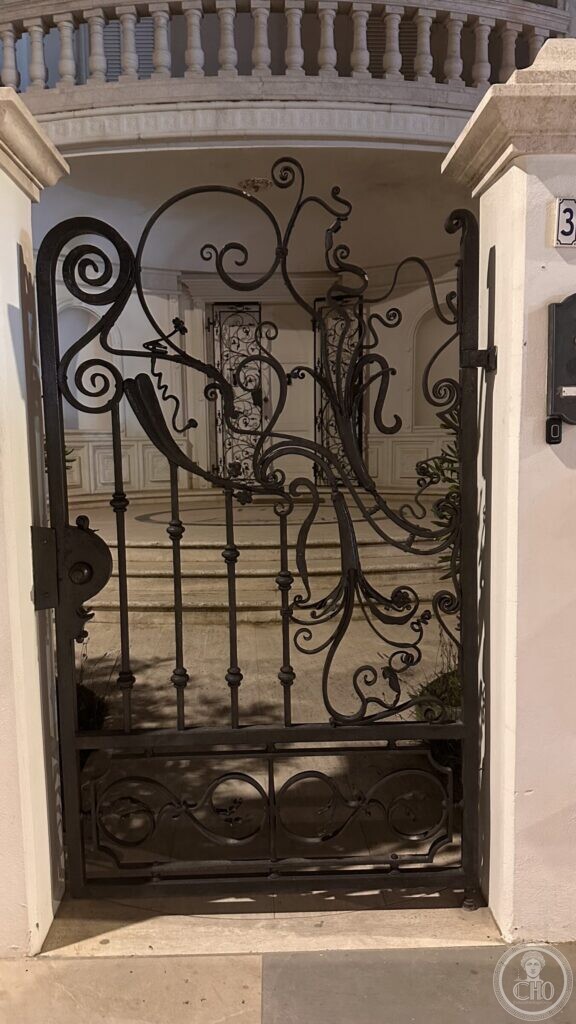
The pedestrian gate is the reason to stop. Within a plain rectangular frame the smith has drawn a single asymmetrical figure in iron: a great C-scroll uncoiling from the left, tendrils spinning off it, a sinuous stem rising and breaking into leaves, and, near the centre, a shape like a blown flower. Below, a separate panel carries a quieter pattern of circles and stems. The bars behind are plain, so that the drawing reads clearly against the darkness of the courtyard.
A short way along the street, in a porch, are three cast-iron doors set into a green wall for the meters: GAS, ACQUA, LUCE, each with a flourish of moulded foliage above and below the word. They are painted the same cream as the walls and nobody notices them, which is what makes them worth a photograph: the new style reached the house’s plumbing, not just its facade.
What survives

Practical information
- Private houses on a public street. The gate and the meter doors are seen from the pavement; do not enter or photograph through the railings at close range.
- Rimini runs Liberty itineraries through Viserba and Viserbella, and the Art Nouveau Week in July opens villas that are normally closed. Check with Rimini Turismo for the current programme.
- The meter doors were photographed about sixty metres along the same street from the villa; they are not on this house.
Getting there
Viserbella is about eight kilometres north of the centre of Rimini. The coastal bus line and the seafront cycle path run the whole way; Rimini Viserba is the nearest railway stop, twenty minutes on foot.
Nearby
- Enzo Ferrari’s seaside house, a few hundred metres along the same road
- Viserba, with the larger concentration of surviving villas and Villa Lydia’s ceramics
- Italia in Miniatura at Viserba, with a 360° virtual tour
- The port of Rimini and the lighthouse, to the south
Sources
- «Corriere Romagna», Viserba e Viserbella «reginette» del Liberty — for Bavassano and Polazzi at Viserba, Mussoni, Gamberini and Aviano at Viserbella, the list of client families and Villa Bonci.
- Manlio Masini, Viserbella. Da squallida distesa di dune a nuovo Eden dell’Adriatico and Viserba nelle cronache della Belle Epoque, Guaraldi Panozzo Editori, Rimini, 2001 and 2002.
- Maria Pia Luzi, C’era una volta… Viserba, in Viserba… e Viserba, ed. Maurizio Zaghini and others, Luisè Editore, Rimini 1993.
- Andrea Speziali, Romagna Liberty, Maggioli Editore, 2012.
- Comune di Rimini and Rimini Turismo — the city’s Liberty itineraries and the Art Nouveau Week.
- On-site observation and photography, 8–9 September 2026.
Find it on the map
See this place and what’s around it →Record researched and written by Luigi De Marchi for Cultural Heritage Online, 2026.
📷 Become a Cultural Heritage Online photographer
Share your photos of places: they stay published under your name as the author. The more they're seen, the more you get noticed — and soon a contest will reward the most appreciated photos.
Log in or sign up free to add a photo