
Barcelona, Catalonia · 30 January 1938 · Site of memory
At a glance
A small square behind the cathedral, a fountain, a plane tree, children from the school on one side. The stone of the church of Sant Felip Neri is pitted from waist height to the first cornice. On the morning of 30 January 1938 the Italian fascist air force bombed Barcelona from nine o’clock until twenty past eleven. The church was in use as an air-raid shelter for children. Forty-two people were killed here.
Key facts
- Date of the bombing: 30 January 1938, 9.00–11.20
- Carried out by the Italian fascist air force, allied to Franco
- The church was serving as a shelter for children from the neighbourhood and for refugees from elsewhere in the Republic
- Around twenty children died in the basement; forty-two people were killed in all, and more than a hundred wounded
- The raids continued, which stopped rescuers from clearing the site
- Only the church façade was left standing — the wall that still carries the marks
- Under Franco, official accounts said the marks were bullets from executions of priests
- The City Council put up explanatory signs in the square in 2018
- Coordinates: 41.3833846, 2.1750998
What you see
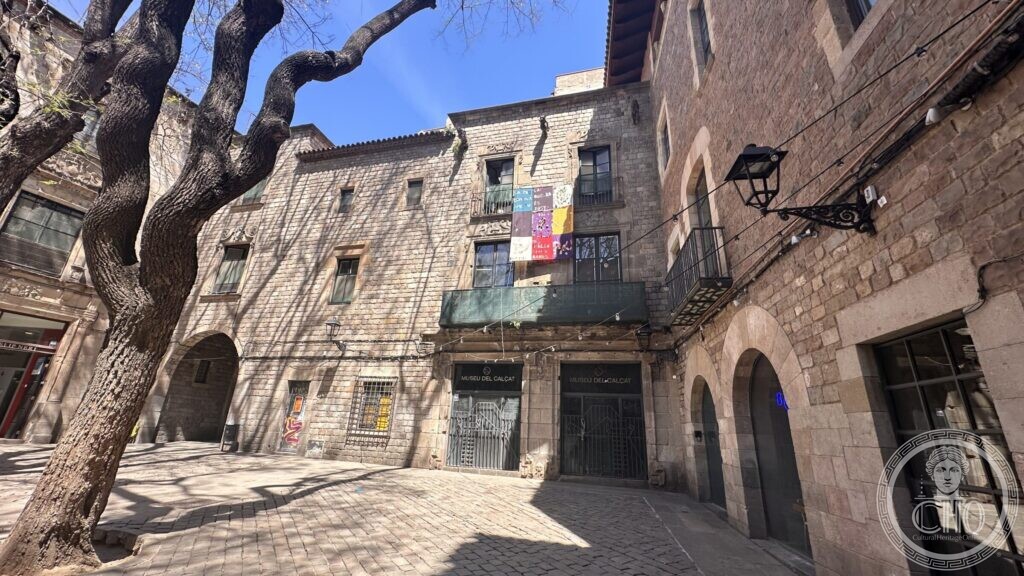
The square was rebuilt in the 1950s, and almost nothing in it stood here before. Renaissance fronts were brought from streets that the bombing and the new avenues had emptied — among them the old Catedral quarter, now Plaça Nova. The result looks older than it is, and that is the point worth carrying away: the Barri Gòtic is in large part a 20th-century composition made out of salvaged stone.
The house with the carved lintels on the north side is the clearest case. It is the Casa del Gremi dels Sabaters, the shoemakers’ guild house, built in 1565 on Carrer de la Corríbia in front of the cathedral steps. When that street was swept away for the Avinguda de la Catedral, the façade was taken down and rebuilt here, in 1950, on ground the bombs had cleared. Its shield carries the lion of Saint Mark, patron of shoemakers. From 1970 the building held the Museu del Calçat, the shoe museum; the museum left after forty-five years when its rent tripled, and the lettering over the door is still there above a locked gate.
Photographs

Practical information
- The square is public and always open. A primary school uses it, so mornings are noisy with children — which is worth knowing before you read the signs.
- The explanatory panels installed in 2018 are in Catalan, Spanish and English.
Sources
- Ajuntament de Barcelona, Programes de Memòria Democràtica — Plaça de Sant Felip Neri: the date and hours of the raid, the Italian fascist air force, the church as a children’s shelter, the casualty figures, the surviving façade, the Francoist version of the marks, the 1950s rebuilding with elements from other bombed sites, and the 2018 signs
- Pobles de Catalunya — Casa del Gremi de Sabaters: built 1565 on Carrer de la Corríbia, moved to this square in 1950 when the street was lost to the Avinguda de la Catedral, the sculpted lintels and the lion of Saint Mark
- betevé — report on the closure of the Museu del Calçat after forty-five years on the square, when the rent tripled
Record researched and written by Luigi De Marchi for Cultural Heritage Online, 2026.
Find it on the map
See this place and what’s around it →📷 Become a Cultural Heritage Online photographer
Share your photos of places: they stay published under your name as the author. The more they're seen, the more you get noticed — and soon a contest will reward the most appreciated photos.
Log in or sign up free to add a photoIs this page about you?
This page is read by travellers and heritage enthusiasts who find it on Google. Tell us how you are connected to this place and we will take it from there.