
Barcelona, Catalonia · 1929–1941 · Noucentisme monument
At a glance
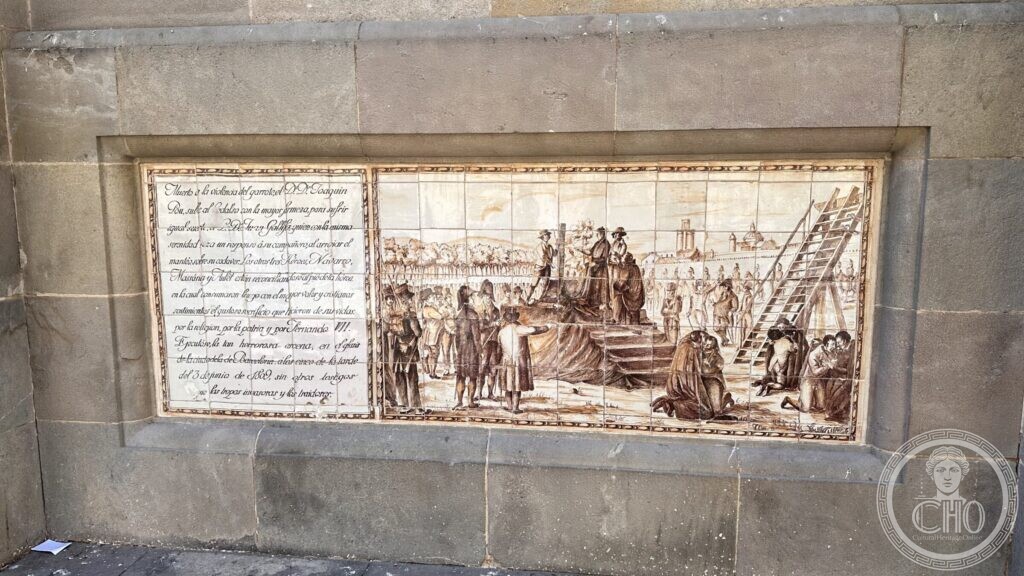
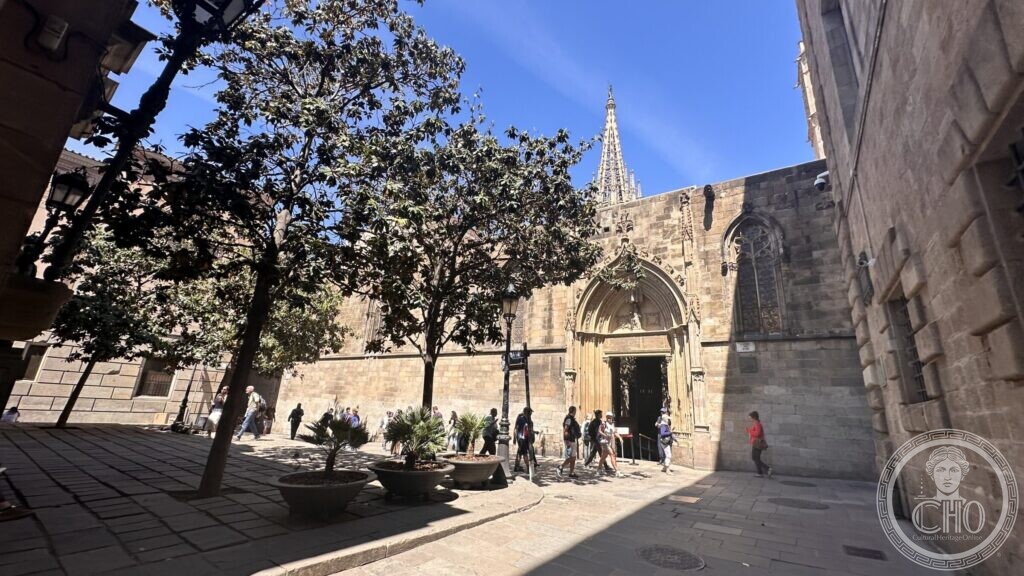
The square is little more than a widening of Carrer del Bisbe, opposite the Porta de Santa Eulàlia of the cathedral cloister. Along one side runs the flank of the church of Sant Sever, and against it stands the Monument to the Martyrs of Independence: a bronze group by Josep Llimona, two alabaster angels by Vicenç Navarro, and a band of painted ceramic panels at eye level. The panels are the part people stop for.
Key facts
- Bronze group: Josep Llimona, modelled 1929–30
- Architecture of the ensemble: Pere Benavent de Barberà i Abelló
- Alabaster relief with angels: Vicenç Navarro
- Inaugurated in 1929 without its sculpture — the plaster model had not yet been cast
- The bronze was finally set in place, on the wall of Sant Sever, in 1941
- Ceramic panels: reproductions of early-19th-century engravings by Bonaventura Planella
- Style: Noucentisme
- Coordinates: 41.3836208, 2.1758103
What you see
The ceramics are painted in sepia on white, framed in stone like pictures hung outdoors. One shows an execution on a scaffold, with a crowd held back at the edges and a ladder propped against the platform; the handwritten caption beside it names Joaquim Pou and Joan Gallifa, two of the men put to death in Barcelona in 1809 for their part in the rising against the French. The lettering is a fair copy of an early-19th-century hand, and it takes a minute to read.
Above them Llimona’s bronze figures stand against bare stone. The monument was twelve years in the making, and the gap is legible: the square got its architecture first, in 1929, and its sculpture only in 1941, after a civil war had passed over the city.
Photographs

Practical information
- The square is open to the street at all hours; the monument is on the church wall.
- The cathedral cloister, with its geese, is through the door opposite.
Sources
- Pobles de Catalunya — Monument als Màrtirs de la Independència, Plaça de Garriga i Bachs: the authors, the 1929 inauguration without the bronze, the 1941 installation, and the ceramics after Bonaventura Planella
- The names on the panel were read from the panel itself, photographed in April 2026
Record researched and written by Luigi De Marchi for Cultural Heritage Online, 2026.
Find it on the map
See this place and what’s around it →📷 Become a Cultural Heritage Online photographer
Share your photos of places: they stay published under your name as the author. The more they're seen, the more you get noticed — and soon a contest will reward the most appreciated photos.
Log in or sign up free to add a photoIs this page about you?
This page is read by travellers and heritage enthusiasts who find it on Google. Tell us how you are connected to this place and we will take it from there.