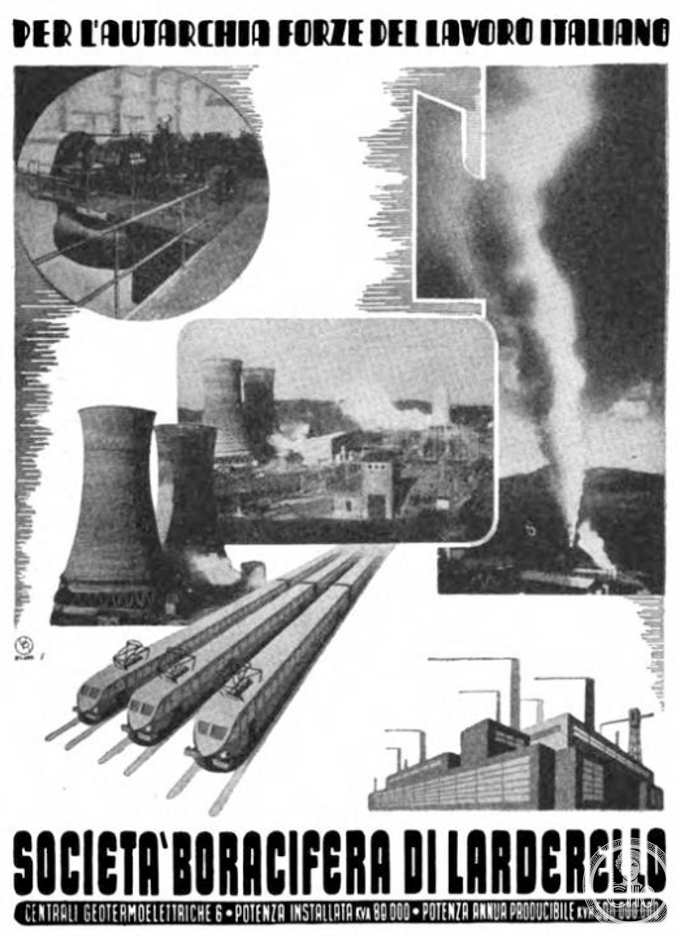
Most sheets in this campaign had to invent their imagery. This one only had to photograph it: a column of steam blasting out of the Tuscan hills, cooling towers wider than the buildings beside them, a turbine hall — and, racing along the bottom of the page, three electric trains.
The banner reads «PER L’AUTARCHIA FORZE DEL LAVORO ITALIANO». Three photographs carry the page: a soffione in full blow, the round towers and steaming yards of the works, the generating machinery. A drawn factory sits in the lower corner, and the trains — streamlined, drawn nose-on in perspective — turn electricity into something a reader can see moving. Along the foot, the company and its balance sheet in one line: SOCIETÀ BORACIFERA DI LARDERELLO — six geothermoelectric power stations, 80,000 kVA installed, 500 million kWh a year producible.
The one autarky that was real
Larderello, in the Metalliferous Hills south of Pisa, had been an industrial site since the early nineteenth century, when boric acid was first worked from its hot springs — the «boracifera» in the company’s name. The turn that matters here came in 1904–05, when Prince Piero Ginori Conti, head of the firm, became the first man in the world to use geothermal steam to generate electricity industrially. By the late 1930s the experiment had grown into the six power stations the sheet enumerates, and geothermal current from Larderello fed, among other things, the electrified railways of Tuscany — which is what the three trains are doing on a chemical company’s advertisement. Alone in this series, the boast needed no varnish: energy from the ground under Tuscany owed nothing to anyone’s imports, and Larderello remains to this day one of the great geothermal fields of the world.
Marks and date
On the left edge sits the small circular agency monogram with «MILANO» beneath it, common to the series and read by the collector as the mark of the Milanese concessionaire IGAP; the scan does not allow the reading to be confirmed. The sheet carries no printed date and is published without an attribution; its installed-power figures and the campaign slogans place it in the late 1930s.
About this image. The work is still protected by copyright: under Italian law (L. 633/1941) rights run for 70 years from the death of the author. Since the author has not been identified, that term cannot be considered expired, and the image is treated as fully protected. It is reproduced here for documentation, study and critical purposes only, under Art. 70 of L. 633/1941 and the fair-use provision of 17 U.S.C. §107. The scan was made by the collector from his own copy of the sheet, part of the period material he keeps in a private archive: owning the physical sheet is not the same as holding the rights to the work. The image is not offered for sale, no reproduction rights are granted, and any request concerning the work should be addressed to the rights holders. Cultural Heritage Online publishes this material to document it, with no celebratory intent; see our terms and the DMCA contact published there.
Sources
- Piero Ginori Conti — the first in the world to use geothermal energy for industrial electricity generation
- Larderello — the geothermal field in the Metalliferous Hills and its place in world geothermal production
- The sheet itself, for the six power stations, the 80,000 kVA and the annual production figure.