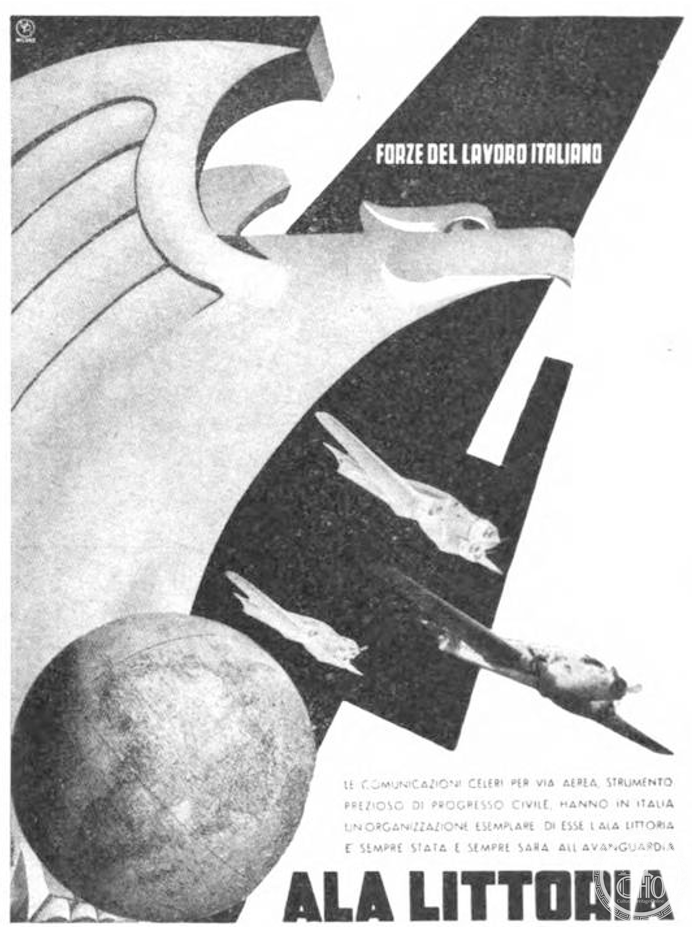
A wing the size of the page, a globe pushed into the corner, three aircraft climbing the dark diagonal between them. The state airline did not advertise a destination or a fare. It advertised the fact of itself.
The banner across the top reads «FORZE DEL LAVORO ITALIANO» — forces of Italian labour — which gives the sheet away as part of a series: the same banner, or its twin «forze dell’economia italiana», appears on sheets for banks, wool mills and chemical works from the same campaign. The drawing is dominated by an enormous stylised eagle, its head in profile, its wing feathers cut like sheet metal; below it a globe, and against the dark wedge three three-engined transports drawn climbing away in formation. The copy at the foot is institutional to the point of stiffness: fast communication by air, it says, is a precious instrument of civil progress, and in Italy it has an exemplary organisation — «of these things Ala Littoria has always been, and always will be, in the vanguard». Then the name, in heavy block letters.
The airline the state built
Ala Littoria S.A. was Italy’s first state-owned airline. It was constituted on 28 October 1934 — the twelfth anniversary of the March on Rome, a date not chosen by accident — by merging the country’s existing private carriers into a single company; the name itself is said to have been suggested by Mussolini, and Umberto Klinger was appointed its president. Through the second half of the 1930s its network ran across the Mediterranean, down the Adriatic, into Libya and East Africa, carrying passengers and, above all, the post. The three-engined silhouettes in the drawing are the airline’s stock in trade: the trimotor was the machine on which Italian civil aviation of the decade ran.
What the sheet does not say
There is no route map, no price, no timetable. The reader of this page was not being sold a ticket; he was being reassured that the nation’s air transport was modern, organised and Italian. That is the register of the whole «forze del lavoro italiano» series, which put banks, textile mills and oil derricks through the same treatment: each company a proof, page by page, that the economy could stand on its own. In the top corner of the sheet there is a small circular monogram with «MILANO» beneath it — the mark of the advertising agency that produced the series. The collector who owns the sheet reads it as the mark of IGAP, the big Milanese poster and advertising concessionaire of those years; the monogram is too small on the scan for us to confirm the reading, and the sheet is published here without an attribution. It carries no date; the airline it advertises existed under this name from 1934 until the war ended its operations.
About this image. The work is still protected by copyright: under Italian law (L. 633/1941) rights run for 70 years from the death of the author. Since the author has not been identified, that term cannot be considered expired, and the image is treated as fully protected. It is reproduced here for documentation, study and critical purposes only, under Art. 70 of L. 633/1941 and the fair-use provision of 17 U.S.C. §107. The scan was made by the collector from his own copy of the sheet, part of the period material he keeps in a private archive: owning the physical sheet is not the same as holding the rights to the work. The image is not offered for sale, no reproduction rights are granted, and any request concerning the work should be addressed to the rights holders. Cultural Heritage Online publishes this material to document it, with no celebratory intent; see our terms and the DMCA contact published there.
Sources
- Ala Littoria — constitution on 28 October 1934, the merger of the private carriers, Klinger’s presidency
- The sheet itself, for the series banner, the copy and the agency monogram.