
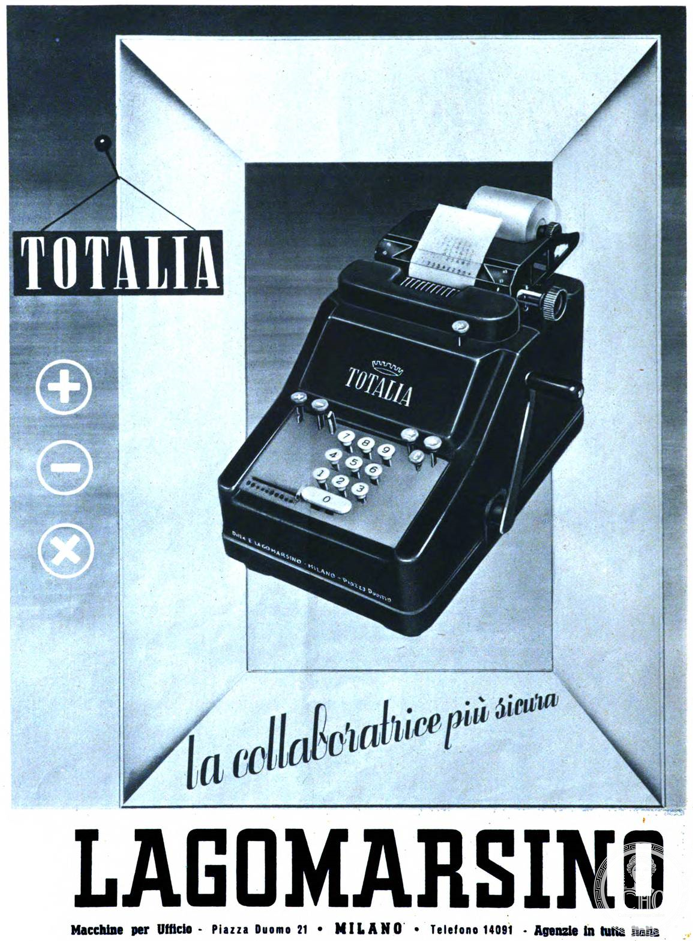
The machine sits in a box drawn in perspective, like a picture in a deep frame, with its paper tape curling out of the top and the printed figures already on it. A small sign hangs on a nail at the upper left: TOTALIA. Down the left margin, three white circles carry a plus, a minus and a multiplication sign. Across the bottom of the frame, in a copperplate script: la collaboratrice più sicura — the most reliable colleague, in the feminine.
Below the frame the advertiser signs off in heavy capitals: LAGOMARSINO, and under it the line that does the real work — Macchine per Ufficio · Piazza Duomo 21 · MILANO · Telefono 14091 · Agenzie in tutta Italia. On the base plate of the machine itself, in type small enough to need a lens, the same address again: Ditta E. Lagomarsino, Milano, Piazza Duomo 21.
The keyboard is the argument
The Totalia is a ten-key adding machine with a printing mechanism: nine digits in three rows, a nought below them, function keys down the right side, a crank on the flank and a paper roll on top. The ten-key layout was the selling point. The competing machines of the period were full-keyboard adders, with a separate column of nine keys for each decimal place — a wall of keys that required a trained operator. Ten keys and a printed tape meant that a clerk could work at it, quickly, and that the result could be torn off and filed. That is what the three symbols in the margin are there to say.
And that is also what the script line is doing. Calling an adding machine la collaboratrice is not an accident of Italian grammar: the office in 1940 was where women were being hired in numbers, and the sentence sells the machine by putting it in that place — the assistant who does not tire, does not resent and does not get sums wrong. It is a small, exact piece of period advertising, and it says more about the office than about the machine.
Milan, and Malmö
The Lagomarsino company was founded at Milan in 1896 by Enrico Lagomarsino; on his death in 1918 his son Luigi took it over. For a long time it was a distributor, importing and reselling calculating machines from Germany and elsewhere in Europe — Facit, AB Addo, Brunsviga — sometimes badging them with both names. Only from 1937 did it begin manufacturing on its own account, in the works in viale Umbria that carried the name F.A.I., Fabbrica Addizionatrice Italiana.
The Totalia is exactly that hinge. The machine was originally the Addo X of the Swedish firm Addo of Malmö, of 1936; Lagomarsino built it under licence in Italy. So the sheet advertises, in the years of autarky and of the campaign for national self-sufficiency, a Swedish design made in Milan under a licence agreement — and says nothing about it, because there was nothing to say: a machine assembled in viale Umbria was an Italian machine. Alongside the Totalia the firm made the Numeria, first produced around 1940. Lagomarsino went on until the 1970s and 1980s; the viale Umbria works were converted in 1982 and let to twenty-seven small firms, most of them artisan workshops.
What is not settled
The sheet is not dated and not signed. The note that came with the scan proposes about 1938–43, which is compatible with the machine and with the address, but we have found no independent confirmation, and no designer’s mark appears anywhere on the page. The article is published without an author.
About this image. The work is still protected by copyright: under Italian law (L. 633/1941) rights run for 70 years from the death of the author. Since the author has not been identified, that term cannot be considered expired, and the image is treated as fully protected. It is reproduced here for documentation, study and critical purposes only, under Art. 70 of L. 633/1941 and the fair-use provision of 17 U.S.C. §107. The scan was made by the collector from his own copy of the sheet, part of the period material he keeps in a private archive: owning the physical sheet is not the same as holding the rights to the work. The image is not offered for sale, no reproduction rights are granted, and any request concerning the work should be addressed to the rights holders. Cultural Heritage Online publishes this material to document it, with no celebratory intent; see our terms and the DMCA contact published there.
Sources
- S1 — Silmo, Gastone. Dalle dita al chip: Storia delle macchine per calcolare. Montabone, 2001. ISBN 978-88-86854-15-3.
- S2 — Castronovo, Valerio. L'industria italiana dall'Ottocento a oggi. Mondadori, 1980. ISBN 978-88-04-17765-4.
Spotted an error? Write to editorial@culturalheritageonline.com and we correct it the same day.


