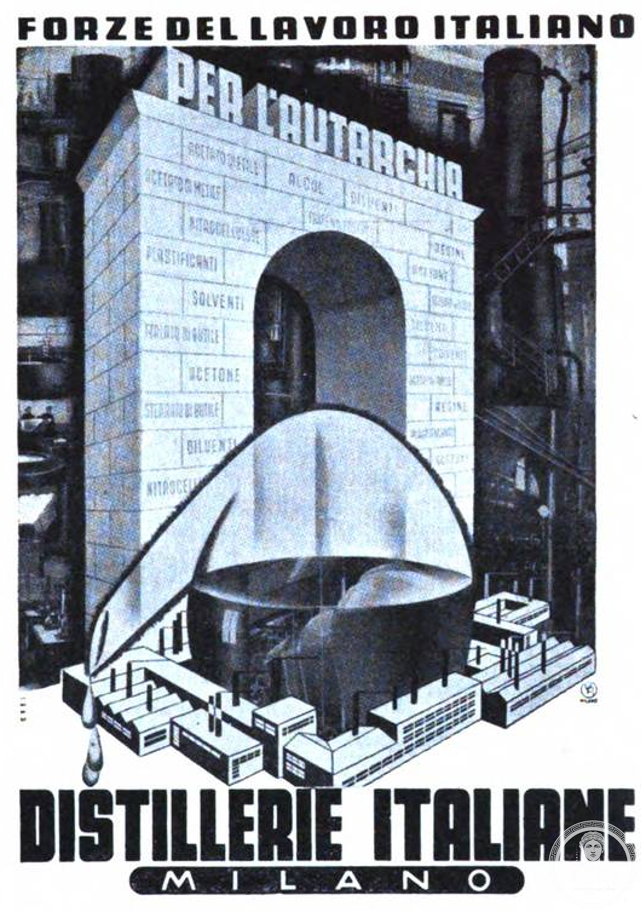
The draughtsman was asked to make industrial alcohol heroic, and he found the only way to do it: he built a triumphal arch out of it. Every block in the arch is labelled — acetone, solvents, plasticisers, nitrocellulose — and from the vault a single colossal drop falls toward a ring of factories.
The series banner «FORZE DEL LAVORO ITALIANO» runs across the top, and «PER L’AUTARCHIA» curves along the top of the arch itself, so that the monument literally carries the slogan. The blocks name the catalogue of a distillery that has long since stopped meaning grappa: alcol, acetato di metile, nitrocellulosa, plastificanti, solventi, ftalato di butile, acetone, stearato di butile, diluenti, resine. Behind the arch, photographic fragments of stills and columns; below it, drawn tiny to make the arch taller, the works themselves. At the foot: DISTILLERIE ITALIANE — MILANO.
Alcohol as feedstock
The sheet is a chemistry lesson in disguise. Distillation, it argues, is not about drink: fermentation alcohol and its derivatives were feedstock for lacquers, explosives-grade nitrocellulose, synthetic resins, plasticisers and solvents — exactly the intermediate chemicals a country cut off from imports needed to make at home from its own crops. That is why a Milanese distilling company belongs in the same advertising series as oil derricks, wool mills and banks: in the autarky drive of the late 1930s, every domestic feedstock was a strategic one. We have not traced an independent history of the Distillerie Italiane firm in this pass; what the page itself documents — the company name, the Milan address, the product range — is presented here as the sheet gives it.
Marks and date
Two small marks sit at the edges: on the right, the circular agency monogram with «MILANO» beneath it that recurs across the series, read by the collector as the mark of the concessionaire IGAP; on the left edge, a few minute vertical letters that do not resolve on the scan. Neither amounts to an attribution, and the sheet carries no date; the slogans place it in the same late-1930s campaign as its companions.
About this image. The work is still protected by copyright: under Italian law (L. 633/1941) rights run for 70 years from the death of the author. Since the author has not been identified, that term cannot be considered expired, and the image is treated as fully protected. It is reproduced here for documentation, study and critical purposes only, under Art. 70 of L. 633/1941 and the fair-use provision of 17 U.S.C. §107. The scan was made by the collector from his own copy of the sheet, part of the period material he keeps in a private archive: owning the physical sheet is not the same as holding the rights to the work. The image is not offered for sale, no reproduction rights are granted, and any request concerning the work should be addressed to the rights holders. Cultural Heritage Online publishes this material to document it, with no celebratory intent; see our terms and the DMCA contact published there.
Sources
- S1 — Zamagni, Vera. Dalla periferia al centro: La seconda rinascita economica dell'Italia. Il Mulino, 1993. ISBN 978-88-15-04142-5.
- S2 — Castronovo, Valerio. L'industria italiana dall'Ottocento a oggi. Mondadori, 1980. ISBN 978-88-04-17765-4.
Spotted an error? Write to editorial@culturalheritageonline.com and we correct it the same day.