
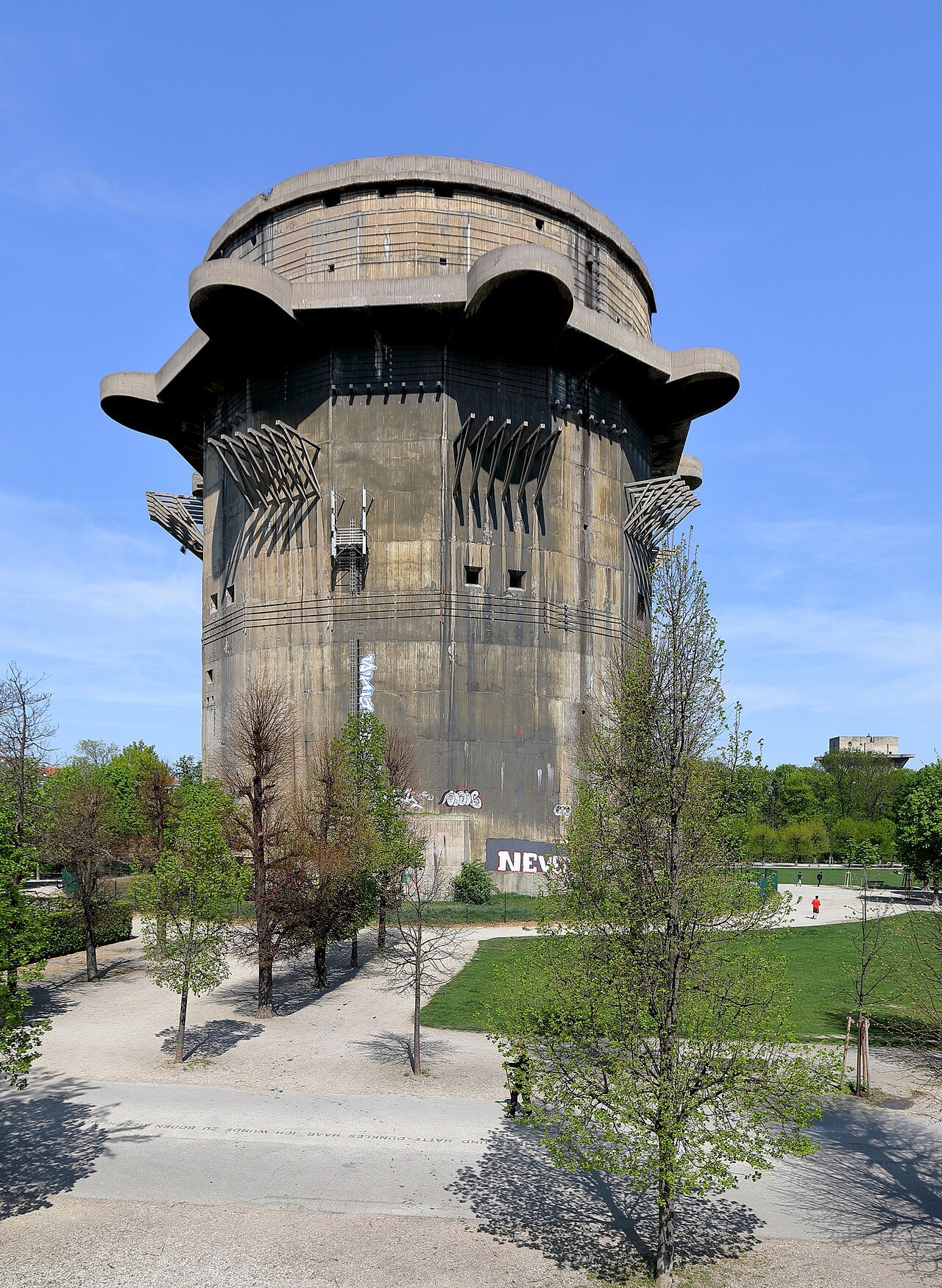
Three pairs of anti-aircraft towers, walled in concrete up to three and a half metres thick, proved too solid to demolish and too central to ignore. Eighty years on, one is an aquarium with a rooftop restaurant, one is a military cyber-security centre, and two stand empty and cracking above the parks that surround them.
At a glance
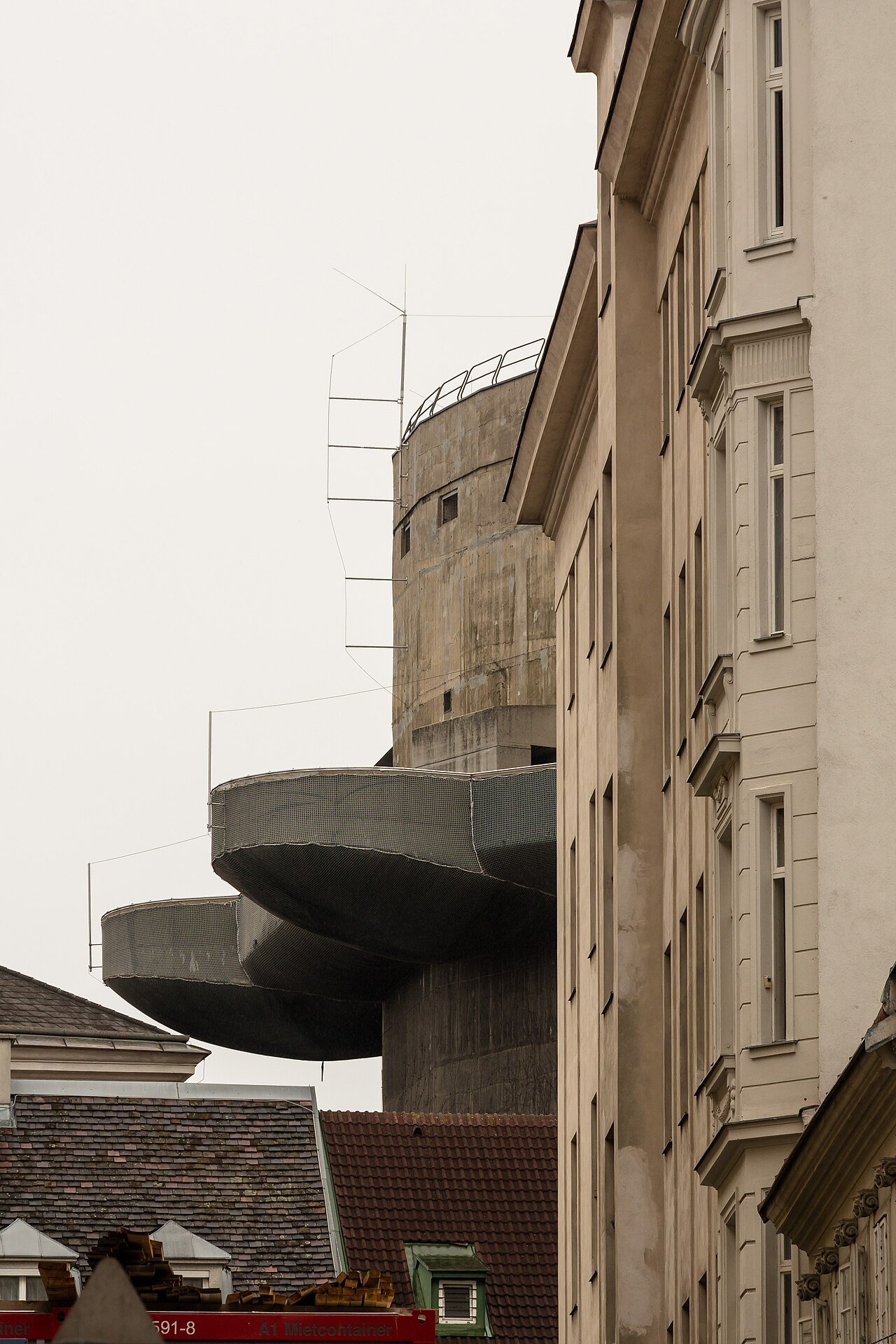
After the first RAF raids on Berlin, Hitler ordered massive flak towers for Berlin, Hamburg and Vienna under a 1940 emergency programme; architect Friedrich Tamms oversaw the design, with Robert Ruschitzka representing him in Vienna. The city received three pairs, each combining a Gefechtsturm (gun tower) with a Leitturm (radar and fire-control tower): Arenbergpark, finished first in October 1943; Stiftskaserne and Esterházypark, finished July 1944 to a lighter sixteen-sided design used only in Vienna; and Augarten, still unfinished when the war ended in 1945. Each Gefechtsturm carried four twin 12.8-centimetre anti-aircraft guns; the shelters below held an estimated 40,000 people across the city during raids.
The overwhelming majority of the construction workforce, per the Wien Museum’s own account, was prisoners of war, supplemented by foreign forced labourers and concentration camp inmates. Their walls proved effectively impossible to demolish afterward, and Vienna has spent eight decades finding different uses — and different silences — for six buildings it could not remove.
Key facts
- Construction, tower by tower: Arenbergpark pair, December 1942–October 1943 (first completed); Stiftskaserne Gefechtsturm and Esterházypark Leitturm, October 1943–July 1944, a lighter cylindrical design that saved steel and concrete; Augarten pair, 1944 into January 1945, never fully finished when the war ended.
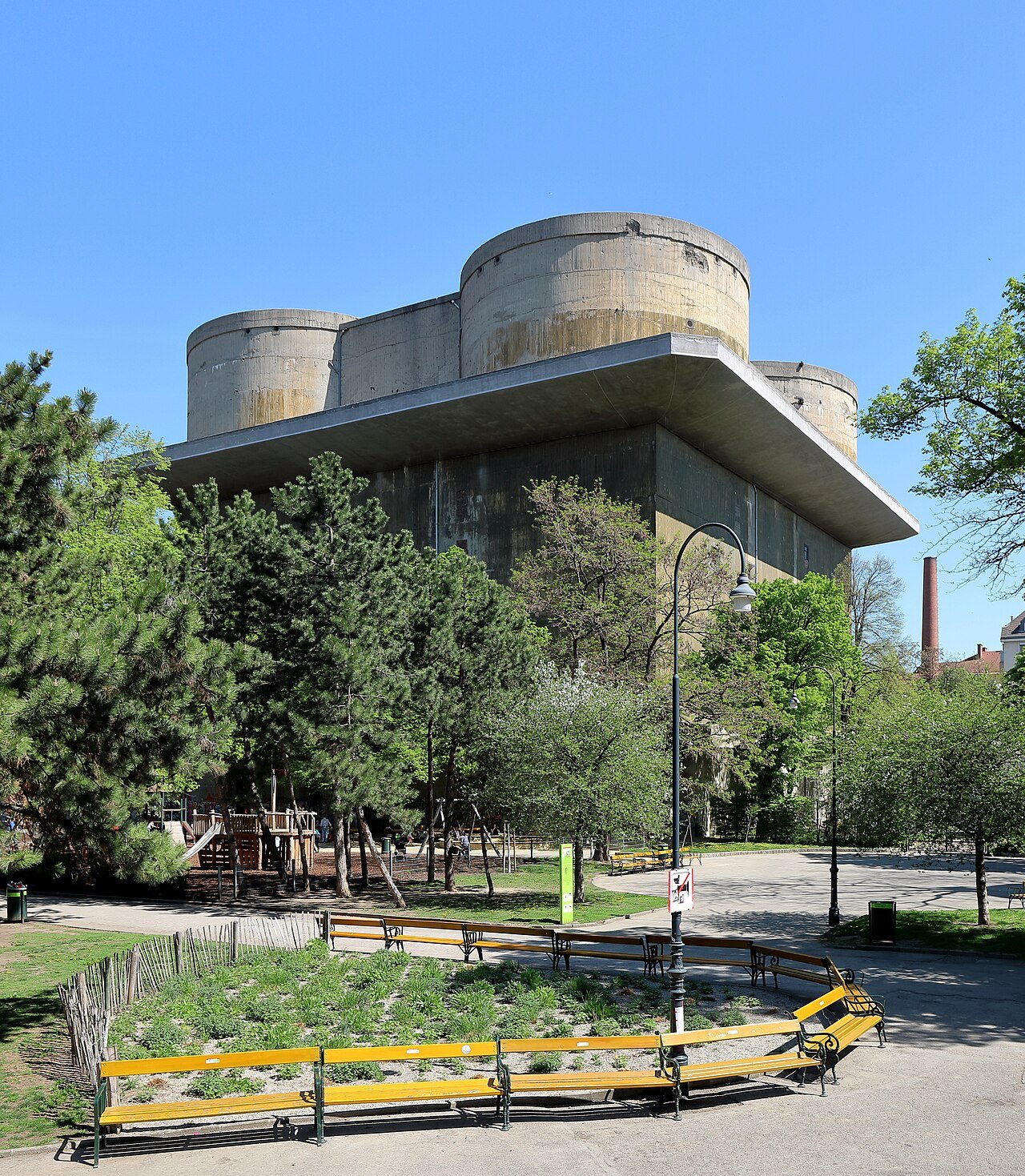
- Dimensions: the Augarten Gefechtsturm, at 53 to 55 metres depending on the source, is the tallest in Vienna, with walls and roof up to 3.5 metres of reinforced concrete; the other towers range from 39 to 47 metres.
- Forced labour: prisoners of war formed the majority of the workforce, with foreign civilian labourers and concentration camp inmates from Italy, France, Belgium, Czechoslovakia, Serbia and eastern Europe. In 2006, 240 inscriptions left by forced labourers — mostly French and Italian — were found inside the Arenbergpark tower; three Italians have since been identified by name.
- Dual use: alongside anti-aircraft guns and radar, the towers held rescue stations, dedicated shelter areas for mothers and children and for the disabled, and from mid-1944 an emergency command post for Vienna’s mayor on the Stiftskaserne tower. War-industry firms also operated inside the Arenbergpark and Augarten towers; from November 1944 the Augarten G-tower restricted civilian shelter access to make room for arms production.
- Postwar plans that never happened: regime documents show the towers were to be clad in marble after a German victory and converted into war memorials bearing the names of the fallen — a plan overtaken by defeat.
- 21 November 1946: an explosion of some 2,000 rounds of stored ammunition destroyed the upper storeys of the Augarten Gefechtsturm, cracking its crown; one account blames children who climbed in and lit a fire, another attributes it to a Soviet test demolition — the two versions are not reconciled in the sources.
- Coordinates (anchor, Augarten Gefechtsturm): 48.2258° N, 16.3733° E.
Who tells it, and where the accounts diverge
The towers were presented as shields for Vienna’s population, and tens of thousands did shelter in them during raids. But the regime’s own construction schedule undercuts the claim of urgent defence: the Augarten pair was finished only in January 1945, when the air war was already lost, and the same regime’s own plans — for postwar marble cladding and hero-monument status — show towers designed as future propaganda architecture as much as present defence. Postwar assessments record no meaningful count of aircraft actually shot down from them.
Austria’s own postwar «first victim» narrative sits awkwardly against six buildings that could not be talked away: walls up to 3.5 metres thick made demolition impractical in a dense city, and the one serious attempt — the 1946 explosion in the Augarten — only cracked a crown that still stands. No plaque named the forced labour that built them until decades after the war; the first official one, at Esterházypark, dates only to 2020.
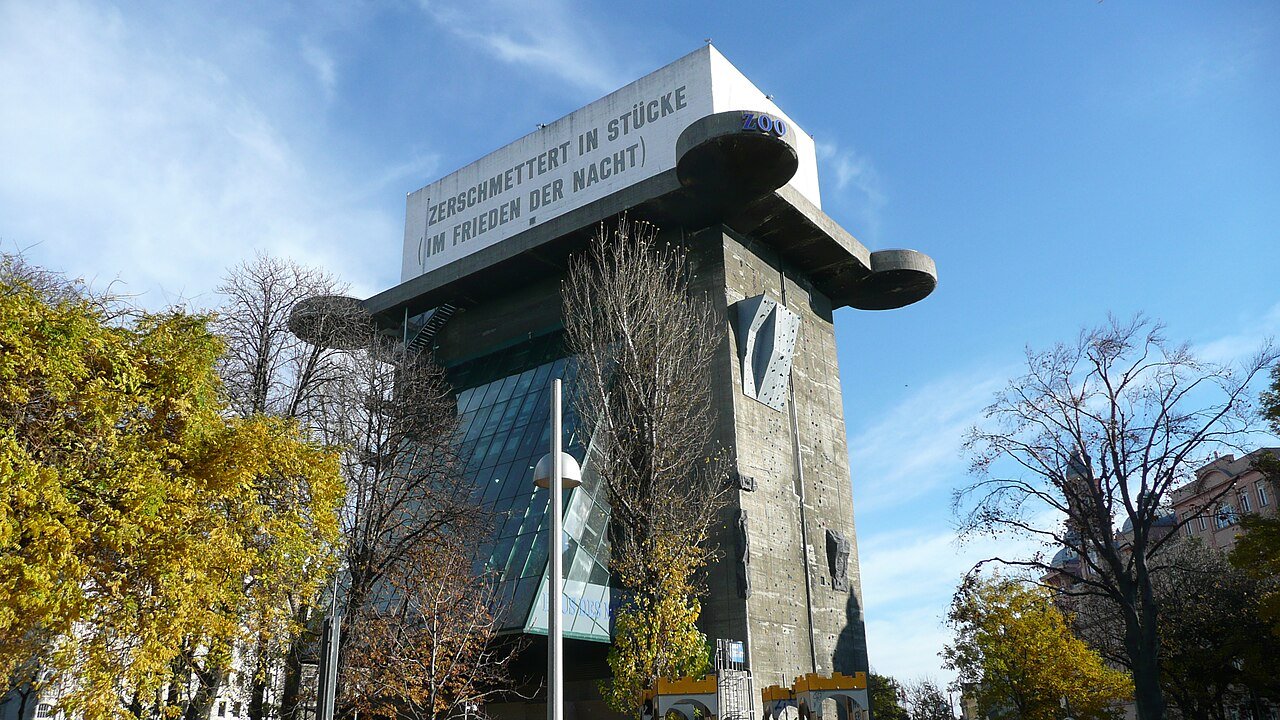
The most concrete disagreement is about memory itself. In 1991 artist Lawrence Weiner installed an anti-war text on the Esterházypark tower, intended for six weeks and left for twenty-eight years; a 2017–2020 renovation of the aquarium below removed it, and the public-art body that commissioned it and the aquarium that hosts the building give contradictory written accounts of whether Weiner agreed to the removal. Anonymous activists repainted the text in 2019; the city’s answer was a ground-level plaque, not a restoration.
Media
Street View — the Esterházypark tower (Haus des Meeres), a 360° panorama.
Street View — the Augarten pair, a 360° panorama in the park.
Live camera — Haus des Meeres roof camera, looking north from the Esterházypark tower toward the Stiftskaserne tower and the city skyline.
Video — zoos.media, on the Esterházypark tower’s wartime history and its memorial exhibition today.
Video — Real Engineering, on the design and engineering of Vienna’s flak towers.
What you see today
- Esterházypark Leitturm: the Haus des Meeres aquarium and zoo since 1957/58, with a rooftop restaurant and terrace added in a 2017–2019 extension, and a flak-tower history exhibition on an upper floor — the only tower with regular public access.
- Stiftskaserne Gefechtsturm: still an active Austrian Armed Forces installation, housing a military cyber-security centre; a restricted area, visible only from outside.
- Arenbergpark Gefechtsturm: used by the MAK applied-arts museum as an art depot from 1995 to 2011, currently closed to the public for lack of official approval.
- Arenbergpark Leitturm: closed, but the best preserved of the six, retaining original fittings, period signage and the forced-labourers’ graffiti found in 2006.
- Augarten pair: both sealed and closed; the Gefechtsturm has been cordoned off since 2006 after a partial internal collapse, its cracked crown visible from the surrounding park.
Getting there
The Haus des Meeres, Fritz-Grünbaum-Platz 1 in the 6th district, is open daily and the only tower open to visitors. The other five can be seen only from outside: Augarten park (2nd district), Arenbergpark (3rd district) and the Stiftskaserne courtyard off Mariahilfer Straße (7th district) are all public ground.
Sources
- Geschichtewiki der Stadt Wien — construction dates, dimensions, armament and forced labour for each pair.
- Wien Museum, magazine article on the Stiftskaserne tower — workforce composition, shelter capacity, postwar occupation.
- Ö1/ORF, drawing on Ute Bauer’s academic study of Vienna’s flak towers — the postwar hero-monument plans, the 2006 graffiti discovery, monument-protection status.
- Kunst im öffentlichen Raum Wien (KÖR) and Haus des Meeres, official pages — the Lawrence Weiner installation, its removal and the 2020 memorial plaque.
- MAK (Österreichisches Museum für angewandte Kunst) — the Arenbergpark tower’s use and current closure.
Find it on the map
See this place and what’s around it →📷 Become a Cultural Heritage Online photographer
Share your photos of places: they stay published under your name as the author. The more they're seen, the more you get noticed — and soon a contest will reward the most appreciated photos.
Log in or sign up free to add a photo